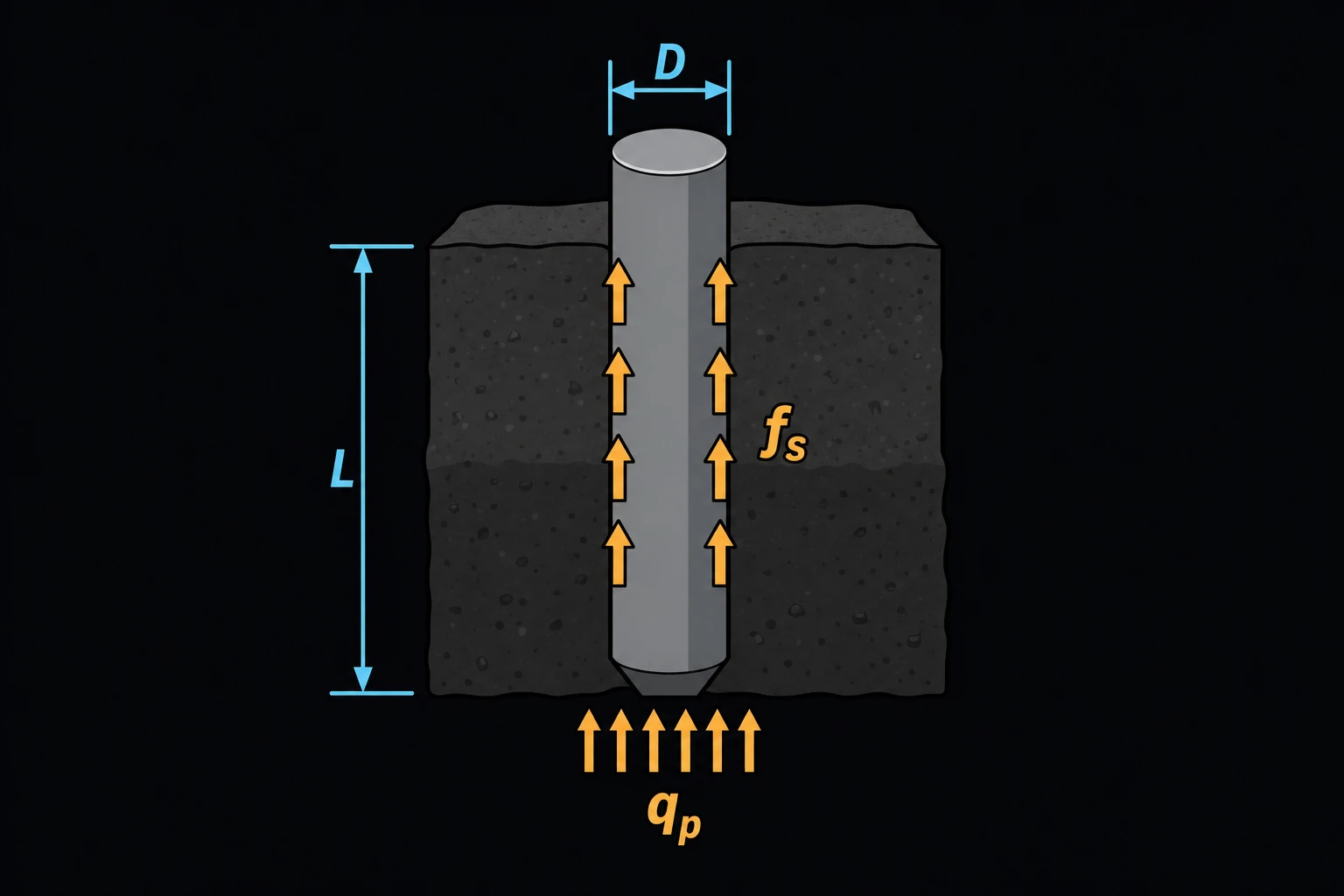
Single Pile Axial Capacity
Estimates the axial compression capacity of a single driven or bored pile in one uniform soil: the friction along its shaft plus the bearing at its tip. Use the α method for clay and the β method for sand [1], [3], [4]. Use it to size a pile’s diameter and length before a detailed design or a load test.
Equations
Qult = fs·As + qp·Ap
As = π·D·L Ap = π·D²/4
Clay: fs = α·cu
Clay: qp = 9·cu
Sand: f(z) = β·γ′·z
Sand: qp = Nq·γ′·L
D is the pile diameter and L its embedded length. In clay, cu is the undrained shear strength and α the adhesion factor, the share of cu that the shaft mobilizes. α is near 1 for soft clay and falls to about 0.5 or less for stiff clay [1]. In sand, γ′ is the effective unit weight (submerged below the water table), so γ′·z is the effective vertical stress at depth z. β = K·tan δ combines the lateral earth pressure coefficient and the pile–soil friction angle, and Nq is the end-bearing factor. fs in sand is the average of f(z) over the shaft.
Choosing a sand description fills in β, Nq and the limiting values from API RP 2A [2], [5]. Unit friction then stops growing at flim, and the result shows the depth where that happens. End bearing stops at qlim. With custom β and Nq, no limits are applied, so long piles in sand come out too strong.
Limits and common mistakes
- The soil is one uniform layer. For layered ground, add the shaft friction of each layer by hand.
- The API sand values are for open-ended pipe piles driven unplugged into silica sand. Other piles and soils need their own values.
- The capacity is geotechnical only. Check the pile itself as a column, and the group effect for closely spaced piles.
- A factor of safety of 2 to 3 is usual; use the lower end only with load tests.
Worked example
A 600 mm pipe pile is driven 25 m into dense sand below the water table, where γ′ is 9.5 kN/m³. What load can it carry with a factor of safety of 3?
- Choose Soil / Method Cohesionless soil — β / Nq method.
- Enter Pile Diameter 0.6 m, Embedded Length 25 m and Effective Unit Weight 9.5.
- Choose Sand Description Dense sand, or very dense sand-silt.
- Enter Factor of Safety 3 and press Solve. The Solution shows:
Shaft resistance Qs: 2,536.28 kN
End bearing Qp: 2,686.06 kN
Ultimate capacity Qult: 5,222.34 kN
Allowable capacity Qult / FS: 1,740.78 kN
Depth where shaft friction reaches f_lim: 21.968 m
Check by hand. Friction reaches 96 kPa at z = 96 / (0.46 × 9.5) = 21.97 m. Above that it averages 48 kPa, so the shaft carries π × 0.6 × (48 × 21.97 + 96 × 3.03) = 2,536 kN. The tip gets 40 × 9.5 × 25 = 9,500 kPa, below the 10,000 kPa limit, on 0.2827 m²: 2,686 kN.