Pipe Flow & Pressure Drop
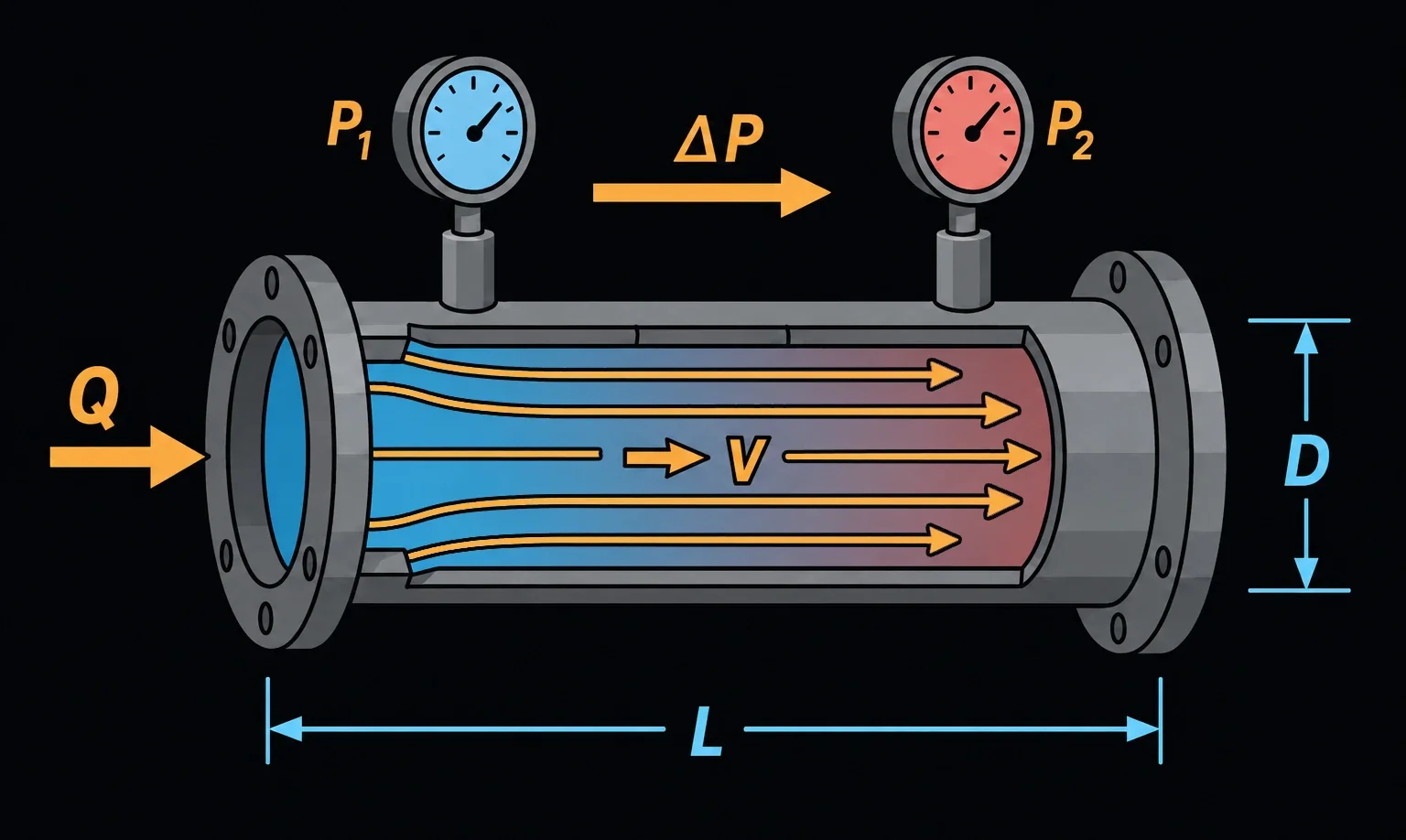
Finds the friction pressure drop and head loss for a liquid or gas flowing full through a straight round pipe. It also gives the velocity, the Reynolds number, the flow regime and the friction factor, and marks the point on a live Moody chart. Pick a steel pipe size and schedule [2], a fluid [3]–[6] and a pipe material [1] to fill in the inside diameter, the fluid properties and the roughness. Piping and plant engineers use it to size lines and pumps.
Equations
V = Q/A Re = ρ·V·D/μ
ΔP = f·(L/D)·ρV²/2 hL = ΔP/(ρ·g)
Q is the volumetric flow rate, A = πD²/4 the flow area of a pipe of inside diameter D, V the mean velocity, ρ the density and μ the dynamic viscosity. ΔP is the pressure drop over the length L by the Darcy–Weisbach equation [1], and hL the same loss as a height of the flowing fluid, with g = 9.80665 m/s². The Darcy friction factor f is 64/Re for laminar flow (Re below 2300). Above that the page uses the Swamee–Jain fit to the Colebrook equation:
f = 0.25 / [log10(ε/(3.7D) + 5.74/Re0.9)]²
where ε is the absolute roughness of the pipe wall [1].
Limits and common mistakes
- D is the inside diameter. A nominal size is neither the inside nor the outside diameter.
- The result is straight-pipe friction only. Add the losses through valves and fittings, and any change of elevation, separately.
- Between Re = 2300 and 5000 no correlation is reliable, and f steps at 2300. The page flags this zone.
- The roughness values are for new pipe. Old steel or cast iron can be many times rougher.
- The fluid is taken as incompressible. For a gas, keep ΔP below about a tenth of the line pressure, or split the line into shorter runs.
- Viscosity changes strongly with temperature. Use the preset nearest the operating temperature.
Worked example
A cooling-water line carries 12 L/s of water at 20 °C through 80 m of new 4 in Schedule 40 steel pipe. Find the friction loss.
- Enter Volumetric Flow Rate 12 L/s.
- Choose Pipe Size NPS 4 (114.3 mm OD). Schedule moves to Sch 40 — wall 6.02 mm, ID 102.26 mm, and the inside diameter fills in.
- Enter Pipe Length 80 m and choose Fluid Water, 20°C.
- Leave Pipe Material at Commercial steel, new — ε = 0.045 mm, and press Solve. The Solution shows:
Velocity (V): 1.4611 m/s
Reynolds Number (Re): 148,845
Flow Regime: Turbulent
Friction Factor (f): 0.0191902
Pressure Drop (ΔP): 15.9959 kPa
Head Loss (hL): 1.63407 m
Check by hand. The Colebrook equation, solved by iteration for Re = 148,845 and ε/D = 0.00044, gives f = 0.0191, within 0.5 % of the page. Then ΔP = 0.0192 × (80/0.10226) × 998.2 × 1.461²/2 ≈ 16.0 kPa. A velocity of about 1.5 m/s is normal for a water line.