Pipe Pressure Drop with Fittings (Darcy + K-Method)
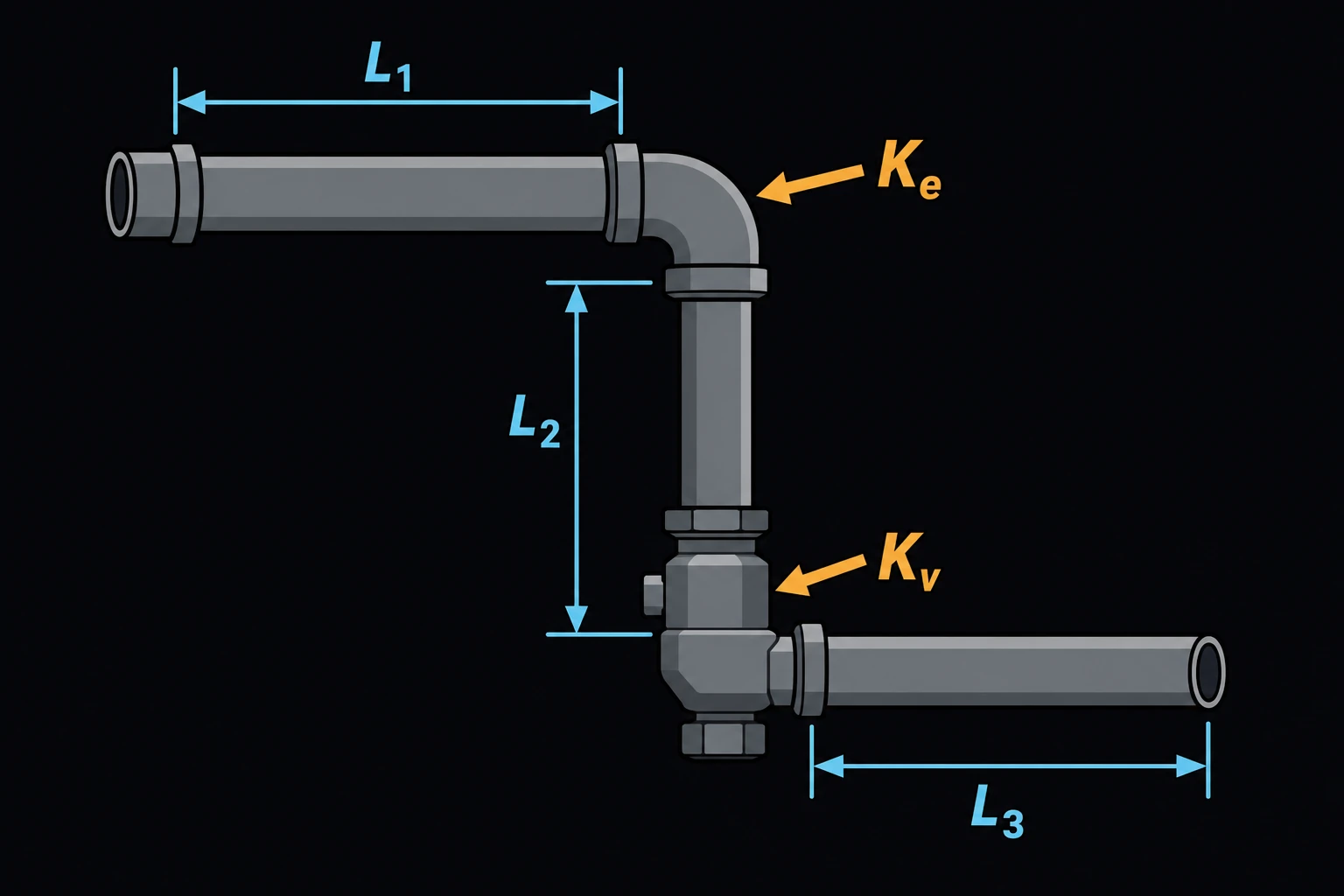
Finds the pressure drop and head loss of a fluid flowing through straight pipe plus its elbows, tees, valves, entrance and exit. Enter the sum of the loss coefficients, or count the fittings and let the page price each one from Crane TP-410 [1]. Piping and HVAC engineers use it to size a line or a pump.
How the loss is calculated
The straight pipe follows Darcy–Weisbach, and each fitting adds K velocity heads:
ΔP = (f·L/D + ΣK)·ρV2/2
where V = Q/(πD2/4) is the mean velocity, D the inside diameter, L the straight length, ρ the density and f the Darcy friction factor. The page takes f from the Reynolds number Re = ρVD/μ: f = 64/Re below Re = 2300, and the Swamee–Jain fit to the Colebrook equation above it, using the roughness ε [3]. Head loss is ΔP/(ρg).
When you count fittings, each one gets Crane’s resistance coefficient
K = (L/D)eq·fT
where (L/D)eq is the fitting’s equivalent length in pipe diameters (shown in each label) and fT the friction factor of clean commercial steel pipe of that nominal size in fully turbulent flow. A sharp entrance adds K = 0.5 and an exit into a tank K = 1.0. Picking a pipe size and schedule fills the inside diameter from ASME B36.10M [4], and picking a fluid fills its density and viscosity [5–8].
Limits and common mistakes
- Crane’s K values are for fully turbulent flow. At low Reynolds numbers fittings lose more than this.
- Between Re = 2300 and 5000 no friction correlation is reliable. The page says so, and the result is only a guide.
- The roughness choices are for new pipe. Old, scaled pipe is much rougher.
- For a gas, the result holds only while the drop is small (under about 10 % of the inlet pressure), because the density is taken as constant.
- Elevation change is not included.
Worked example
A cooling-water line carries 60 m³/h of water at 20 °C from a tank through 80 m of 4 in. Schedule 40 steel pipe, six standard elbows, two gate valves and a swing check valve, and discharges into a second tank. Find the friction loss the pump must make up.
- Enter Volumetric Flow 60 m³/h.
- Choose Pipe Size NPS 4 and Schedule Sch 40, and enter Straight Pipe Length 80 m.
- Choose Fluid Water, 20°C and Pipe Material Commercial steel, new.
- Choose Fittings and Valves Count fittings, Pipe Entrance Sharp-edged and Pipe Exit Exit into a tank. Enter 6 standard elbows, 2 gate valves and 1 swing check valve.
- Press Solve. The Solution shows:
Velocity V: 2.0293 m/s
Reynolds number Re: 206,730
Darcy friction factor f: 0.0185521
ΣK of the fittings list: 6.532
ΔP — straight pipe: 29.8304 kPa
ΔP — fittings & valves: 13.4254 kPa
ΔP — total: 43.2559 kPa
Head loss: 4.41883 m
Check by hand. The fittings add (6×30 + 2×8 + 100) × 0.017 = 5.032, and the entrance and exit 1.5, so ΣK = 6.532. The velocity head is 998.2 × 2.0292/2 ≈ 2,055 Pa, so the fittings cost about 13.4 kPa. Solving the Colebrook equation itself gives f = 0.01845 and a total of 43.09 kPa, within 0.4 % of the page. The fittings are almost a third of the loss.