Power Factor Correction
Finds the capacitor bank that raises a load’s power factor to a target. It gives the reactive power the capacitors must supply and the capacitance that delivers it: one capacitor on a single-phase supply, or each of the three capacitors in a wye or delta bank on a three-phase supply. Plant engineers use it to cut utility power-factor charges, free up transformer and cable capacity, and reduce line losses.
Equations
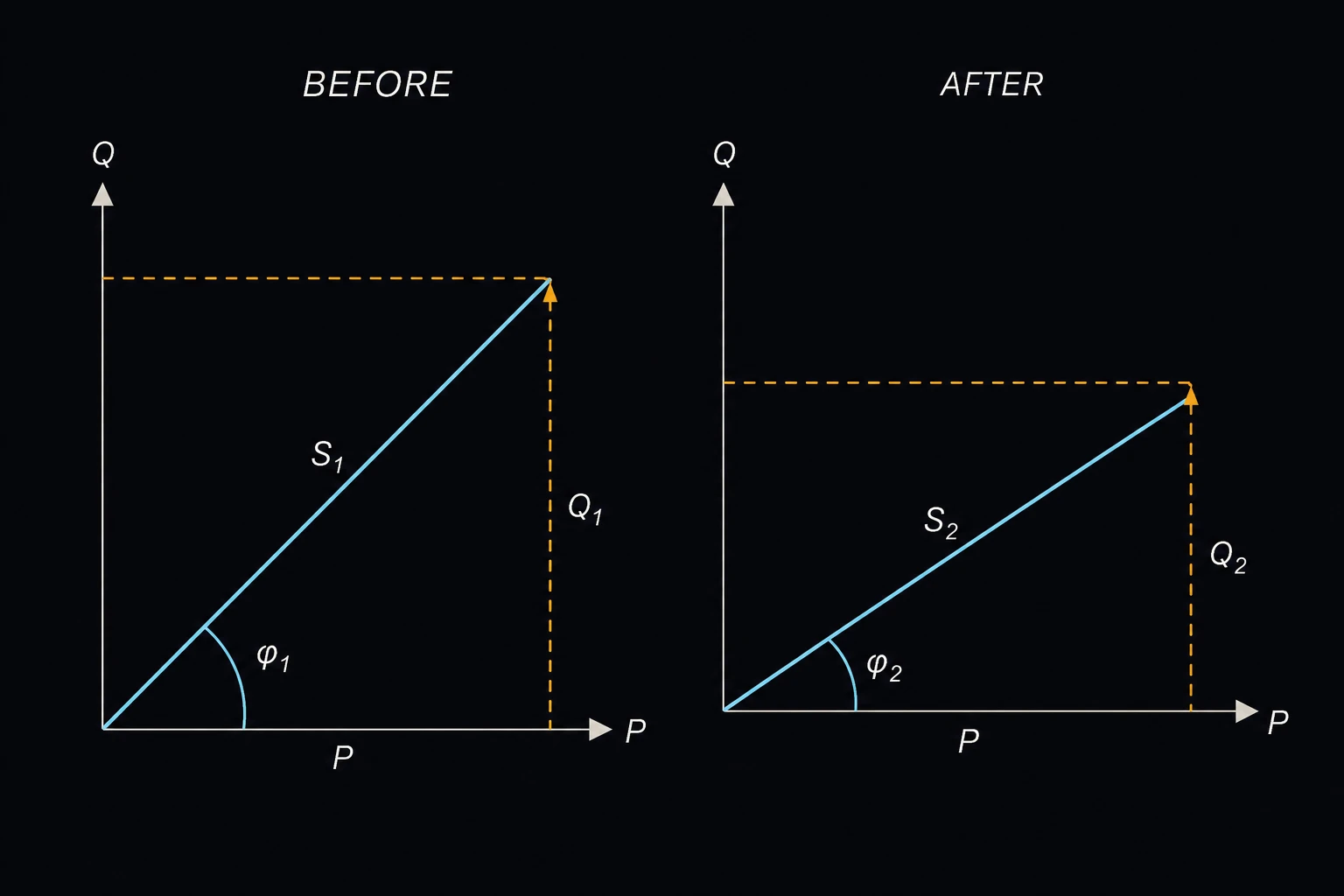
Qc = P·(tan φ1 − tan φ2)
P is the real power of the load, which the capacitors do not change. φ1 = acos(existing power factor) and φ2 = acos(target power factor). P·tan φ is the reactive power the load draws at each power factor, so Qc is the reactive power the capacitors must supply to close the gap [1].
Single-phase: C = Qc/(2πf·V²) Wye bank: C = Qc/(2πf·V²) Delta bank: C = Qc/(3·2πf·V²)
f is the supply frequency and V the supply voltage: line to line on a three-phase system. A capacitor across a voltage U supplies 2πf·C·U² of reactive power. Each capacitor of a three-phase bank supplies Qc/3. In wye it sees V/√3, and in delta the full V, so a delta bank needs a third of the capacitance of a wye bank [1]. The Nominal supply list fills in the voltage and frequency of the standard systems of ANSI C84.1 [2] and IEC 60038 [3]. Choose Custom to enter your own.
Limits and common mistakes
- Correcting all the way to 1.0 costs much more capacitance than 0.95 for little gain, and risks a leading power factor when the load drops. Most utilities bill below 0.90 or 0.95.
- Take P and the existing power factor from a measurement at the load you want to correct. Lightly loaded motors run at a much lower power factor than their nameplate.
- Capacitors are sold by kVAR at a rated voltage. A capacitor run below its rated voltage gives less: the output scales with V².
- On a system with drives or rectifiers, capacitors can resonate with the supply at a harmonic. Use detuned (reactor-protected) banks there.
Worked example
A plant on a 480 V, 60 Hz three-phase supply draws 150 kW at a power factor of 0.78. The utility charges a penalty below 0.95. What bank does it need?
- Enter Real power (P) 150 kW, Existing power factor (cos φ1) 0.78 and Target power factor (cos φ2) 0.95.
- Choose System Three-phase (V = line-to-line voltage).
- Choose Nominal supply 480 V, 60 Hz (ANSI C84.1) — 480 V line to line. The voltage and frequency fill in. Press Solve. The Solution shows:
Required capacitor reactive power (Qc): 71.0396 kVAR
Required capacitance per capacitor, wye-connected bank: 817.875 µF
Required capacitance per capacitor, delta-connected bank: 272.625 µF
Reactive power per capacitor (Qc/3): 23.6799 kVAR
Check: tan(acos 0.78) = 0.8023 and tan(acos 0.95) = 0.3287, so Qc = 150 × 0.4736 = 71.04 kVAR. A standard 75 kVAR, 480 V bank would be the usual choice.