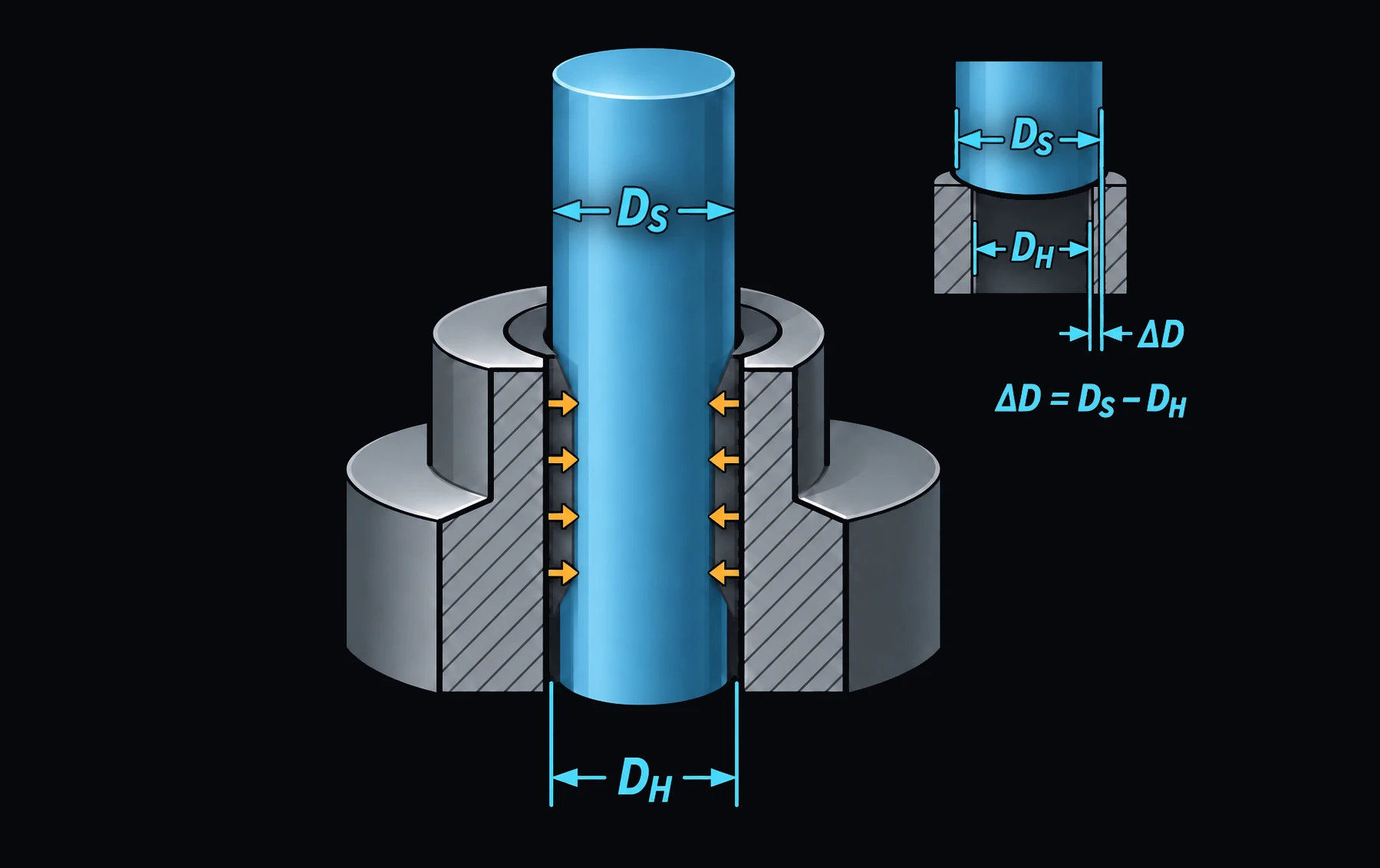
Press-Fit / Interference Fit
Finds the contact pressure between a solid shaft and a hub pressed onto it, and the hoop stress at the hub bore. Enter the diametral interference, or pick an ISO 286 hole-basis fit and the page takes the interference limits for the shaft size. Designers use it to choose a fit for a gear, pulley or bearing seat that must hold without cracking the hub.
Equations
For a solid shaft and a hub of the same material [1]:
p = (E·δ/d)·(D² − d²)/(2D²) σt = p·(D² + d²)/(D² − d²)
p is the contact pressure, δ the diametral interference (shaft diameter minus bore diameter, before assembly), d the shaft diameter, D the hub’s outer diameter and E the elastic modulus. Poisson’s ratio cancels when both parts are the same material. σt is the tensile hoop stress at the bore, the highest stress in the hub.
For an ISO fit, the hole is H7 (0 to +IT7) and the shaft is k6, n6, p6, s6 or u6 (its lower deviation to that plus IT6), at the shaft diameter as the nominal size [1], [2]. The largest interference is the largest shaft in the smallest hole; the smallest is the smallest shaft in the largest hole. The page gives the pressure and hoop stress at the largest interference, and the pressure at the smallest one.
Limits and common mistakes
- Shaft and hub must be of one material. A steel shaft in an aluminum or cast-iron hub needs the two-material equation.
- The shaft is solid. A hollow shaft gives a lower pressure.
- Compare σt with the hub’s yield strength, at the largest interference. A brittle hub such as gray cast iron needs a wide margin.
- Use the smallest interference to check the grip. Pressing smooths the surfaces, so the real interference is a little less than measured.
- k6 and n6 are transition fits. At their loosest limits they can have clearance, and the page then says so.
Worked example
A steel gear with a 100 mm hub is to be pressed onto a 50 mm steel shaft with an H7/s6 fit. Check the hub stress and the range of contact pressure.
- Choose Interference H7/s6 — medium drive.
- Enter Shaft Diameter 50 mm and Hub Outer Diameter 100 mm.
- Choose Material Steel. The modulus fills in as 200 GPa.
- Press Solve. The Solution shows:
Fit Limits: hole H7 0/+25 µm, shaft s6 +43/+59 µm (IT7 25, IT6 16 µm)
Maximum Interference: 0.059 mm
Minimum Interference: 0.018 mm
Contact Pressure at Maximum Interference: 88.5 MPa
Hub Bore Hoop Stress (σt) at Maximum Interference: 147.5 MPa
Contact Pressure at Minimum Interference: 27 MPa
Check by hand. 200,000 × 0.059/50 = 236 MPa, and (100² − 50²)/(2 × 100²) = 0.375, so p = 88.5 MPa. The hoop stress is 88.5 × 12,500/7,500 = 147.5 MPa, well under the yield strength of a steel gear blank. The pressure scales with the interference: 88.5 × 18/59 = 27 MPa.