Rolled Throughput Yield & DPMO
Turns a defect count into the standard Six Sigma yield metrics: defects per unit (DPU), defects per opportunity (DPO), defects per million opportunities (DPMO), the rolled throughput yield (RTY), the normalized yield of each step and the process sigma level. Six Sigma belts and quality engineers use it to baseline a multi-step process and to see how much hidden rework the final yield conceals [1], [3].
Equations
DPU = D / U DPO = D / (U·O) DPMO = 106·DPO
RTY = e−DPU Ynorm = RTY1/k
Sigma level = Φ−1(1 − DPO) + 1.5
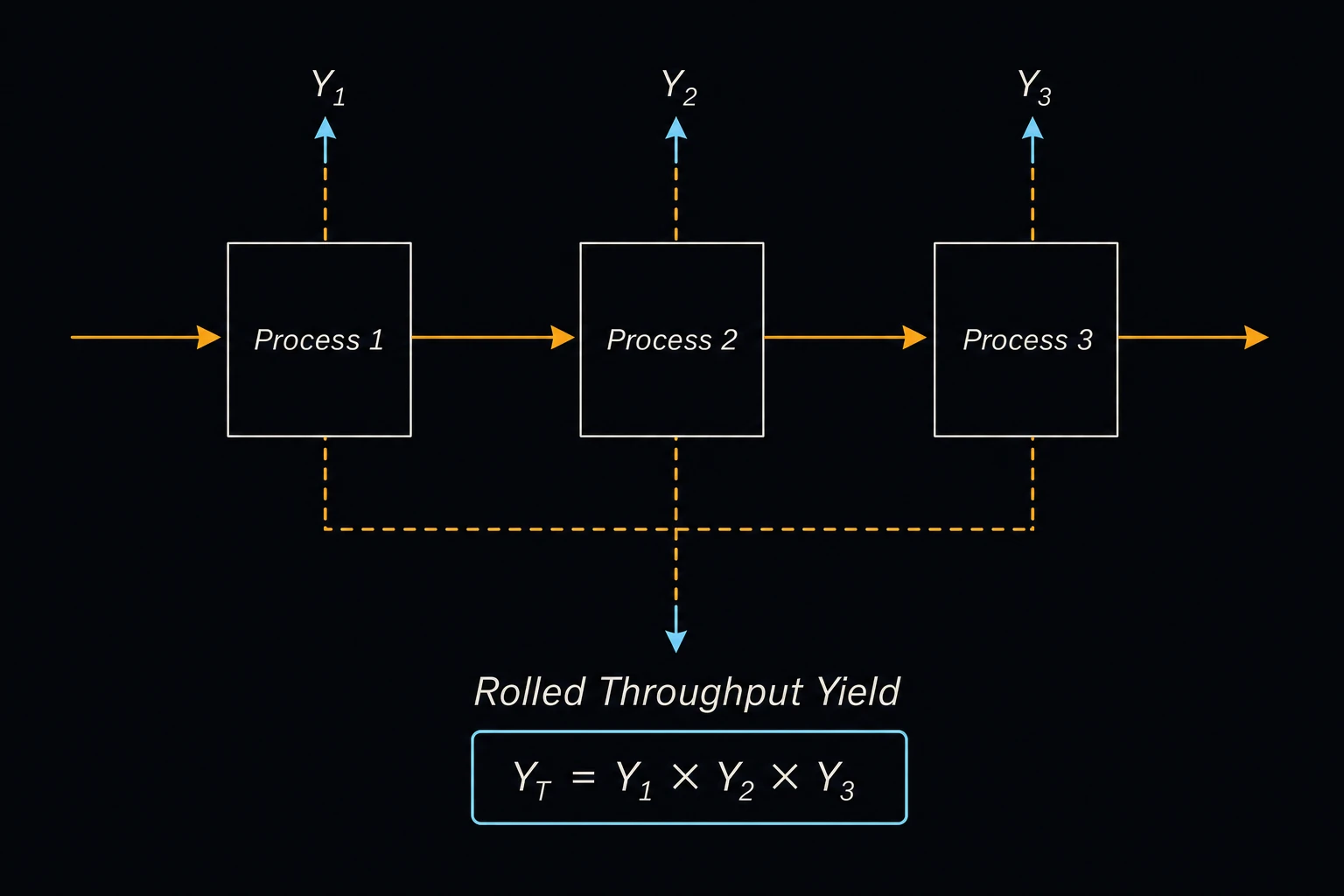
U is the number of units processed, D the total defects found on them, O the defect opportunities per unit and k the number of process steps. RTY is the chance a unit passes every step with no defect at all, the product of the first-pass yields Y1·Y2·…·Yk. When defects fall at random, the Poisson distribution gives the chance of zero defects as e−DPU, which is how the page estimates it from the total count [1]–[3]. Ynorm is the yield each step would need, if all steps were alike, to give that RTY. Φ−1 is the inverse standard normal distribution, and 1.5 is the conventional Six Sigma long-term shift.
Limits and common mistakes
- Count every defect, including ones fixed by rework at the station. A unit that passes final test after rework is not a first-pass unit, and leaving it out makes RTY look better than it is.
- e−DPU assumes defects are independent. If defects cluster on a few bad units, the true RTY is higher.
- Normalized yield is an average. It doesn’t show which step is the weak one; measure each step’s first-pass yield for that.
- Define the opportunities before counting and keep them fixed. To convert a DPMO or yield without counts, use the Sigma Level ↔ DPMO ↔ Yield calculator.
Worked example
A four-step assembly line built 800 control boxes last week. Inspection at every station logged 36 defects in all, and each box has 12 defect opportunities. What is the line’s rolled throughput yield and sigma level?
- Enter Units Processed (U) 800 and Total Defects Found (D) 36.
- Enter Defect Opportunities per Unit (O) 12 and Number of Process Steps 4.
- Press Solve. The Solution shows:
Defects per unit (DPU): 0.045
Defects per opportunity (DPO): 0.00375
DPMO: 3,750
Rolled throughput yield (RTY = e^−DPU): 95.5997 %
Normalized yield (per step): 98.8813 %
Process sigma (with 1.5σ shift): 4.17379
Check: e−0.045 is about 1 − 0.045 + 0.001 = 0.956, and 0.9888134 = 0.955997, the RTY. About 1 box in 23 needs some rework somewhere along the line.