Psychrometric Properties (Moist Air)
Finds the properties of moist air from its dry-bulb temperature and one more reading: the relative humidity, the wet-bulb temperature or the dew point. It gives the humidity ratio, enthalpy, specific volume, dew point and wet bulb in SI and US units, at any site elevation, and plots the state on a live psychrometric chart. HVAC designers use it for coil and outdoor-air loads; technicians use it to turn a sling psychrometer reading into a full state.
Equations
The vapor pressure of saturated air at temperature t (°C) comes from Buck’s equation [1], in kPa:
pws = 0.61121·exp[(18.678 − t/234.5)·t/(257.14 + t)]
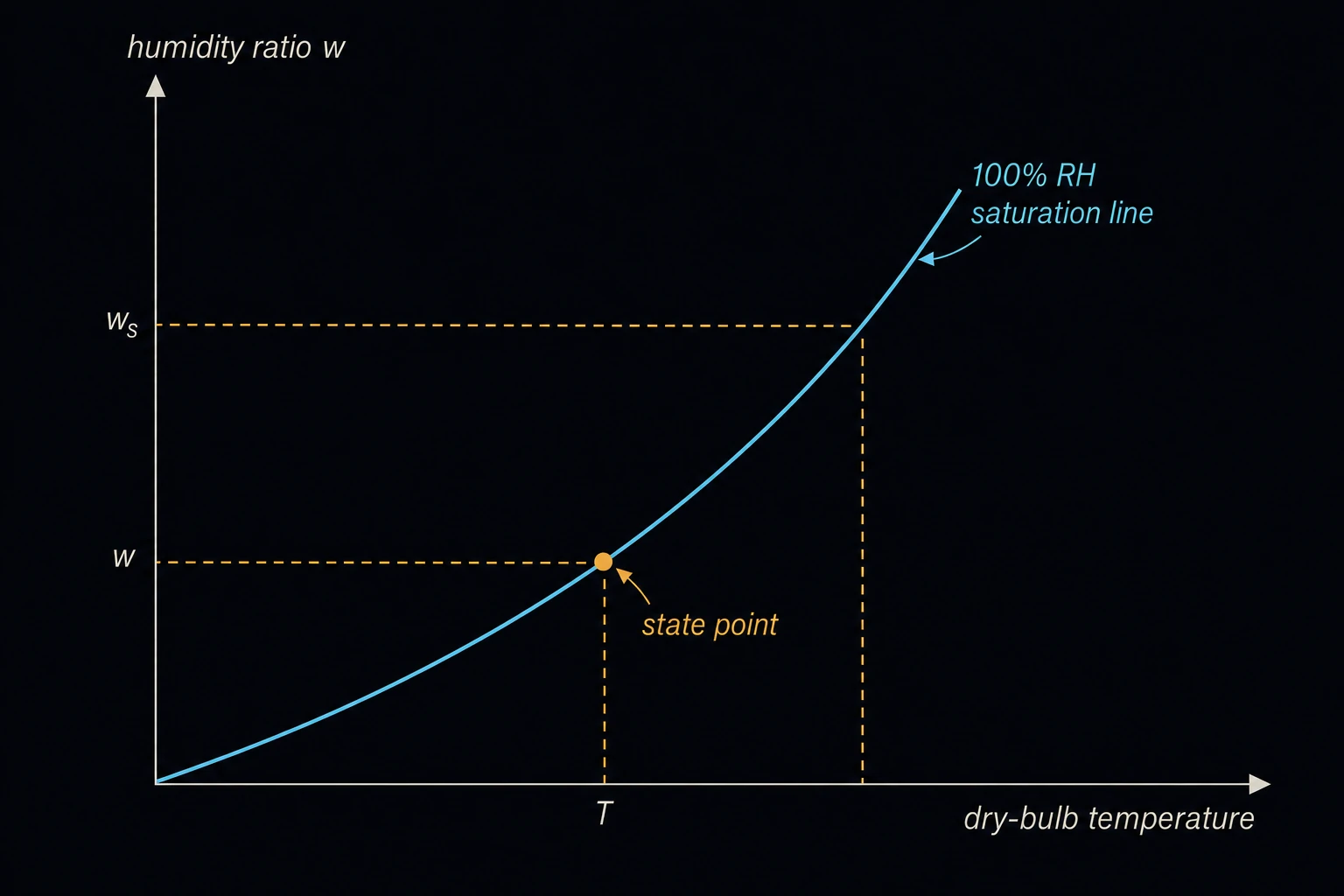
Relative humidity sets the vapor partial pressure pw = RH·pws(t), and a dew point td sets pw = pws(td). A wet bulb t* gives the humidity ratio directly by the adiabatic saturation relation [2]. Then [2]
W = 0.621945·pw/(P − pw)
h = 1.006t + W·(2501 + 1.86t) v = 0.287042·(t + 273.15)·(1 + 1.607858W)/P
W is the humidity ratio in kg of water per kg of dry air, P the barometric pressure in kPa, h the enthalpy in kJ/kg of dry air and v the specific volume in m³/kg of dry air. Choosing a site elevation fills in P from the standard atmosphere [2].
Limits and common mistakes
- Set the elevation. A high site has lower pressure, so the same wet bulb means more moisture per kg of air.
- The US enthalpy is measured from 0 °F dry air, as on the ASHRAE IP chart, so it is not the SI value converted. Never mix values from the two datums.
- Properties are per kg (or lb) of dry air, not of moist air.
- The saturation curve is over liquid water at every temperature, so below 0 °C the dew point is a dew point, not a frost point, and the results differ slightly from a chart drawn over ice.
- The page accepts dry bulbs from −80 to 100 °C, and wet bulbs down to −60 °C.
Worked example
A sling psychrometer at a site 1,500 m up reads 33 °C dry bulb and 17 °C wet bulb. Find the outdoor air’s humidity and enthalpy for an evaporative cooler study.
- Enter Dry-Bulb Temperature 33 °C.
- Choose Second Property Wet-bulb temperature and enter Wet-Bulb Temperature 17 °C.
- Choose Site Elevation 1500 m (4,921 ft) — 84.556 kPa, and press Solve. The Solution shows:
Humidity ratio W: 7.95079 g/kg dry air
Relative humidity: 21.2046 %
Enthalpy (per kg dry air): 53.5709 kJ/kg
Specific volume (per kg dry air): 1.05257 m³/kg
Dew-point temperature: 7.92522 °C
Humidity ratio W (US): 55.6555 gr/lb dry air
Check: with the ASHRAE (Hyland–Wexler) saturation pressure in place of Buck’s, the same equations give W = 7.953 g/kg, 21.21 % and 53.58 kJ/kg, within 0.05 %. At sea level the same readings would give only about 5.5 g/kg, which is why the elevation matters.