Pump Hydraulic & Brake Power
Finds the power a pump puts into a liquid, the shaft (brake) power it draws and the electrical power its motor takes, from the flow, the head or pressure rise, the density and the two efficiencies. Process, plant and HVAC engineers use it to size a motor, to estimate running costs or to check a pump curve.
How the power is calculated
The hydraulic power is the work done on the liquid each second [1, 2]:
Ph = ρ·g·Q·H = Q·ΔP
Pb = Ph / ηp, Pin = Pb / ηm
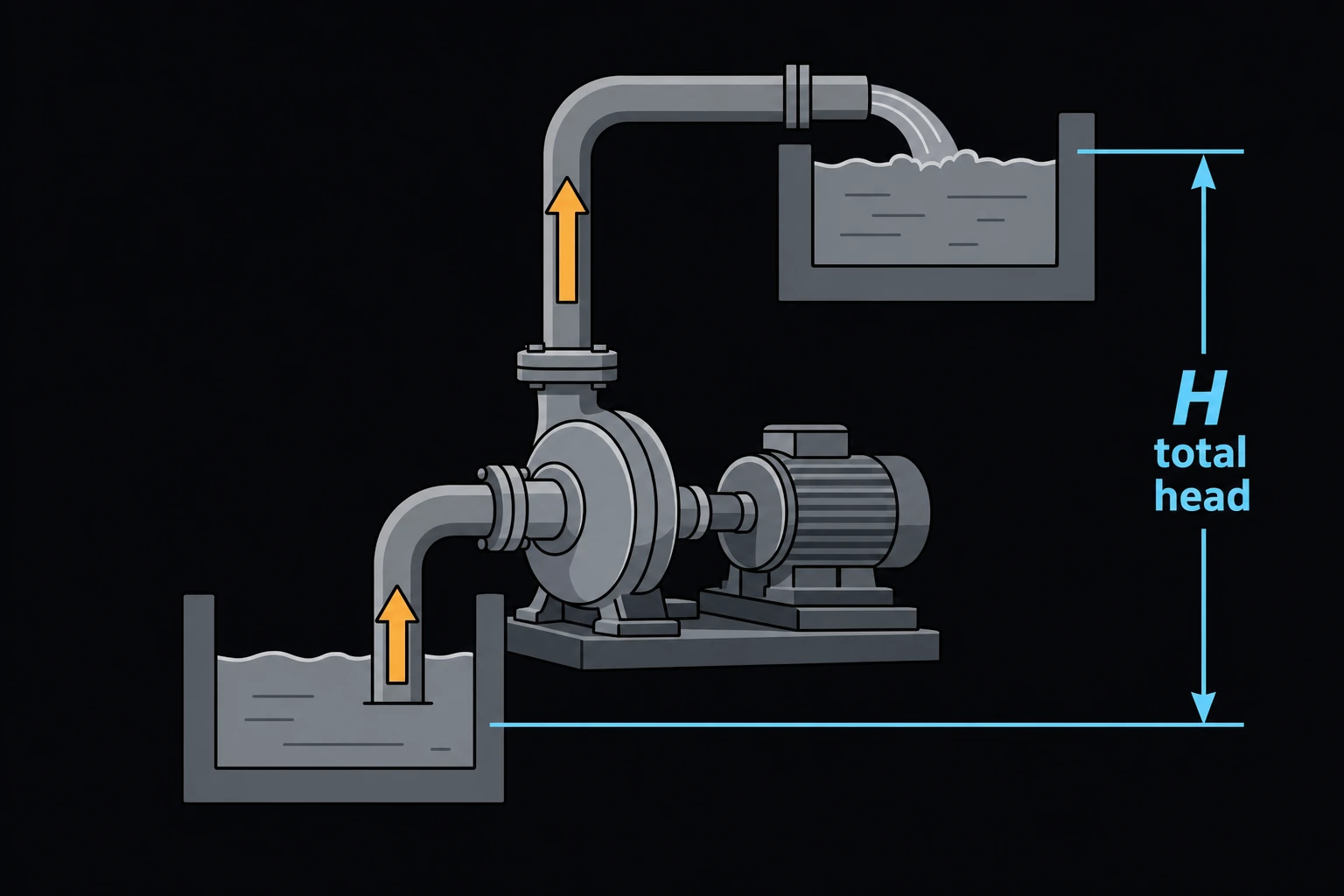
where ρ is the liquid density, g = 9.80665 m/s², Q the volumetric flow, H the total dynamic head (the head the pump adds: static lift plus friction losses plus any rise in pressure head between the tanks), ΔP = ρgH the pressure rise across the pump, ηp the pump efficiency and ηm the motor or driver efficiency. Pb is the brake power at the pump shaft, the figure the motor must supply, and Pin the power the driver takes from the supply. With Head Basis set to differential pressure, the page also reports the equivalent head ΔP/(ρg).
The motor list gives the NEMA Premium full-load efficiency of 4-pole, enclosed, 60 Hz motors from NEMA MG 1 Table 12-12 [7]. Picking a fluid fills its density [4–6].
Limits and common mistakes
- Take ηp from the pump curve at the duty point. It falls well away from the best-efficiency point.
- Head is in meters of the liquid pumped. The same head needs more power for a denser liquid; the same pressure rise does not.
- The efficiencies are percentages: enter 75, not 0.75.
- NEMA efficiencies are at full load. A lightly loaded motor is less efficient.
- Size the motor for the highest brake power on the curve, not just the duty point, with a margin; the Hydraulic Institute standards [3] give guidance.
- Viscous liquids reduce pump head and efficiency. The page applies no viscosity correction.
Worked example
A pump must move 120 m³/h of water at 20 °C against a total dynamic head of 45 m. The pump curve shows 75 % efficiency there, and a 30 hp NEMA Premium motor is proposed. Is the motor large enough, and what does it draw?
- Enter Flow Rate 120 m³/h, choose Head Basis Total dynamic head and enter Total Dynamic Head 45.
- Choose Fluid Water, 20°C and enter Pump Efficiency 75.
- Choose Motor 30 hp (22 kW), which fills 93.6 %.
- Press Solve. The Solution shows:
Equivalent head H: 45 m
Hydraulic power Ph: 14.6835 kW
Brake (shaft) power Pb: 19.578 kW
Brake power Pb: 26.2545 hp
Driver input power: 20.9167 kW
Check by hand. Q = 120/3600 = 0.03333 m³/s, so Ph = 998.2 × 9.807 × 0.03333 × 45 ≈ 14.68 kW, and 14.68/0.75 ≈ 19.58 kW at the shaft. The 30 hp (22 kW) motor runs at about 89 % of its rating, which is a reasonable fit. A 25 hp (18.5 kW) motor would be overloaded.