RC Column Axial Capacity (ACI 318)
Finds the largest axial load a short reinforced concrete column can carry, by ACI CODE-318-25 [1]. It gives the steel ratio, the nominal axial strength and the maximum design strength for a tied or spiral column, and warns when the bars break the Code’s limits. Designers use it for a first sizing of a column, or to check a column that carries little bending.
The axial strength equations
Po = 0.85f′c(Ag − Ast) + fyAst
Pn,max = α·Po
Design strength = φ·Pn,max
ρg = Ast/Ag
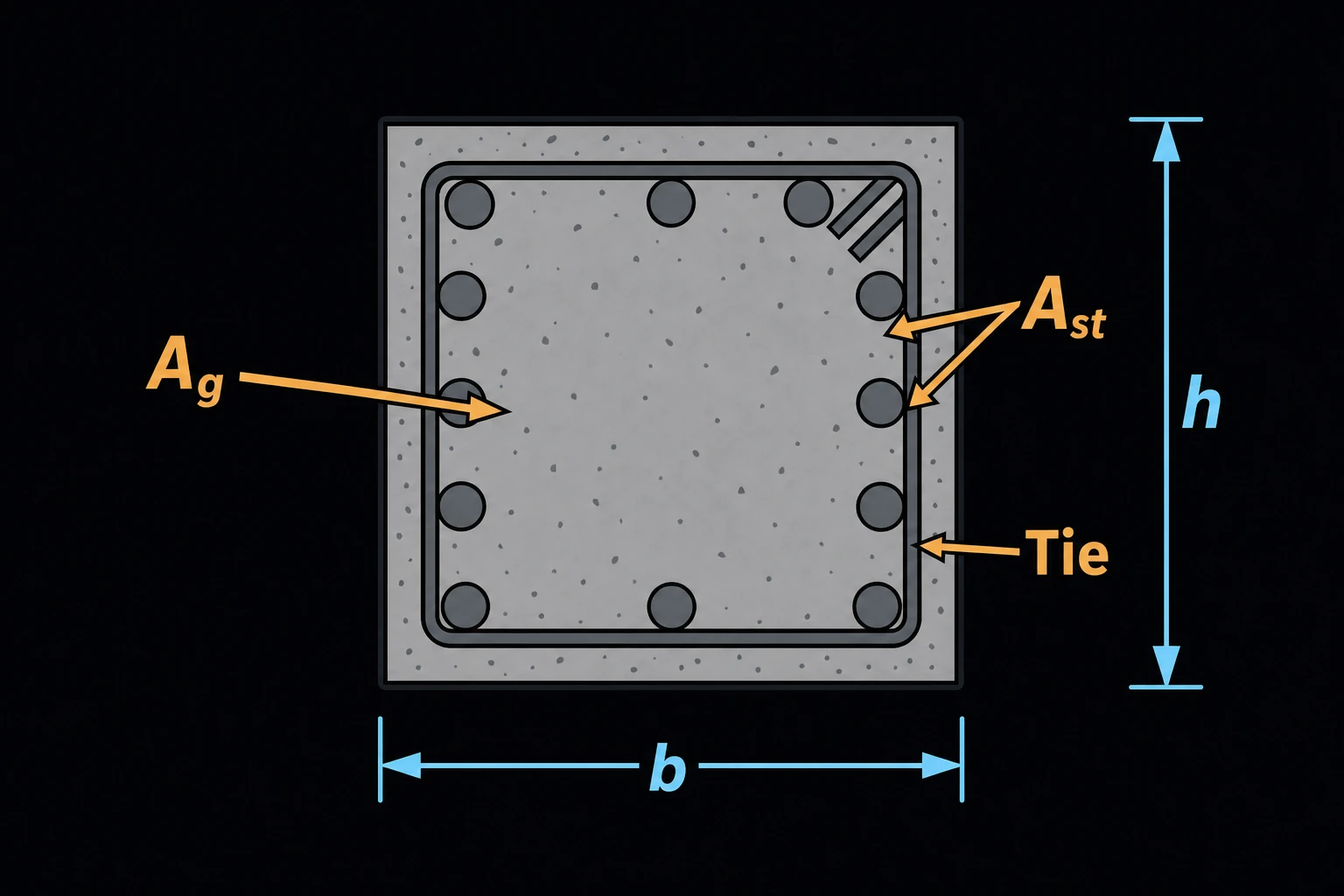
Ag is the gross area of the concrete section, Ast the total area of the longitudinal bars, f′c the concrete strength and fy the bar yield strength, not taken above 80,000 psi (551.6 MPa) [1]. Po is the strength of the section under pure axial load. The Code caps the usable strength at α = 0.80 of Po for tied columns and 0.85 for spiral columns, to allow for the small bending every real column has. φ is 0.65 for tied and 0.75 for spiral columns, the strength reduction factors for compression-controlled sections [1].
Pick a bar size and count and the page multiplies the count by the bar’s nominal area from ASTM A615 [2], or enter the total steel area directly.
Limits and common mistakes
- This is the axial limit only. A column with real moment needs an interaction diagram; one that is slender also needs the moment magnification of Chapter 6.
- ρg must be from 0.01 to 0.08 [1]. In practice above about 0.04 the bars become hard to splice and place.
- A column needs at least 4 bars within rectangular or circular ties, 3 within triangular ties and 6 within a spiral. The page warns when there are fewer.
- Ag is the whole section, including the area the bars occupy; the equation deducts Ast itself.
- The grade presets use the nominal metric yield strengths (Grade 60 = 420 MPa) [2], [3].
Worked example
A 450 mm square tied column has eight #8 bars, 5000 psi concrete and Grade 60 steel. Find the most factored axial load it may carry.
- Keep Transverse Reinforcement Rectangular or circular ties (α = 0.80, φ = 0.65).
- Enter Gross Cross-Section Area (Ag) 2025 cm² (450 × 450 mm).
- Choose Longitudinal Bars #8 [No. 25] — 0.79 in² (510 mm²) each, and enter Number of Bars 8.
- Choose Concrete Strength 5000 psi (34.5 MPa) and Rebar Grade ASTM A615 Grade 60 — fy = 420 MPa.
- Press Solve. The Solution shows:
Ast = 8 × 510 mm² (#8): 4,080 mm²
Reinforcement ratio ρg = Ast/Ag: 0.0201481
Nominal axial strength Po: 7,527.85 kN
Pn,max = α·Po: 6,022.28 kN
Design strength φPn,max: 3,914.48 kN
Check: 0.85 × 34.474 MPa × (202,500 − 4,080) mm² = 5,814 kN of concrete, plus 420 × 4,080 = 1,714 kN of steel, gives Po = 7,528 kN. 0.80 × 0.65 = 0.52, and 0.52 × 7,528 = 3,914 kN. In inch-pound units with 60 ksi the same column gives 877 kips (3,901 kN), slightly less because 60 ksi is 413.7 MPa.