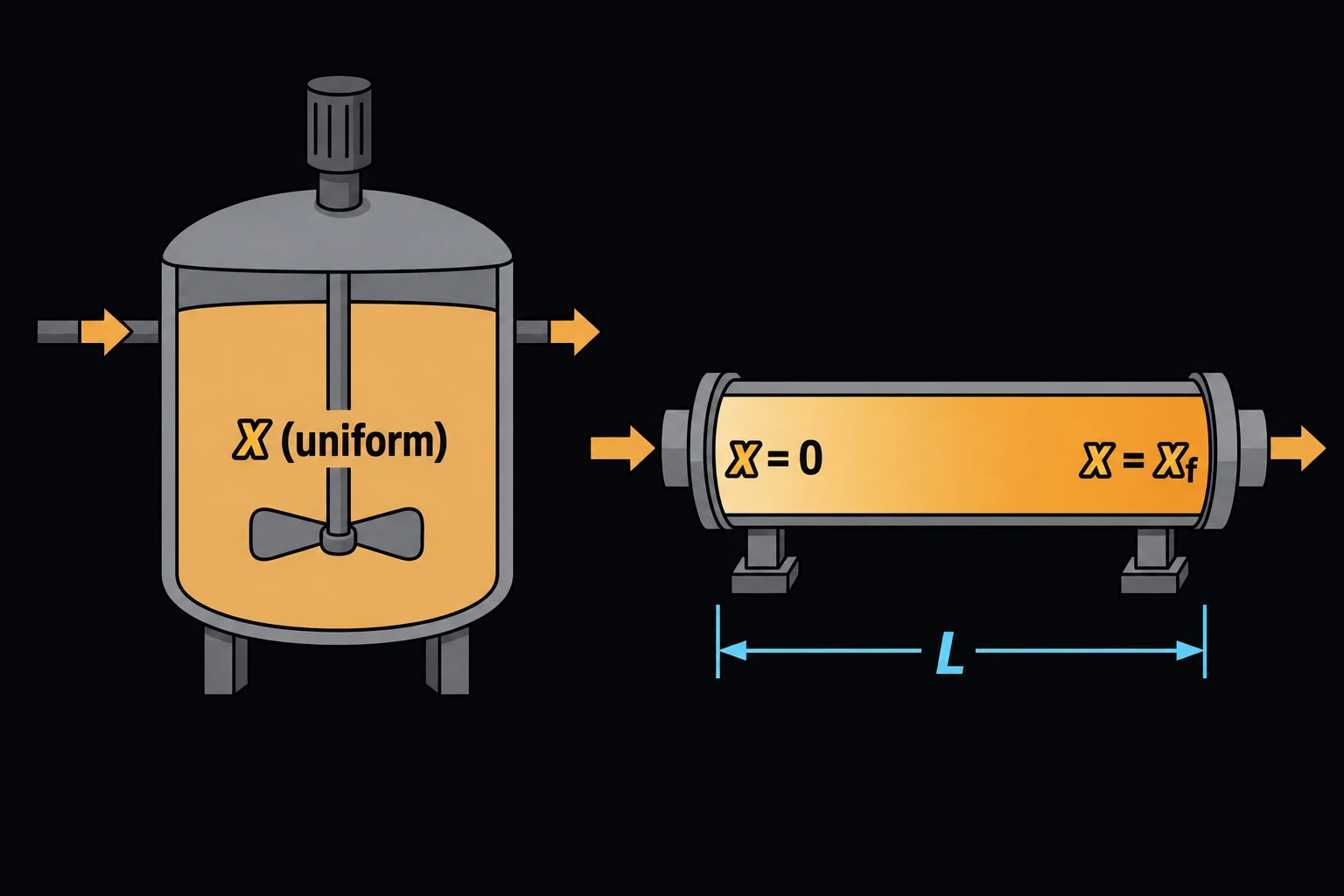
Ideal Reactor Conversion (CSTR / PFR)
Finds the conversion an existing ideal reactor reaches: a continuous stirred-tank reactor (CSTR) or a plug-flow reactor (PFR), for a zero-, first- or second-order reaction. You know the reactor and the flow, and want to know what comes out. Use it to rate a reactor or check a new throughput.
Equations
The space time τ = V/v0 is the reactor volume divided by the inlet volumetric flow. The Damköhler number Da compares the reaction rate with the flow through the reactor: Da = k·τ/CA0 for zero order, k·τ for first order and k·τ·CA0 for second order. The conversion X then follows from the design equations [1], [2]:
Zero order (both): X = Da, up to 1
First order: CSTR X = Da/(1 + Da)
PFR X = 1 − e−Da
Second order: CSTR Da = X/(1 − X)2
PFR X = Da/(1 + Da)
k is the rate constant and CA0 the inlet concentration of reactant A in mol/L. The page solves the second-order CSTR equation, a quadratic in X, for its root between 0 and 1. The outlet concentration is CA = CA0·(1 − X).
Inputs and limits
- k must use mol, L and s, and its units follow the order: mol/(L·s), 1/s or L/(mol·s). Divide a per-minute value by 60.
- The reactor is isothermal, at steady state and at constant density. Gas-phase reactions that change the number of moles need the expansion factor [1].
- Second order means −rA = k·CA2, or A + B fed in equal amounts.
- For zero order, a conversion of 1 means the reactant runs out before the outlet. The rate law no longer holds once A is nearly gone.
- Use the inlet volumetric flow for τ, not the outlet flow, and the reactor’s liquid volume, not its total volume.
Worked example
A 2000 L reactor is fed 2 L/s of a solution at 1 mol/L. The reaction is second order with k = 0.002 L/(mol·s). What conversion does it reach as a stirred tank, and what would a tube of the same volume give?
- Choose Reactor Type CSTR (ideal) and Reaction Order Second order.
- Enter Rate Constant k (mol, L, s) 0.002, Space Time τ = V/v₀ (s) 1000 (2000 L ÷ 2 L/s) and Inlet Concentration CA0 (mol/L) 1.
- Press Solve. The Solution shows:
Damköhler number Da: 2
Conversion X: 0.5
Conversion X: 50 %
Outlet concentration CA: 0.5 mol/L - Choose Reactor Type PFR (ideal) and press Solve again. The Solution shows:
Damköhler number Da: 2
Conversion X: 0.666667
Conversion X: 66.6667 %
Outlet concentration CA: 0.333333 mol/L
Check by hand: Da = 0.002 × 1000 × 1 = 2. For the CSTR, X = 0.5 gives 0.5/0.52 = 2, which matches. For the PFR, 2/(1 + 2) = 2/3. The same volume converts a third more as a tube.