Reorder Point & Safety Stock
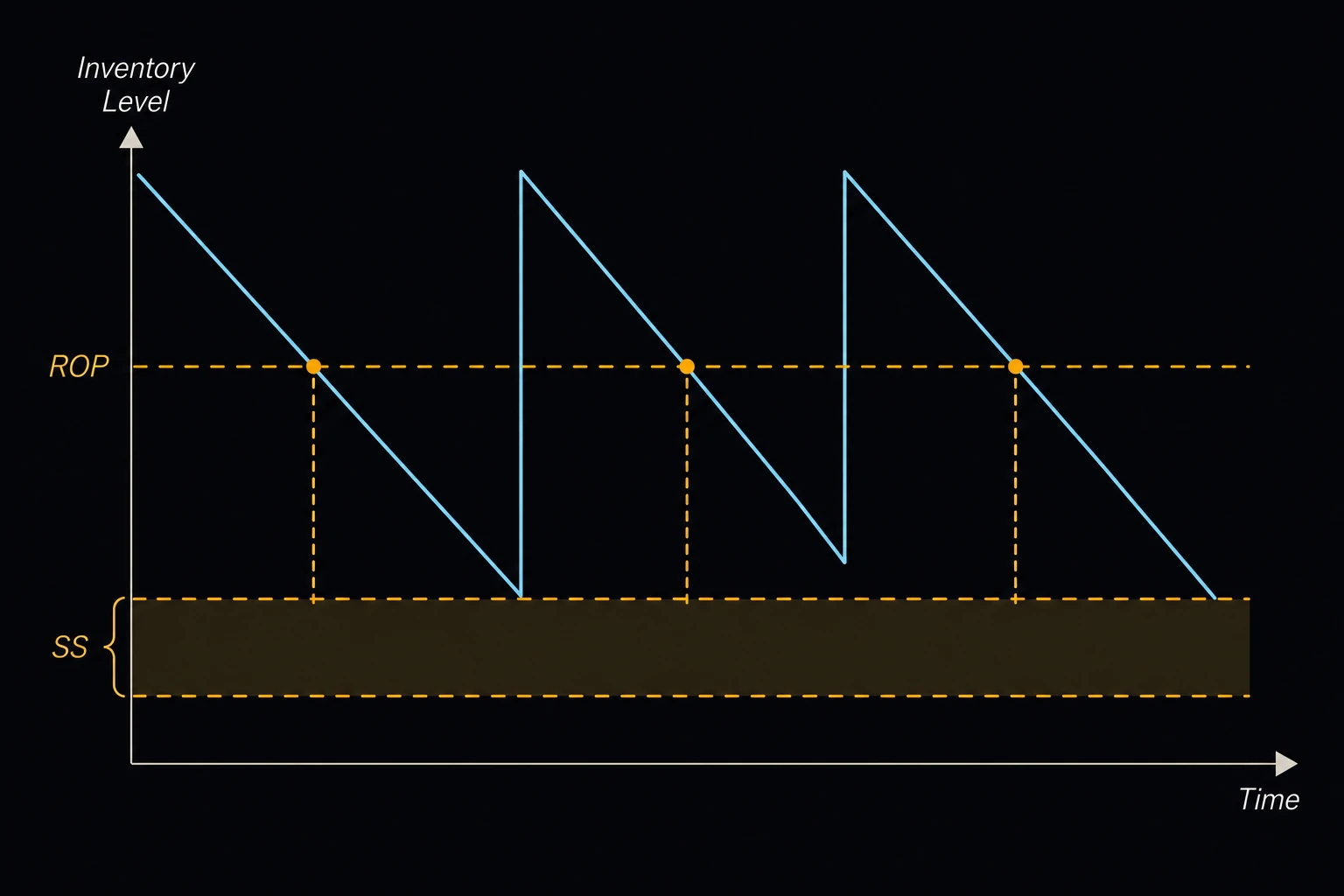
Finds the safety stock and the reorder point for a stocked item whose demand and supplier lead time both vary. When the stock on hand plus on order falls to the reorder point, a new order goes out. The safety stock is the part of that point held against a busy lead time or a late delivery. Planners and buyers use it to set the minimum level in a continuous-review (s, Q) system [1], [3].
The equations
σDLT = √(L·σd² + d²·σL²)
SS = z·σDLT ROP = d·L + SS
d is the average daily demand and σd its standard deviation. L is the average lead time in days and σL its standard deviation. σDLT is the standard deviation of the demand during the lead time, which combines both sources of variation, assuming they are independent [1], [2]. z is the standard normal value for the cycle service level, the chance that a cycle ends without a stockout: 1.645 for 95 %, 2.326 for 99 %. SS is the safety stock and ROP the reorder point. d·L is the stock expected to be used while an order is on its way.
Limits and common mistakes
- The cycle service level counts cycles without a stockout. It is not the fill rate, the share of demand served from stock, which is usually much higher for the same safety stock [2].
- Use daily figures throughout. If demand is recorded weekly, divide the weekly standard deviation by √5 or √7 (the working days in the week), not by 5 or 7.
- The formula assumes demand during the lead time is roughly normal. For slow movers that sell a few units a month, a Poisson model gives better results.
- Lead-time variation is often the larger term. Enter 0 for σL only when deliveries really arrive on time.
- Safety stock rises steeply near 100 %. Going from 95 % to 99 % adds about 40 % more safety stock.
Worked example
A distribution center ships an average of 120 filter cartridges a day, with a standard deviation of 30. The supplier quotes 8 days, but deliveries vary with a standard deviation of 2 days. The target is a 97.5 % cycle service level.
- Enter Average Demand Rate (d, units per day) 120 and Average Lead Time (L, days) 8.
- Enter Std Dev of Daily Demand (σd) 30 and Std Dev of Lead Time (σL, days; 0 if fixed) 2.
- Enter Cycle Service Level (%) 97.5.
- Press Solve. The Solution shows:
Safety factor z: 1.95996
Lead-time demand (d·L): 960 units
Std dev of lead-time demand σ_DLT: 254.558 units
Safety stock: 498.925 units
Reorder point: 1,458.93 units
Check: √(8 × 30² + 120² × 2²) = √(7,200 + 57,600) = 254.6. The lead-time term is eight times the demand term. 1.96 × 254.6 = 499, so the buyer reorders at about 1,460 cartridges, with 500 of them as safety stock.