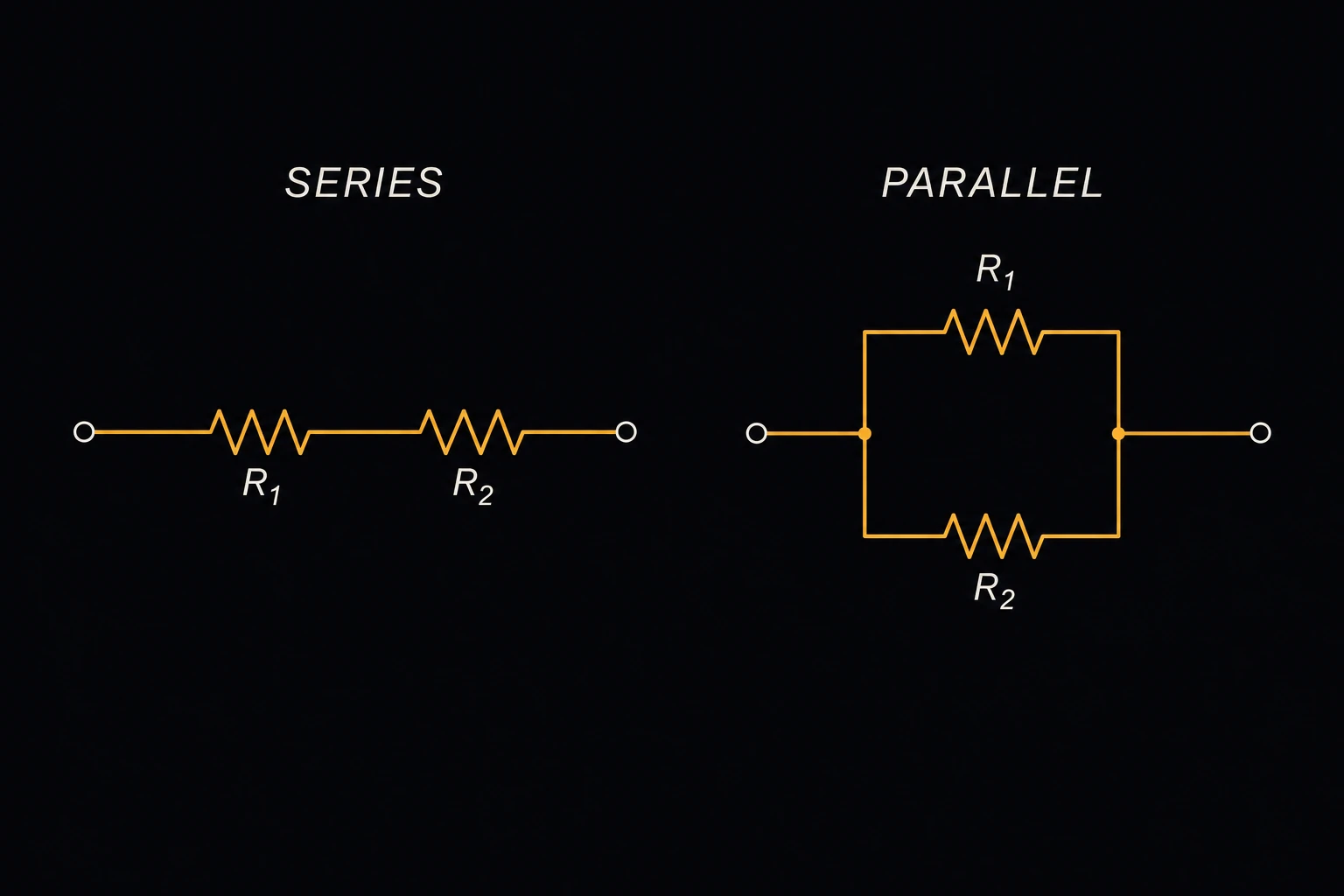
Series/Parallel Resistance
Finds the single resistance that can replace up to four resistors wired all in series or all in parallel. Use it to build an odd value from the standard values you have in the drawer, to reduce part of a circuit before further analysis, or to check what a string of heaters or a bank of shunts adds up to.
Equations
Series: Req = R1 + R2 + R3 + R4
Parallel: 1/Req = 1/R1 + 1/R2 + 1/R3 + 1/R4
R1 to R4 are the individual resistances and Req the equivalent resistance [1]. In series the same current flows through every resistor, so their voltages add and so do their resistances. In parallel every resistor sees the same voltage, so their currents add and so do their conductances, 1/R. For just two resistors in parallel this becomes the familiar product over sum, R1R2/(R1 + R2).
Inputs and limits
- Leave a field at 0 to leave that resistor out. Resistors used counts the ones that went into the result.
- Because 0 means “not there”, the page can’t model a short circuit (0 Ω) in parallel. A short in parallel makes the whole group 0 Ω.
- Negative resistances are rejected.
- All resistors must be in the same arrangement. For a mixed network, reduce it a piece at a time: work out each parallel group, then enter the group results in series, or the other way round.
Common mistakes
- A series total is always larger than the largest resistor. A parallel result is always smaller than the smallest one. If yours isn’t, the arrangement is set wrong.
- Watch the unit picker on each field: 4.7 in a kilohm field is 4,700 Ω.
- The resistors’ tolerance carries into the result. Two 5 % parts make a combination that is still only good to about 5 %.
- The equivalent says nothing about how the power splits. In parallel the smallest resistor carries the most current and runs hottest.
Worked example
A sensor circuit needs about 120 Ω, but the drawer has run out of 120 Ω parts. Will a 220 Ω and a 270 Ω in parallel do?
- Choose Configuration Parallel.
- Enter R1 220 Ω and R2 270 Ω, and leave R3 and R4 at 0.
- Press Solve. The Solution shows:
Equivalent resistance (Req): 121.224 Ω
Resistors used: 2
Check with product over sum: 220 × 270 / 490 = 59,400 / 490 = 121.2 Ω. That is within 1 % of the 120 Ω target, closer than the 5 % tolerance of the parts themselves. As expected, it is below the smaller resistor.