Resistor Color Code Decoder
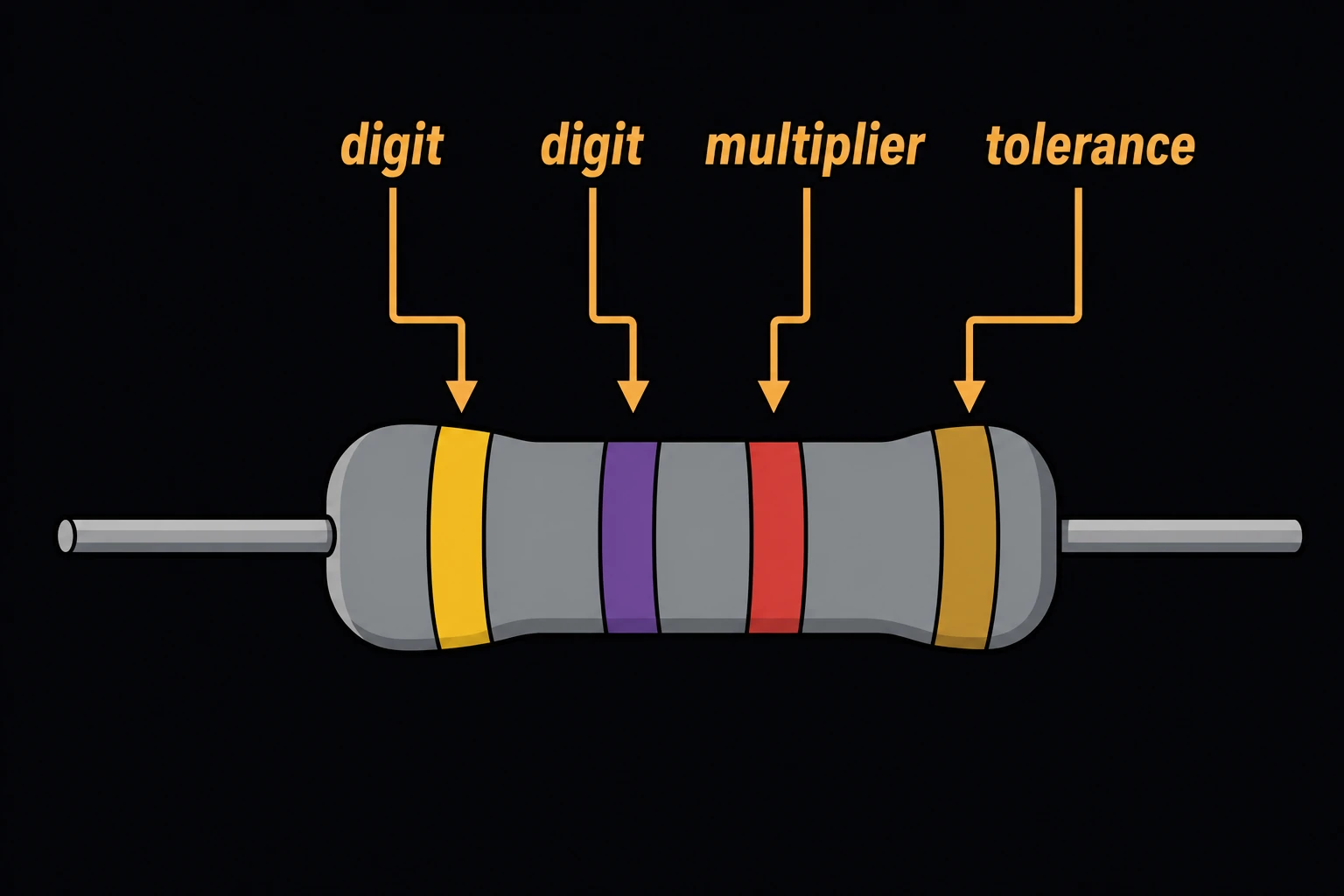
Reads the colored bands on a through-hole resistor and gives its resistance and tolerance. Pick 4-band or 5-band, then the color of each band from left to right. Use it at the bench to sort parts, check a board against its parts list, or identify a resistor in equipment you are repairing.
How the code works
R = (digits)·10m
The color code is set by IEC 60062 [1]. On a 4-band resistor the first two bands are digits and on a 5-band resistor the first three are. Each digit color stands for a number: black 0, brown 1, red 2, orange 3, yellow 4, green 5, blue 6, violet 7, gray 8, white 9. The next band is the multiplier: the same colors give the power of ten m, from 0 to 9, and gold and silver give m = −1 and −2. R is the resistance in ohms. The last band is the tolerance: brown ±1 %, red ±2 %, green ±0.5 %, blue ±0.25 %, violet ±0.1 %, gray ±0.05 %, gold ±5 %, silver ±10 %, and no band ±20 %. The decoded value is exact: it is the nominal value the maker printed, not a measurement.
Limits and common mistakes
- Read from the correct end. The tolerance band is usually set a little apart from the others and goes on the right, and gold or silver is never a first digit. If the reading in one direction gives a value that is not a standard E-series value, try the other.
- Brown, red and orange look alike on a small or old part, and heat can darken the body. When in doubt, measure the resistor out of circuit with a meter.
- A 6-band resistor adds a temperature-coefficient band after the tolerance band. Ignore it and decode the first five as a 5-band part.
- A single black band marks a zero-ohm jumper, not a resistor.
- Surface-mount resistors use printed number codes instead of colors.
Worked example
A resistor from an unmarked bin has five bands: yellow, violet, black, brown and brown, with the last brown band set slightly apart. What is it?
- Choose Number of Bands 5-band.
- Choose Band 1 (1st digit) Yellow, Band 2 (2nd digit) Violet and Band 3 (3rd digit) Black.
- Choose Multiplier band Brown and Tolerance band Brown, and press Solve. The Solution shows:
Resistance: 4,700 Ω
Tolerance: ± 1%
Check by hand: the digits read 4, 7, 0, so 470 × 101 = 4700 Ω, or 4.7 kΩ, a standard E24 and E96 value. A meter should read between 4653 and 4747 Ω. Read the other way round, the first band would be brown and the tolerance band yellow, which is not a tolerance color, so the direction above is right.