Retaining Wall Design (Rankine)
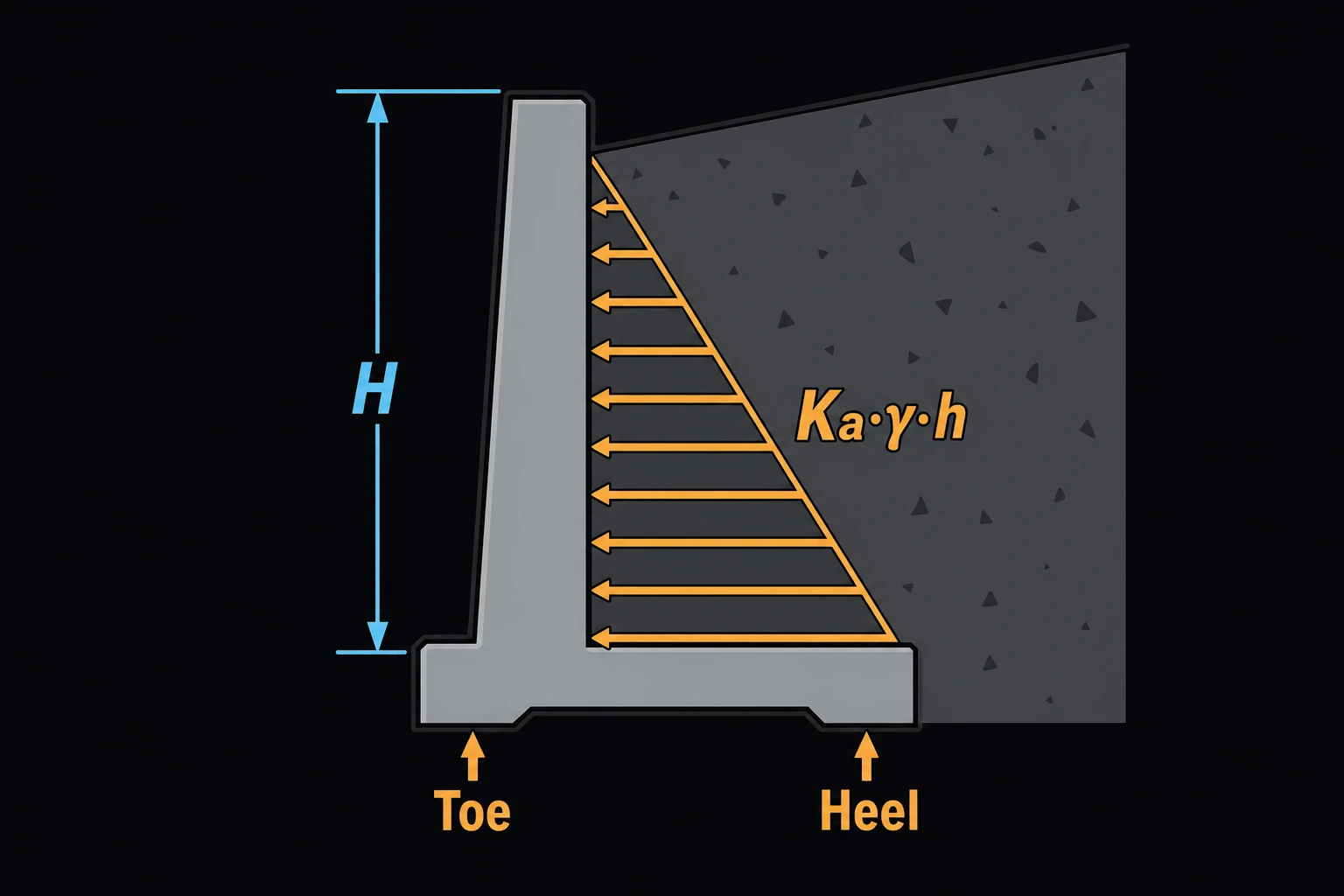
Checks a gravity or cantilever retaining wall for overturning and sliding, per meter of wall length, for a first stability check while proportioning it. It finds the Rankine active earth pressure from a level, drained backfill and compares the overturning and driving forces with the wall’s own resistance. Pick a backfill by USCS group and a foundation soil to fill in typical values, or enter your own.
The equations
Ka = (1 − sinφ)/(1 + sinφ)
Pa = ½KaγH²
Mo = PaH/3
Mr = W·x
FSoverturning = Mr/Mo
FSsliding = μW/Pa
φ is the backfill’s friction angle and γ its unit weight, H the height of the retained soil, and Ka the Rankine active coefficient [1]. Pa acts at H/3 above the base. W is the total vertical weight per meter: the stem, the base and the soil resting on the heel. x is the distance from the toe to W’s line of action, and μ the friction coefficient between the base and the soil below. Common targets are FS ≥ 2.0 against overturning and FS ≥ 1.5 against sliding [2].
The backfill presets take φ′ for compacted fill from NAVFAC DM-7.02 [3] and γ from AASHTO [4]. The foundation presets fill in the lower bound of the NAVFAC friction factor for mass concrete on soil [3].
Limits and common mistakes
- The backfill is level and drained, the back of the wall vertical, and wall friction is ignored. A sloping backfill, a surcharge or water behind the wall all raise the pressure.
- Passive resistance in front of the toe is left out, which is conservative for sliding.
- Bearing pressure, the eccentricity of the base reaction and global stability are not checked. The resultant should fall in the middle third of the base.
- Fine-grained backfill drains poorly and can swell or creep, so the page warns when you pick one. Prefer free-draining granular fill.
Worked example
A cantilever wall retains 3.6 m of compacted well-graded sand. The stem, base and soil over the heel weigh 120 kN per meter, acting 1.1 m from the toe. The base sits on medium sand.
- Enter Wall Height (H) 3.6 m.
- Choose Backfill Soil SW — well-graded clean sand, gravelly sand. The page fills in γ and φ.
- Enter Wall Weight per Unit Length (W) 120 and Distance, Toe to W Line of Action (x) 1.1 m.
- Choose Foundation Soil under the Base Clean fine to medium sand, silty medium to coarse sand, silty or clayey gravel: μ 0.45–0.55.
- Press Solve. The Solution shows:
Active Earth Pressure Coefficient (Ka): 0.237883
Active Force (Pa): 29.0577 kN/m
Overturning Moment (Mo): 34.8692 kN·m/m
Resisting Moment (Mr): 132 kN·m/m
Factor of Safety, Overturning: 3.78557
Factor of Safety, Sliding: 1.85837
Check: Ka also equals tan²(45° − φ/2) = tan²(26°) = 0.2379. With γ = 120 pcf = 18.85 kN/m³, Pa = 0.5 × 0.2379 × 18.85 × 3.6² = 29.06 kN/m, and sliding gives 0.45 × 120 / 29.06 = 1.86.