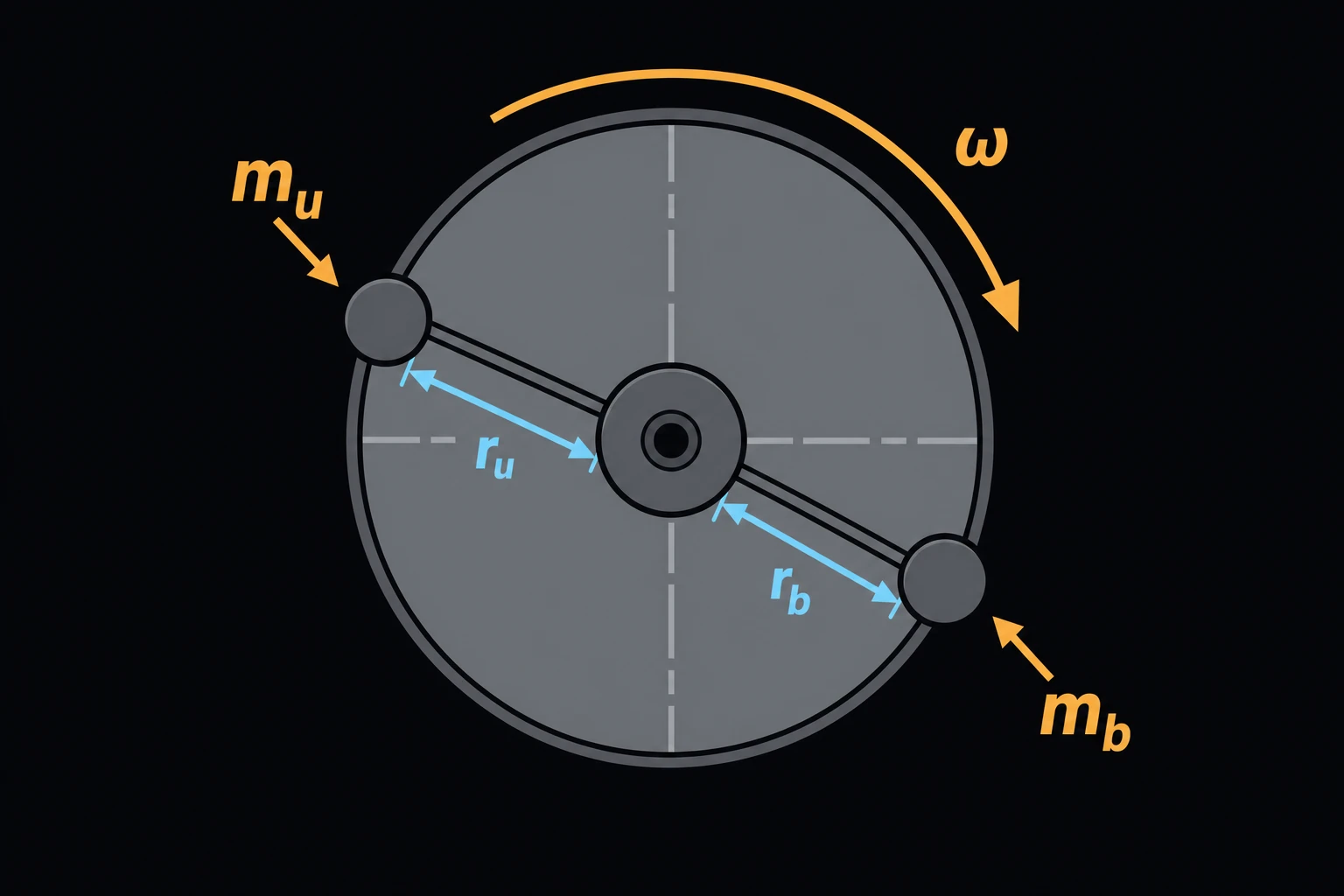
Rotating Mass Balancing
Sizes the correction mass that balances a rotor in a single plane, and gives the force the unbalance puts on the bearings if it is left uncorrected. Use it for thin rotors such as fans, pulleys, grinding wheels, flywheels and disks, where all the mass lies close to one plane.
Equations
mb·rb = mu·ru F = mu·ru·ω² ω = 2πN/60
mu is the unbalance mass, the extra mass on the heavy side, and ru its radius from the axis of rotation. mb is the balance mass added at radius rb, exactly opposite the unbalance. The two products must be equal so that the centrifugal forces cancel [1]. The product m·r is the unbalance itself, often quoted in g·mm. F is the rotating force that the uncorrected unbalance applies to the bearings at speed N in rpm, where ω is the angular velocity in rad/s.
Placing the correction mass farther out means less mass is needed. The force grows with the square of the speed, so doubling the speed makes it four times larger.
Limits and common mistakes
- Single-plane (static) balancing cancels only the net radial force. A long rotor, such as a motor armature or a roll, can be in static balance and still wobble because its unbalances sit in different planes. It needs two-plane (dynamic) balancing on a balancing machine.
- Measure both radii from the axis of rotation to the center of each mass, not to the rim or to the edge of the weight.
- Removing material works too. Drilling out mb at radius rb on the heavy side has the same effect as adding it on the light side.
- How much residual unbalance is acceptable depends on the rotor’s type and speed. Check it against the balance grade your industry uses.
Worked example
A fan rotor running at 1,800 rpm has an unbalance of 15 g at a radius of 120 mm. Weights can be clipped on at a radius of 90 mm. What weight is needed, and how hard does the unbalance pull on the bearings now?
- Enter Unbalance Mass (mu) 15 g and Unbalance Radius (ru) 120 mm.
- Enter Balance Radius (rb) 90 mm.
- Enter Rotational Speed 1800 rpm and press Solve. The Solution shows:
Required Balance Mass (mb): 20 g
Placement: 180° opposite the unbalance mass
Unbalanced Centrifugal Force: 63.955 N
Check: 15 g × 120 mm = 1,800 g·mm = 20 g × 90 mm. At 1,800 rpm, ω = 188.5 rad/s, and F = 0.015 kg × 0.12 m × 188.5² = 64 N, about the weight of a 6.5 kg mass, from a weight of only 15 g.