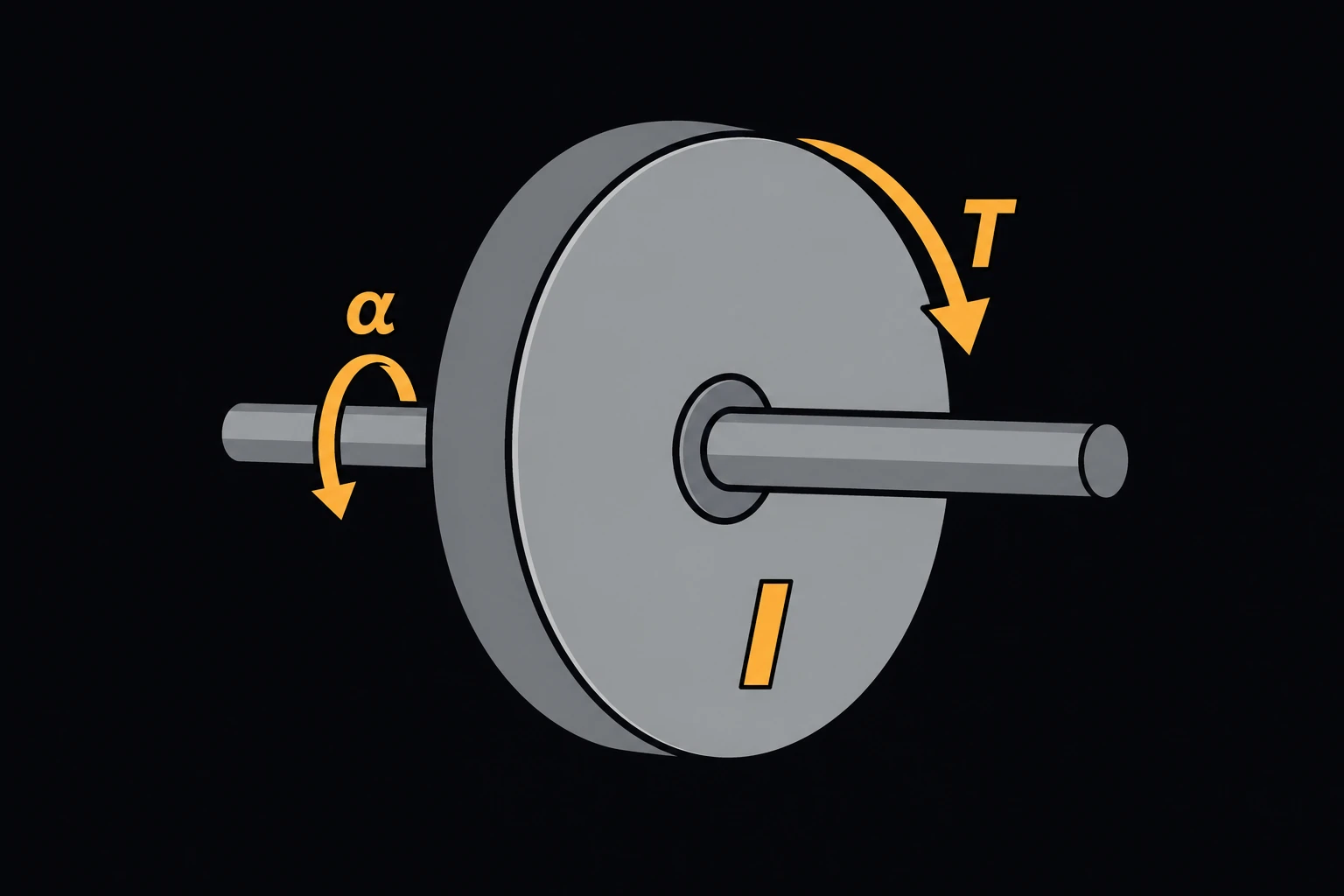
Rotational Inertia/Torque
Applies Newton’s second law to rotation. Give the mass moment of inertia of a rotating part and either the angular acceleration you want, to get the torque it takes, or the torque you have, to get the angular acceleration it produces. Designers use it to size motors, brakes and clutches for flywheels, turntables, rollers and spindles that must start or stop in a set time.
Equation
T = I·α
T is the net torque about the axis of rotation, I the mass moment of inertia about that same axis, and α the angular acceleration in rad/s² [1]. A part that must go from rest to a speed of N rpm in t seconds, at a steady rate, needs α = (2πN/60)/t. In the second mode the page solves the same law for α = T/I.
I depends on how the mass is spread out, not just on how much there is. A solid disk of mass m and radius r has I = ½mr², a thin ring has I = mr², and a part turning about an axis a distance d from its own center of mass adds md² (the parallel-axis theorem) [1].
Limits and common mistakes
- T is the net torque. A motor must also overcome friction, windage and any load torque, so add those to the result before choosing it.
- Angular acceleration is in rad/s², not rpm per second. Multiply rpm/s by 2π/60 = 0.1047 to convert.
- Include every part that turns with the load: shaft, hub, coupling and pulleys. Parts behind a gear or belt reduction count as I times the square of their speed ratio to the shaft you are sizing.
- Check the units of I in a catalog. Inertia given as lb·ft² (often written WR² or WK²) can be entered directly with the unit picker.
Worked example
A turntable with a mass moment of inertia of 12 kg·m² must reach 300 rpm in 2 s from rest. The angular acceleration is (2π × 300/60)/2 = 15.708 rad/s². What torque must the drive deliver?
- Choose Solve For Torque, given angular acceleration.
- Enter Mass Moment of Inertia (I) 12 kg·m².
- Enter Angular Acceleration (α) 15.708 rad/s² and press Solve. The Solution shows: Torque (T): 188.496 N·m
Check: 12 kg·m² × 15.708 rad/s² = 188.5 kg·m²/s², which is N·m. Units also check the other way: the turntable ends with ½Iω² = ½ × 12 × 31.42² = 5,922 J, the same as the work T·θ done over 31.42 rad of rotation in 2 s.