Secondary Containment (Dike) Sizing
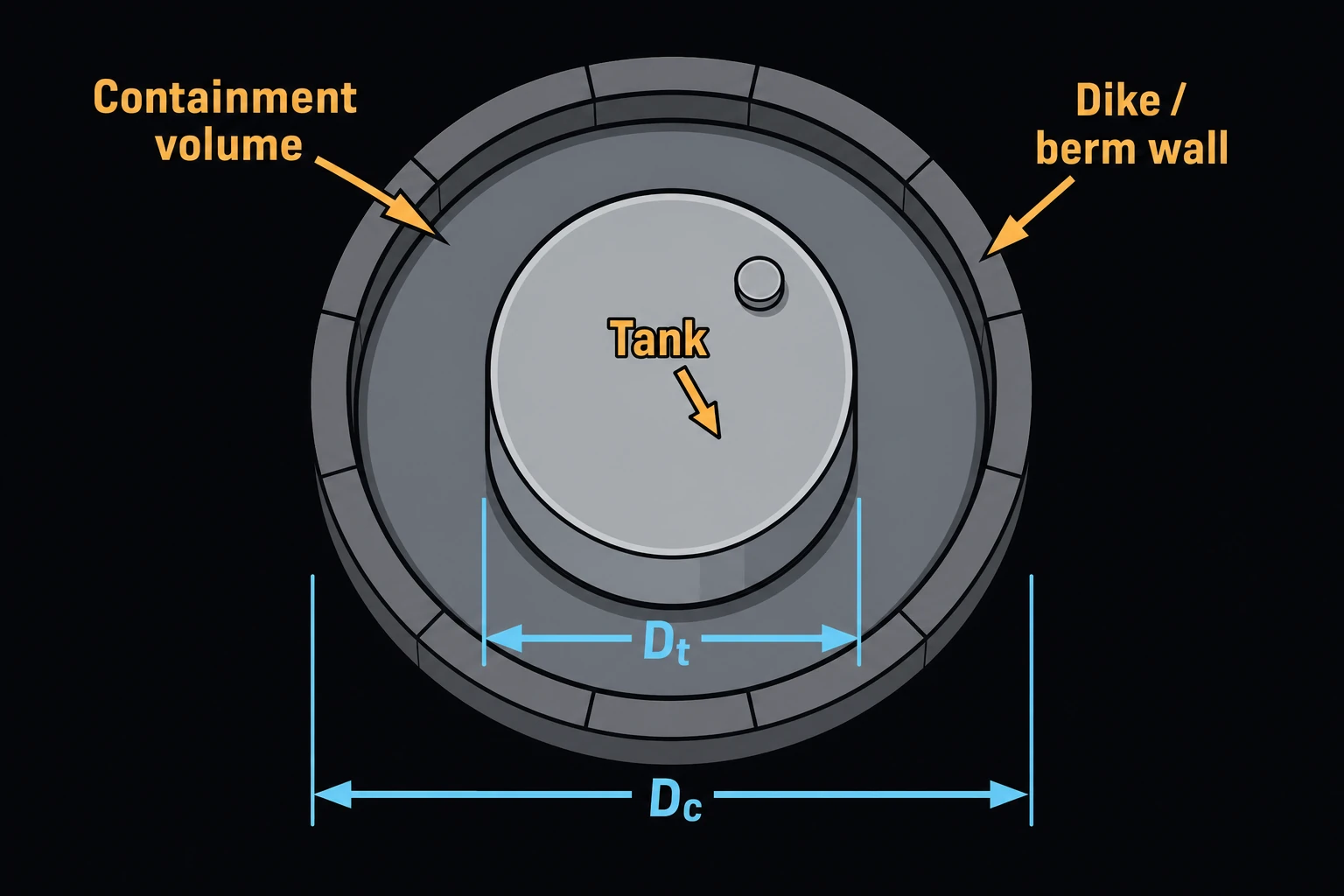
Sizes the dike (or bund) around a group of storage tanks. It gives the volume the dike must hold and the wall height, allowing for other tanks standing in the dike and for freeboard. Process, civil and environmental engineers use it to lay out a tank farm and to check an existing dike against NFPA 30 [1], a US SPCC plan [2] or the UK oil storage rules [3].
Equations
Vreq = f·Vmax hliq = Vreq/A
H = (Vreq + Vdisp)/A + hfb
Vmax is the volume of the largest tank and f the capacity factor on it. Vreq is the volume the dike must hold. A is the floor area inside the dike, in plan. hliq is the liquid depth on an empty floor. Vdisp is the volume of the other tanks’ shells and foundations below the top of the wall, which takes up space the spill cannot use. hfb is the freeboard added on top, and H is the wall height.
Inputs
- Choosing a Containment Capacity Basis fills in the factor. NFPA 30 §22.11.2 asks for the full volume of the largest tank, f = 1.0 [1]. The UK regulations ask for 110 % of the largest container, f = 1.1 [3]. Choose Custom for a company rule, such as extra room for foam.
- Leave the largest tank’s own shell out of the displaced volume, since that tank is the one that fails. Count every other tank and foundation inside the dike.
Limits and common mistakes
- The floor is taken as flat and the walls as vertical. For sloped walls, work out the volume for that shape.
- The displaced volume depends on the wall height, so check it again once you know H.
- With more than one container, the UK rules also need 25 % of the total stored volume, if that is more [3]. The page does not check this; compare it by hand.
- A US SPCC plan also needs room for rain [2]. Raise the factor or the freeboard to suit.
Worked example
A diesel tank farm in England has an 800 m³ tank and two smaller tanks inside a 30 m × 25 m bund. The smaller tanks and their bases take up 45 m³ below the wall top. How high must the wall be, with 150 mm of freeboard?
- Enter Largest Tank Volume 800 m³.
- Choose Containment Capacity Basis UK Oil Storage Regulations 2001. The factor fills in as 1.1.
- Enter Diked Area Floor Plan 750 m², Volume of Other Tank Shells Below Dike Wall 45 m³ and Additional Freeboard 0.15 m, then press Solve. The Solution shows:
Required containment volume: 880 m³
Liquid depth over floor (no displacement): 1.17333 m
Dike wall height (incl. other-tank displacement + freeboard): 1.38333 m
Containment ratio vs largest tank: 1.1
Check by hand: 1.1 × 800 = 880 m³. Then (880 + 45)/750 = 1.2333 m, and adding 0.15 m gives 1.3833 m. If the three tanks hold 1,200 m³ in all, 25 % of that is 300 m³, well below 880 m³, so the 110 % rule governs.