Signal Attenuation
Finds the loss along a cable run and the power left at the far end. Choose a Times Microwave LMR coax and a frequency, and the page works out the cable’s loss rate from the maker’s equation. For any other cable or line, enter its loss rate yourself. RF, antenna and network installers use it to size feed lines and check link budgets.
The attenuation equations
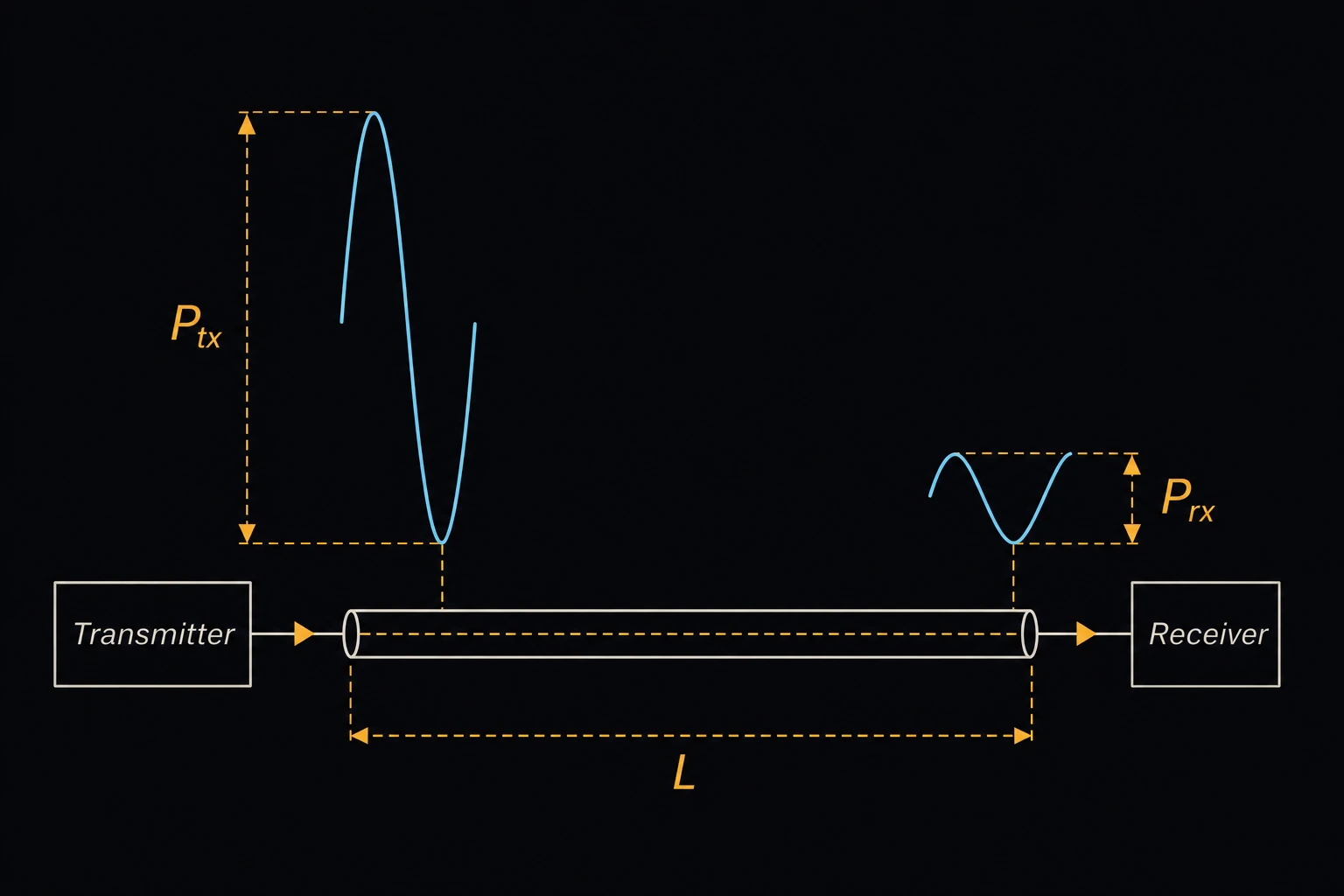
A = α·L/100 Prx = Ptx − A
A is the total attenuation in dB, α the attenuation rate in dB per 100 m and L the run length in meters. Ptx is the power fed into the cable and Prx the power at the far end, both in dBm (decibels relative to 1 mW) [1]. Losses in decibels add, so the received power is a simple subtraction.
For an LMR cable the rate comes from the data-sheet equation [2]:
α (dB/100 ft) = k1·√f + k2·f
Here f is the frequency in MHz. The k1·√f term is the conductor loss, which grows with skin effect, and k2·f is the loss in the dielectric. Each cable has its own k1 and k2. The page divides by 0.3048 to give dB per 100 m.
Limits and common mistakes
- The LMR equations hold from 30 MHz to 5.8 GHz, at a matched load (VSWR 1.0) and 25 °C. Loss rises with temperature and with mismatch, so leave some margin.
- The page covers the cable only. Add the loss of each connector, splitter and lightning arrester to the total before you trust the received power.
- In Custom mode, enter the rate per 100 m. A data sheet in dB per 100 ft needs dividing by 0.3048 first.
- Transmit power must be in dBm. A power in watts converts as 10·log10(P/1 mW), so 1 W is 30 dBm.
Worked example
A 2.4 GHz access point puts out 1 W (30 dBm) and feeds a mast antenna through 30 m of LMR-400. Find the power that reaches the antenna.
- Enter Transmit power (dBm) 30.
- Choose Cable Times Microwave LMR-400 (50 Ω coax).
- Enter Frequency 2400 MHz and Cable/line length (L) 30 m.
- Press Solve. The Solution shows:
Total attenuation: 6.51079 dB
Received power: 23.4892 dBm
LMR-400 attenuation at this frequency: 21.7026 dB/100 m
LMR-400 attenuation at this frequency: 6.61496 dB/100 ft
Check: 21.70 dB/100 m × 0.30 = 6.51 dB, and 30 − 6.51 = 23.49 dBm, about 0.22 W. A 6.5 dB loss throws away three-quarters of the power, so a shorter run or LMR-600 is worth pricing.