Skin Effect Depth
Finds the skin depth: how deep alternating current penetrates a conductor at a given frequency. Pick a metal to fill in its resistivity, or enter the resistivity and relative permeability of your own. Engineers use it to choose wire size or Litz wire for transformers and inductors, to set plating thickness for RF parts, and to judge whether a busbar or shield is thick enough.
Equation
δ = √(ρ / (π·f·μ0·μr))
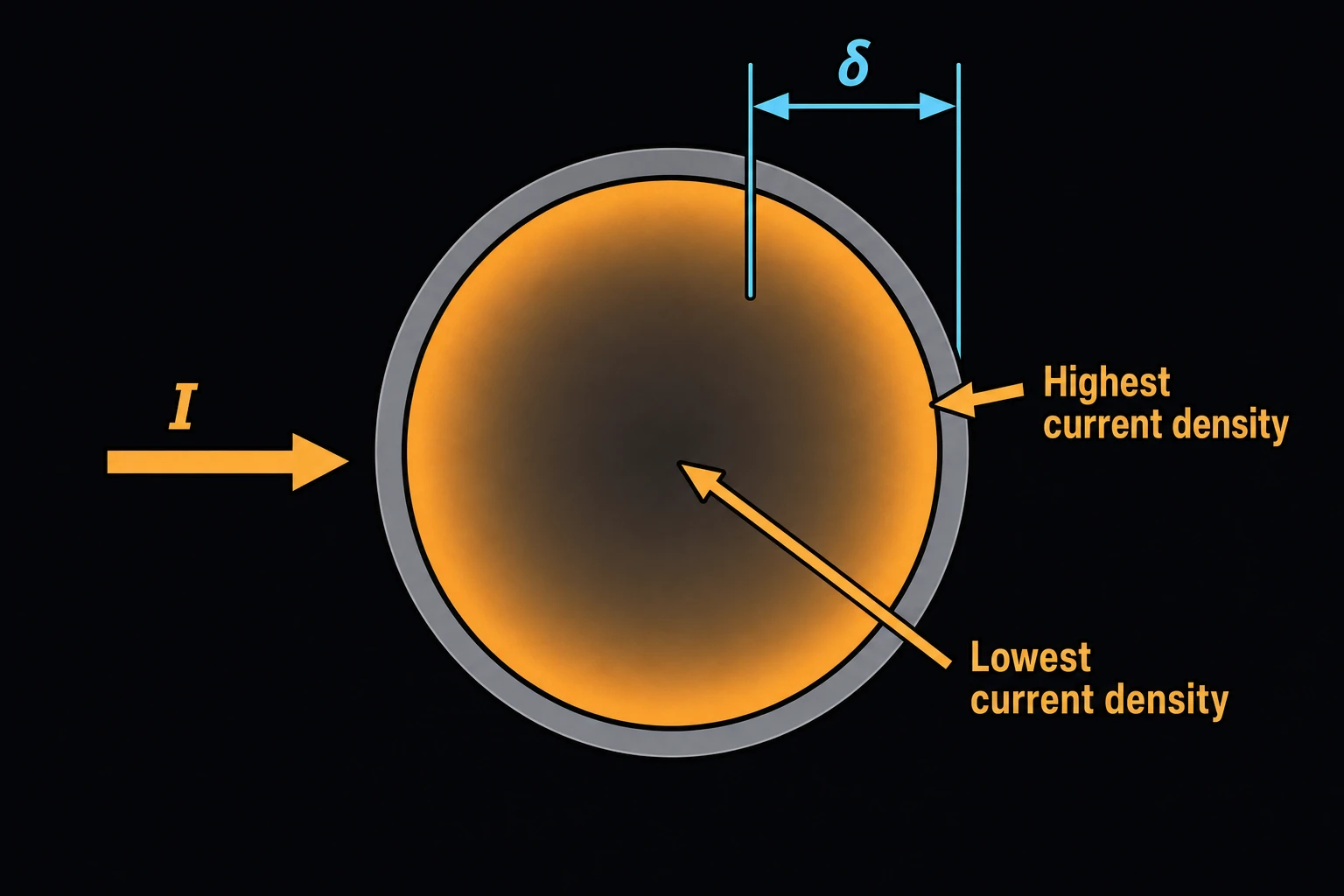
δ is the skin depth: the depth at which the current density has fallen to 1/e, about 37 %, of its value at the surface [1]. ρ is the resistivity in Ω·m, f the frequency, μ0 = 4π × 10−7 H/m the permeability of free space and μr the metal’s relative permeability. For copper, aluminum and the other listed metals μr = 1.
The listed resistivities are 20 °C values for the pure metals [2], annealed copper at 100 % IACS [3] and hard-drawn aluminum wire [4]. Picking a listed conductor also sets μr = 1, right for every non-magnetic metal. As a rule of thumb, current in a conductor many skin depths thick flows as if it were all in a surface layer δ deep, so the AC resistance of a round wire starts to rise once its diameter exceeds about 2δ.
Limits and common mistakes
- δ shrinks as 1/√f: four times the frequency halves it.
- Resistivity rises with temperature, and δ grows with √ρ. Copper at 100 °C has about 31 % more resistance than at 20 °C, so its skin depth is about 15 % deeper.
- Steel and nickel are magnetic. Their μr runs from tens to thousands and changes with the field and saturation, so their skin depth is much smaller and only roughly known. Choose Custom and enter a value for the conditions.
- Nearby conductors carrying current crowd it further (the proximity effect). In a multilayer winding this can matter more than skin effect, and this page does not model it.
Worked example
A switch-mode transformer runs at 100 kHz. Find the skin depth in its copper winding to decide how thick each strand may be.
- Choose Conductor Copper, annealed standard (IACS). The resistivity fills in as 1.7241 × 10⁻⁸ Ω·m.
- Set Frequency (f) to 100 kHz and press Solve. The Solution shows: Skin depth (δ): 0.208978 mm
Check against the rule of thumb for copper, δ ≈ 66 / √f mm with f in Hz: 66 / 316.2 = 0.209 mm. Strands up to about 2δ = 0.42 mm thick carry current through their whole section, so 0.4 mm wire or finer Litz wire suits this winding.