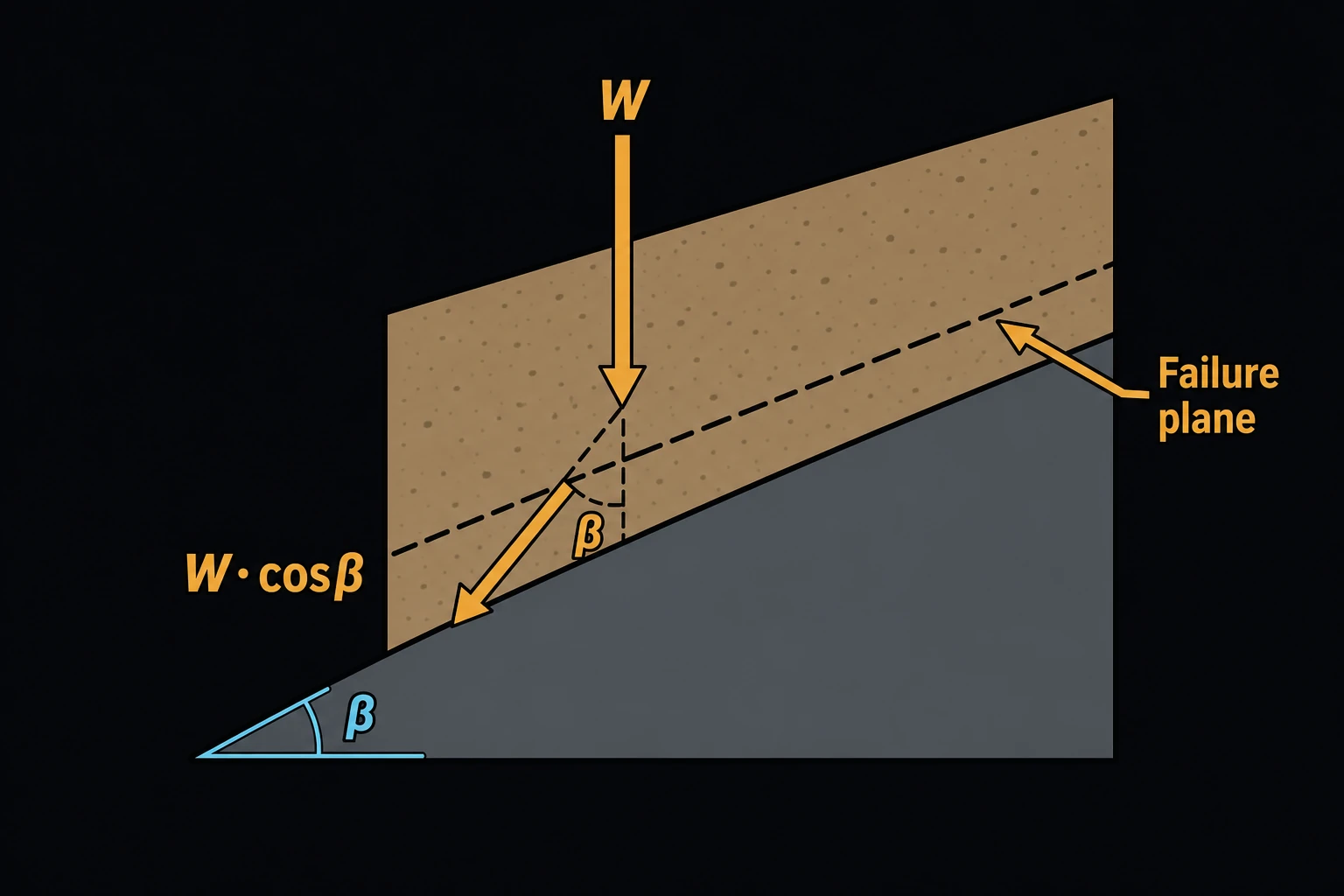
Infinite Slope Stability
Finds the factor of safety of a long, uniform slope against sliding on a plane parallel to its surface. This is the infinite slope model [2], [3]. It suits shallow slides, where a thin layer of soil slips over firmer ground below: hillsides with weathered soil over rock, embankment faces and cut slopes in sand. Engineers use it to check a slope angle, or to see how much a rising water table weakens a slope.
Equations
τ = γ·z·sin β·cos β
s = c′ + γ′·z·cos²β·tan φ′
FS = s / τ
β is the slope angle and z the vertical depth from the surface to the slip plane. γ is the total unit weight of the soil: the moist weight for a dry slope, the saturated weight γsat with seepage. c′ and φ′ are the effective cohesion and friction angle. τ is the shear stress that gravity puts on the slip plane, and s the shear strength available there. For a dry slope γ′ = γ. With the water table at the surface and seepage parallel to the slope, the pore pressure lowers the effective normal stress, so γ′ = γsat − γw [1], [3]. That roughly halves the friction part of the strength.
For a clean sand (c′ = 0), FS = tan φ′ / tan β when dry, whatever the depth. The page rates FS of 1.5 or more as Stable, 1.0 to 1.5 as Marginal and below 1.0 as Unstable. Picking a soil group fills in a typical φ′ for compacted fill [4] and sets c′ to 0; the unit weight stays yours to enter.
Limits and common mistakes
- The model ignores the ends of the slide. It suits a slide much longer than it is deep; for a deep or circular failure use a method of slices.
- Use effective-stress strength (c′, φ′) from drained tests. Small values of c′ raise FS a lot on shallow planes; don’t count on cohesion that wetting or root decay can remove.
- The seepage case is the worst one: water at the surface, flowing parallel to it. A lower water table gives a result between the two cases.
Worked example
A 25° hillside has 2.5 m of silty soil over rock. Tests gave c′ = 4 kPa, φ′ = 32° and γsat = 20 kN/m³. Is it safe after heavy rain saturates it?
- Choose Pore-Water Condition Seepage parallel to slope, water table at surface.
- Enter Slope Angle 25, Effective Cohesion 4, Effective Friction Angle 32 and Soil Unit Weight 20.
- Enter Depth to Failure Plane 2.5 m, keep Unit Weight of Water 9.81 and press Solve. The Solution shows:
Driving shear stress τ: 19.1511 kPa
Available shear strength: 17.0754 kPa
Factor of safety (FS): 0.891614
Assessment: Unstable
The same slope with Dry / no seepage gives FS 1.5489, so it is the water that brings it down. Check by hand: τ = 20 × 2.5 × sin 25° × cos 25° = 19.15 kPa, and s = 4 + 10.19 × 2.5 × 0.8214 × 0.6249 = 17.08 kPa, so FS = 0.892.