Roof Snow Load (ASCE/SEI 7-22)
Finds the uniform design snow load on a roof by ASCE/SEI 7-22 Chapter 7 [1]: the flat-roof load, the sloped-roof load and, on low-slope roofs, the minimum load. Structural engineers use it to size roof framing. It does not cover drifts, sliding snow or unbalanced loads, which are added on top.
How it is calculated
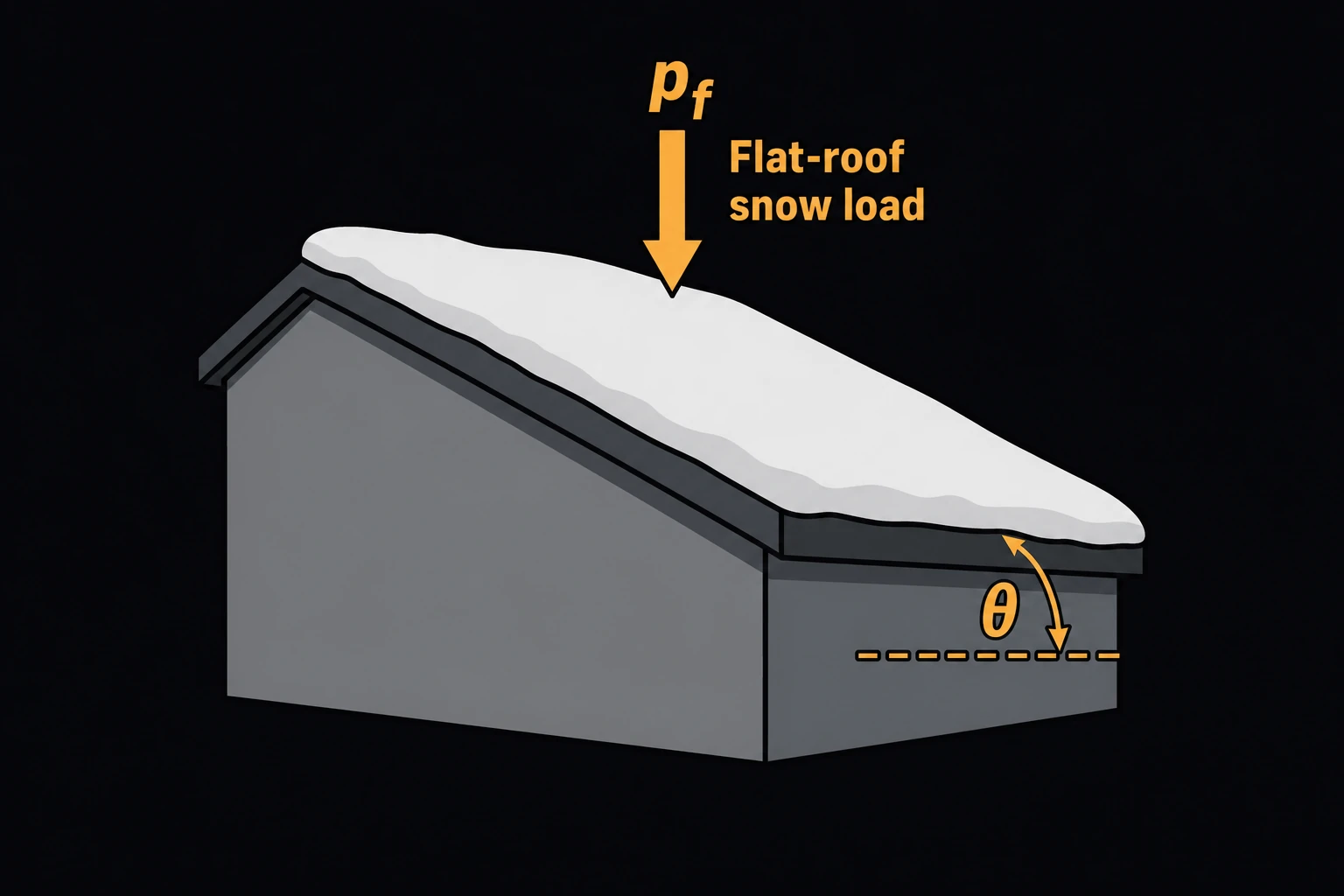
pf = 0.7·Ce·Ct·pg (Eq. 7.3-1)
ps = Cs·pf (Eq. 7.4-1)
where pg is the ground snow load, Ce the exposure factor, Ct the thermal factor and Cs the roof slope factor. The 0.7 reflects that roofs usually hold less snow than the ground. Take pg for the building’s risk category from the 7-22 maps (Figs. 7.2-1A to 7.2-1D) or the ASCE Hazard Tool. Because 7-22 maps a strength-level load for each risk category, there is no snow importance factor. Ce comes from Table 7.3-1, by surface roughness and how exposed the roof is to wind; more wind leaves less snow. Ct comes from Table 7.3-2, or for heated buildings with unventilated roofs (and all others not listed there) from Table 7.3-3. That table is interpolated between its roof R-values and ground snow loads; above R-50, Ct = 1.2. A well-insulated roof stays cold and keeps more snow. Read Cs from the Fig. 7.4-1 chart the page names for that Ct.
On monoslope, hip and gable roofs below 15° (curved roofs below 10°), the minimum pm = pg, but not more than the Table 7.3-4 limit pm,max for the risk category (25 to 40 lb/ft²) (§7.3.3). It is a separate uniform load case, not combined with drift, sliding, unbalanced or partial loads.
Limits and common mistakes
- Use the ground snow load for the risk category you choose. The maps differ by category.
- Don’t apply an importance factor from older editions on top of a 7-22 ground snow load.
- The roof R-value is in h·ft²·°F/Btu. Multiply an SI value in m²·K/W by 5.678.
- Cs is entered, not computed. Use 1.0 for low-slope roofs.
- The result is a strength-level load for use in the ASCE 7 load combinations.
Worked example
A Risk Category II office building with a heated, unventilated low-slope roof (2°, insulated to R-30) stands in open country with scattered trees (surface roughness C). The ground snow load is 40 lb/ft². What uniform snow load should the roof joists carry?
- Keep Risk Category II, set the unit of Ground Snow Load to psf and enter 40.
- Keep Surface Roughness C, Roof Exposure Partially exposed and Thermal Condition All other structures, with Roof Thermal Resistance 30.
- Keep Roof Slope Factor 1.0 and enter Roof Slope 2.
- Press Solve. The Solution shows:
Exposure factor Ce (Table 7.3-1): 1
Thermal factor Ct (Table 7.3-3): 1.13
Flat-roof snow load pf = 0.7·Ce·Ct·pg: 1.51493 kN/m²
Low-slope minimum pm (§7.3.3): 1.43641 kN/m²
Governing (low slope): 1.51493 kN/m²
Check by hand. Table 7.3-3 gives Ct = 1.13 for R-30 at 40 lb/ft². Then pf = 0.7 × 1.0 × 1.13 × 40 = 31.64 lb/ft², and 31.64 × 0.04788 = 1.515 kN/m². The minimum is capped at 30 lb/ft² (1.436 kN/m²) for Risk Category II, so the flat-roof load governs.