SNR Calculator
Finds the signal-to-noise ratio (SNR) in decibels from a measured signal and noise, given either as powers or as RMS voltages. Electronics, instrumentation and communications engineers use it to judge a sensor channel, an amplifier or a receiver, and to compare it with what a converter or a modulation scheme needs.
The SNR equations
SNR = 10·log10(Psignal/Pnoise) SNR = 20·log10(Vsignal/Vnoise)
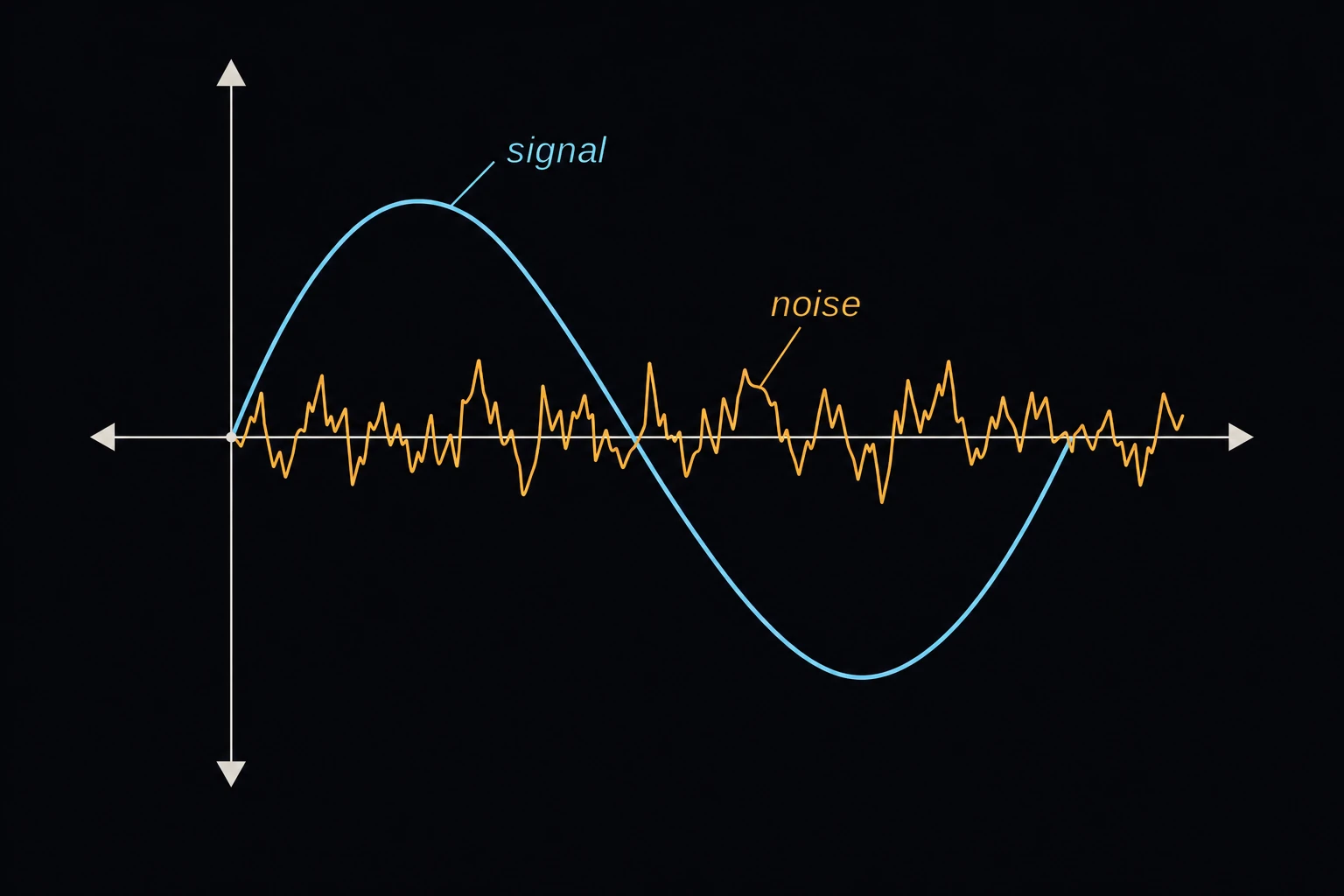
Psignal and Pnoise are the signal and noise powers. Vsignal and Vnoise are their RMS voltages, measured at the same point [1]. Power goes as the square of voltage, so the voltage form takes 20·log. Each pair can be entered in any units the pickers offer, and the two need not match: the page converts them before it takes the ratio.
A positive SNR means the signal is stronger than the noise. Every 10 dB is a tenfold power ratio, and every 20 dB a tenfold voltage ratio.
Limits and common mistakes
- Use RMS values for both voltages. A peak or peak-to-peak noise reading, as an oscilloscope often shows, overstates the noise by a factor of about 3 to 6 and makes the SNR look worse than it is.
- Measure the noise over the same bandwidth the signal uses. Noise power grows with bandwidth, so a wideband noise reading against a filtered signal gives a misleading SNR.
- The voltage form assumes the signal and the noise share one impedance, which is true when both are measured at the same node.
- The page gives one ratio. It doesn’t add noise from several stages; for that, use a noise-figure cascade.
Worked example
A strain-gauge amplifier puts out a 2.5 V RMS signal at full load. With the load removed, a true-RMS meter on the same output, over the same bandwidth, reads 1.2 mV of noise. Find the channel’s SNR.
- Choose Input Type Signal & noise RMS voltage.
- Enter Signal RMS voltage (Vsignal) 2.5 V.
- Enter Noise RMS voltage (Vnoise) 1.2 mV.
- Press Solve. The Solution shows: SNR: 66.3752 dB
Check: 2.5 V ÷ 0.0012 V = 2083, and 20 × log10(2083) = 66.4 dB. An ideal 12-bit converter reaches about 74 dB, so this channel’s noise, not the converter, sets the resolution, at roughly 10 to 11 bits.