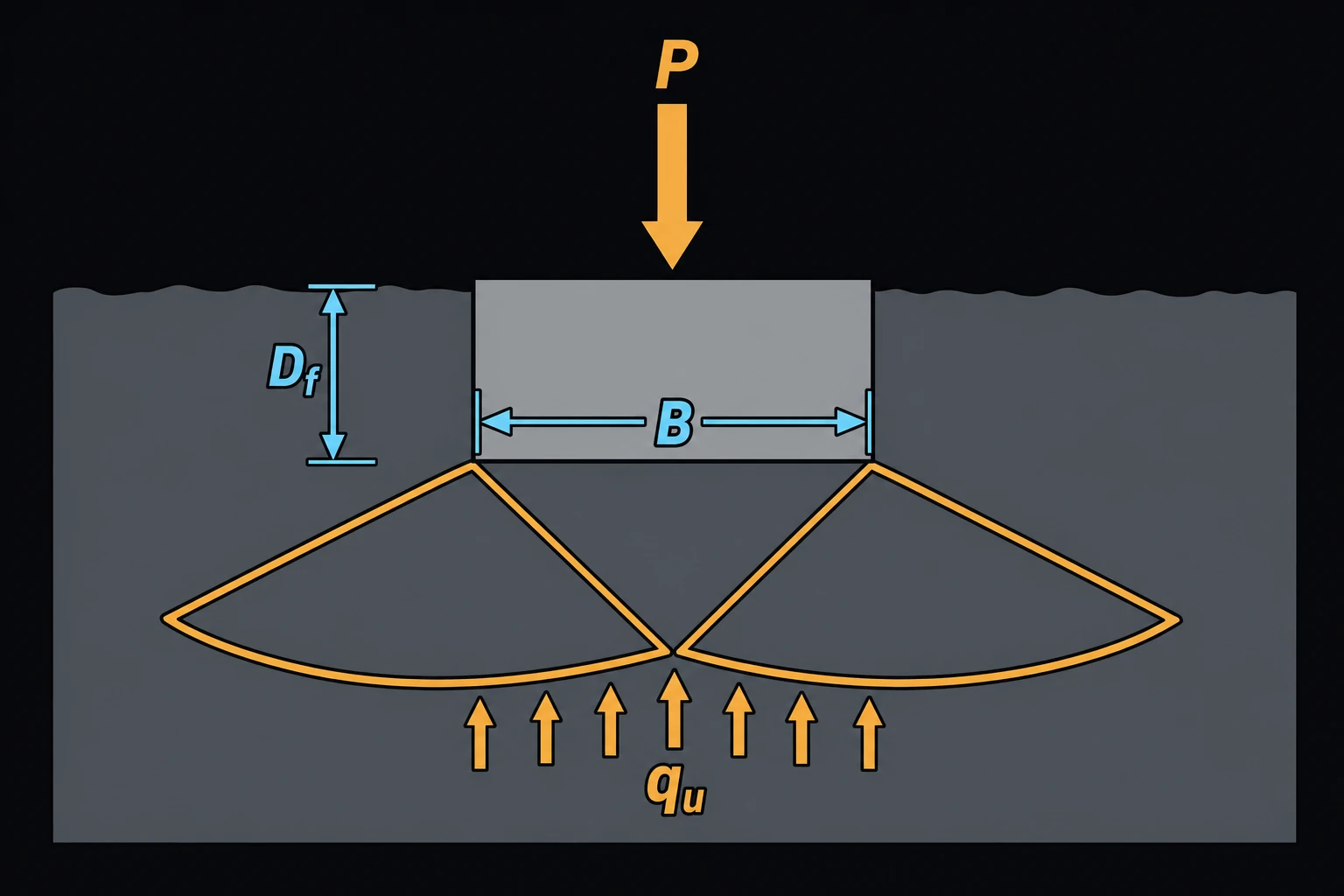
Soil Bearing Capacity (Terzaghi / Vesić)
Finds the ultimate and allowable bearing pressure under a shallow rectangular, square or strip footing on uniform soil. It uses Terzaghi’s general bearing capacity equation [1] with Vesić’s bearing capacity factors [2] and De Beer’s shape factors [3]. Engineers use it for a preliminary footing size before a geotechnical report gives the design value.
The bearing capacity equation
qult = c·Nc·sc + q·Nq·sq + 0.5·γ·B·Nγ·sγ, with q = γ·Df
Nq = eπ·tanφ·tan²(45° + φ/2)
Nc = (Nq − 1)/tanφ (5.14 at φ = 0)
Nγ = 2(Nq + 1)·tanφ
sc = 1 + (B/L)(Nq/Nc), sq = 1 + (B/L)·tanφ, sγ = 1 − 0.4(B/L)
c is the soil cohesion, φ the friction angle, γ the soil unit weight, B the footing width (the shorter side), L its length and Df the depth from the ground surface to the footing base. q is the overburden pressure at the base. The page takes the shorter side as B whichever way you enter them. For a strip footing, enter a long L. The net ultimate pressure is qult − q, the pressure beyond the weight of soil removed. Each is divided by the factor of safety, usually 3, for the allowable values.
The soil list fills c = 0 and typical φ and γ values of compacted granular fill by USCS group [4], [5]. Clays and silts are not listed: their bearing capacity depends on undrained strength, which has to come from tests. For a clay, enter its undrained strength as c with φ = 0.
Limits and common mistakes
- The page assumes a vertical, centered load and a dry, uniform soil. It has no depth, load-inclination or groundwater factors. If the water table is within about B below the base, use the buoyant unit weight.
- Bearing capacity is only half the check: settlement often limits the allowable pressure on sand, especially for wide footings.
- Use drained (c′, φ′) or undrained (su, φ = 0) parameters, not a mix.
- Small changes in φ change the result a lot: Nγ nearly doubles for every 4°.
Worked example
A column footing 2.0 m square will sit 1.2 m below grade. The soil report gives c′ = 0, φ′ = 32° and γ = 18.5 kN/m³. Find the allowable bearing pressure with a factor of safety of 3.
- Keep Soil Custom and enter Cohesion 0 kPa, Soil Unit Weight 18.5 kN/m³ and Friction Angle 32°.
- Enter Footing Width (B) 2 m, Footing Length (L) 2 m and Embedment Depth (Df) 1.2 m.
- Keep Factor of Safety 3.
- Press Solve. The Solution shows:
Nc: 35.4903
Nq: 23.1768
Nγ: 30.2147
Surcharge q = γ·Df: 22.2 kPa
Ultimate bearing capacity q_ult: 1,171.42 kPa
Net ultimate q_net: 1,149.22 kPa
Allowable bearing pressure q_all = q_ult / FS: 390.473 kPa
Net allowable q_net / FS: 383.073 kPa
Check: the factors match Vesić’s published table for φ = 32° (35.49, 23.18, 30.22) [3]. With c = 0, qult = 22.2 × 23.177 × 1.625 + 0.5 × 18.5 × 2 × 30.215 × 0.6 = 836.0 + 335.4 = 1,171.4 kPa.