Solar Panel Sizing
Gives a first estimate of the solar array a system needs: the array’s rated power in watts, and how many panels of a chosen rating make it up. Use it to size panels for an off-grid cabin, a boat, a remote monitoring station or a backup system, before a detailed design with site data.
Equations
Parray = Eday / (H·η) N = ⌈Parray / Ppanel⌉
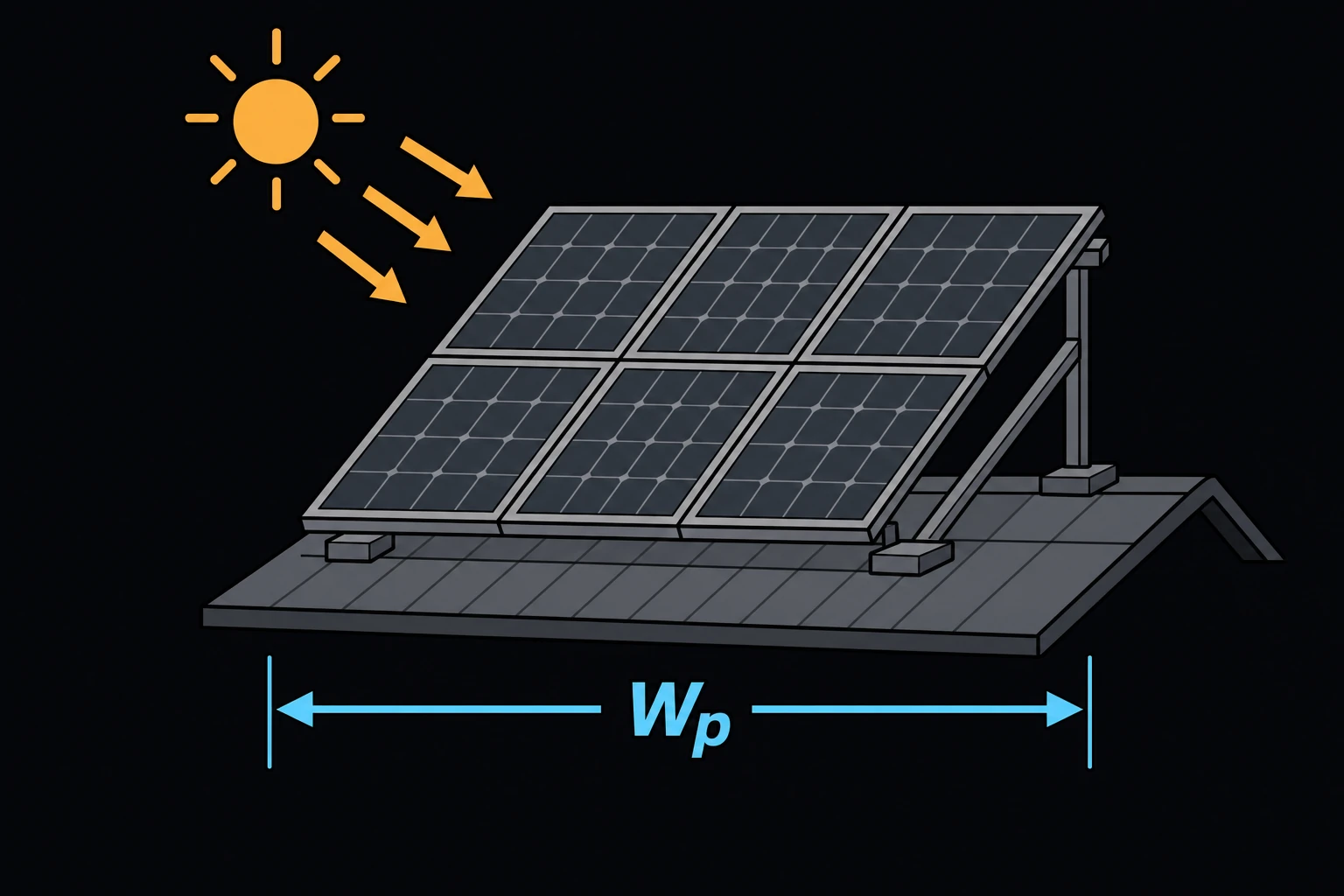
Eday is the energy the loads use per day, in watt-hours. Add up each load’s power times its hours of use. H is the peak sun hours: the day’s solar energy expressed as hours of full sun at 1000 W/m², in kWh/m² per day for the site and season [1]. η is the overall system efficiency, entered as a fraction from 0 to 1. It covers losses in the panels from heat and dirt, the wiring, the charge controller, the battery and any inverter. Parray is the total rated (nameplate) power the array needs. Ppanel is one panel’s rated power, and N is the panel count, rounded up to a whole panel.
Limits and common mistakes
- Use the peak sun hours for the worst month you need to cover, usually winter, not the yearly average. Winter values can be half the summer ones or less [1].
- Peak sun hours are not daylight hours. A summer day with 15 hours of daylight may have only 6 peak sun hours.
- An efficiency of 0.75–0.85 is typical for a whole battery-based system. Shading, poor tilt or hot climates lower it further.
- The page sizes for energy only. It does not size the battery for cloudy days, or check that the panels’ voltage suits the charge controller or inverter. The panel count may also need rounding up to fill whole strings.
Worked example
An off-grid cabin uses 4.2 kWh a day. The site gets 4.5 peak sun hours in its worst month, the system efficiency is taken as 0.75, and the panels on offer are rated 400 W.
- Enter Daily energy demand (Wh/day) 4200.
- Enter Peak sun hours (h/day) 4.5.
- Enter System efficiency (0–1) 0.75.
- Enter Panel wattage (per panel) 400 W and press Solve. The Solution shows:
Required array size: 1,244.44 W
Panels needed (at chosen wattage): 4
Check by hand: 4.5 × 0.75 = 3.375 useful hours, and 4200 / 3.375 = 1,244.4 W. That is 3.11 panels of 400 W, so 4 are needed. Working back, four panels give 1,600 × 3.375 = 5,400 Wh a day, a 29 % margin over the demand.