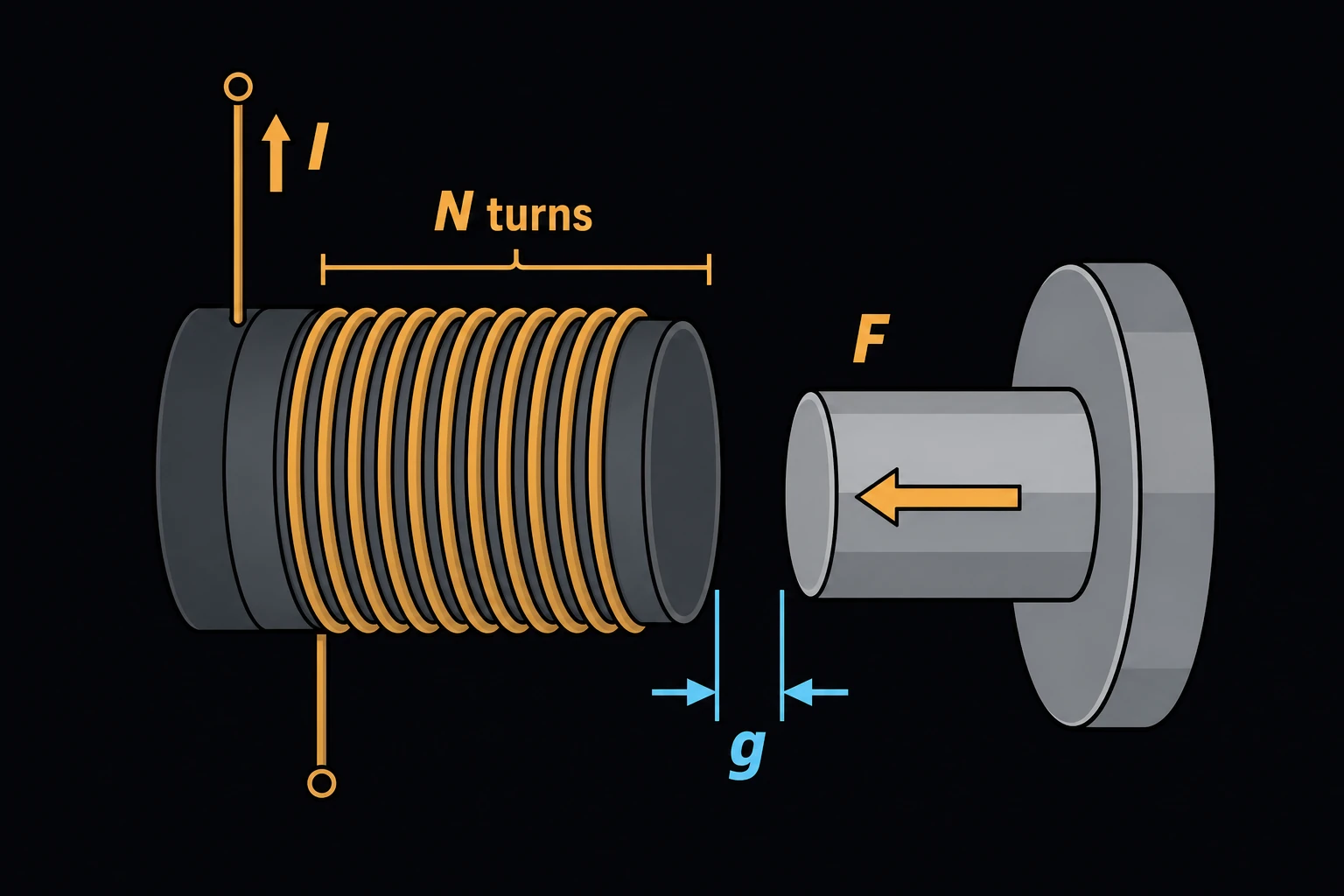
Solenoid Force
Estimates the pull of a solenoid or electromagnet on its iron plunger across an air gap. Enter the number of turns, the coil current, the area of the pole face and the gap. Designers use it to rough-size a coil for a latch, valve or actuator before building one or running a magnetic model.
Equation
F = (N·I)²·μ0·A / (2g²)
F is the attractive force on the plunger, N the number of turns, I the coil current and N·I the magnetomotive force in ampere-turns. A is the pole face area, where the flux crosses the gap, and g the length of the air gap. μ0 = 4π × 10−7 H/m is the permeability of free space.
The equation comes from the energy stored in the gap [1]. It assumes the iron is so permeable that all of the ampere-turns appear across one gap, so the flux density there is B = μ0·N·I/g. The force is then F = B²·A/(2μ0): the magnetic pressure B²/(2μ0) acting on the pole face.
Limits and common mistakes
- The force grows as 1/g², so it climbs steeply as the gap closes. In a real magnet the iron saturates near 1.5 to 2 T, and leakage and the reluctance of the iron take a share of the ampere-turns. Work out B = μ0·N·I/g; once it nears saturation, the result overstates the force.
- At large gaps, flux fringes around the pole face and the simple model is rough. It is best for gaps small compared with the width of the pole face.
- A magnetic circuit with two gaps in series, such as a plunger that passes through a sleeve, splits the ampere-turns between them. Enter g as their total length; the force acts at the working gap.
- The current is what flows once the coil is warm. Its resistance rises as it heats, so a coil on a fixed voltage pulls less when hot.
Worked example
A small door-latch solenoid has 800 turns and carries 0.5 A. Its plunger has a pole face of 3 cm² and starts 1.5 mm from the stop. What is its pull at the start of the stroke?
- Enter Turns (N) 800 and Current (I) 0.5 A.
- Enter Pole face area (A) 3 cm² and Air gap (g) 1.5 mm.
- Press Solve. The Solution shows: Attractive force (F): 13.4041 N
Check: N·I = 400 A-turns, so B = 4π × 10−7 × 400 / 0.0015 = 0.335 T, well below saturation. Then F = 0.335² × 0.0003 / (2 × 1.2566 × 10−6) = 13.4 N, about 1.4 kgf. Halving the gap to 0.75 mm would give four times the force.