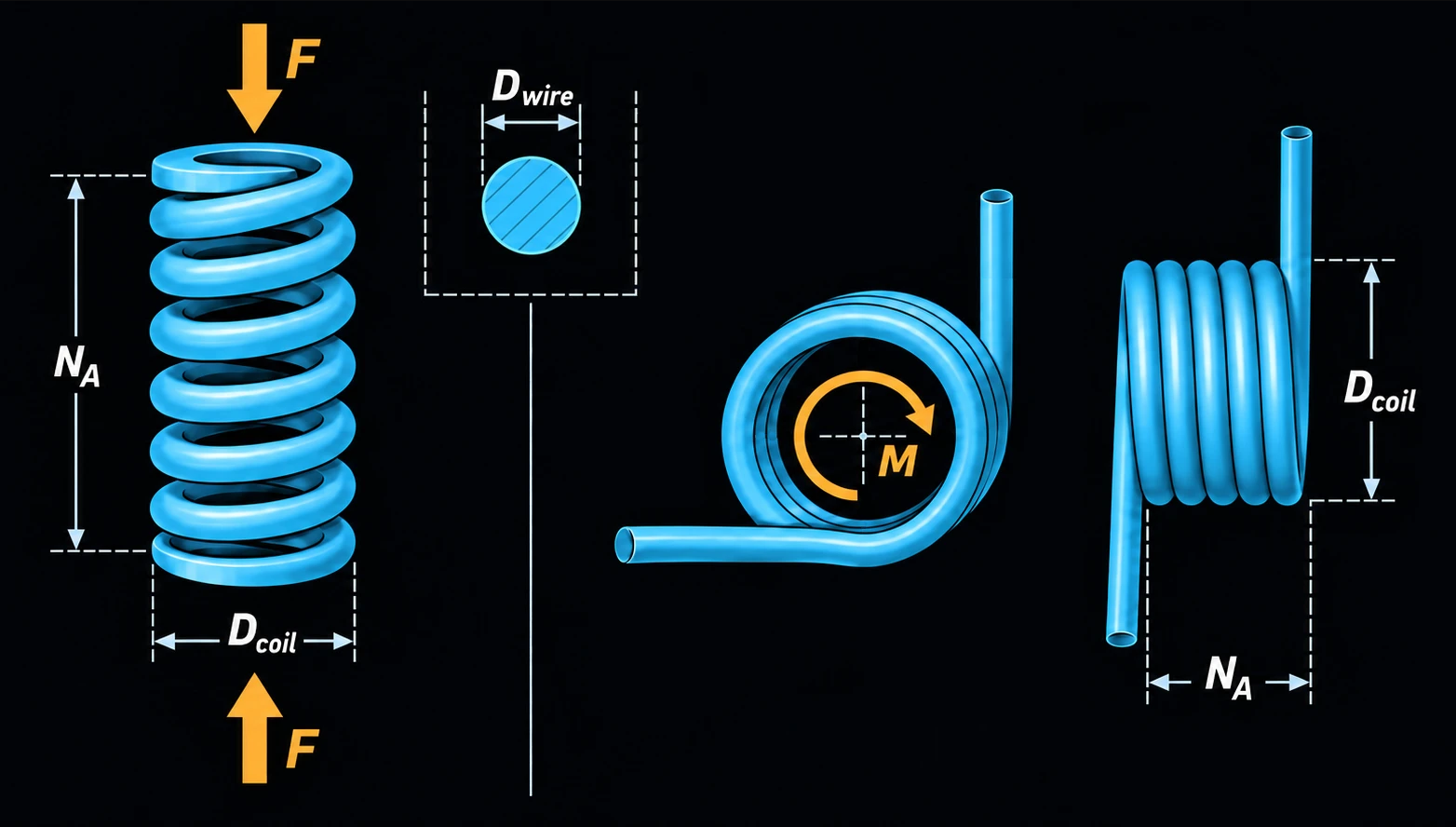
Spring Design
Finds the rate and the wire stress of a helical spring made of round wire: a compression or extension spring under an axial force, or a torsion spring under a moment. Pick a spring wire to fill in its modulus and to compare the stress with the wire’s strength. Designers use it to size a spring for a mechanism, a valve or a latch.
Compression and extension springs
k = G·d4/(8·D3·Na) τ = Kw·8·F·D/(π·d3) Kw = (4C − 1)/(4C − 4) + 0.615/C
d is the wire diameter, D = Dcoil − d the mean coil diameter (the page asks for the outer diameter), C = D/d the spring index, Na the number of active coils and G the shear modulus. k is the force per unit of deflection, τ the shear stress at the inside of the coil and Kw the Wahl factor, which adds the direct shear and the curvature of the wire [1].
Torsion springs
k′ = E·d4/(10.8·D·Na) σ = Kb·32·M/(π·d3) Kb = (4C² − C − 1)/(4C·(C − 1))
k′ is the moment per turn, E the elastic modulus, M the applied moment and Kb the bending correction for the inside of the coil [1]. The 10.8 includes an allowance for friction between the coils.
With a wire picked, the page also gives the minimum tensile strength Sut = A/dm (Table 10-4) and, for compression, the static shear limit Ssy as a share of Sut (Table 10-6) and the factor of safety Ssy/τ [1].
Limits and common mistakes
- Count only the active coils. A compression spring with squared and ground ends has about two fewer active coils than total coils.
- Keep C between about 4 and 12. Below that the spring is hard to coil, and above it the spring buckles and tangles.
- Music and hard-drawn wire have a row for each diameter range. Pick the row that holds your wire, or the page warns that E and G may be off.
- The check is static. An extension spring also needs its hooks checked, and a cycling spring needs a fatigue check.
Worked example
A return spring must push with 100 N at its working length. Try 2.5 mm music wire wound to a 22 mm outside diameter with 8 active coils.
- Choose Spring Type Compression / Extension.
- Enter Wire Diameter 2.5 mm, Coil Outer Diameter 22 mm and Active Coils 8.
- Choose Wire Material Music wire (A228), d 0.064–0.125 in (1.63–3.18 mm). The shear modulus fills in as 81 GPa.
- Enter Applied Force 100 N and press Solve. The Solution shows:
Spring Rate (k): 6.66747 N/mm
Shear Stress (τ): 377.909 MPa
Spring Index (C = Dmean/Dwire): 7.8
Mean Coil Diameter (Dmean): 19.5 mm
Wahl Factor (Kw): 1.18914
Minimum Tensile Strength (Sut = A/dm, Table 10-4): 1,935.92 MPa
Static Shear Limit (Ssy = 0.45·Sut, Table 10-6): 871.164 MPa
Factor of Safety (Ssy/τ): 2.30522
Check: 81,000 × 2.54/(8 × 19.53 × 8) = 6.67 N/mm, so the spring deflects 100/6.667 = 15.0 mm to reach 100 N. Leave that much plus some clearance between the coils at the working length.