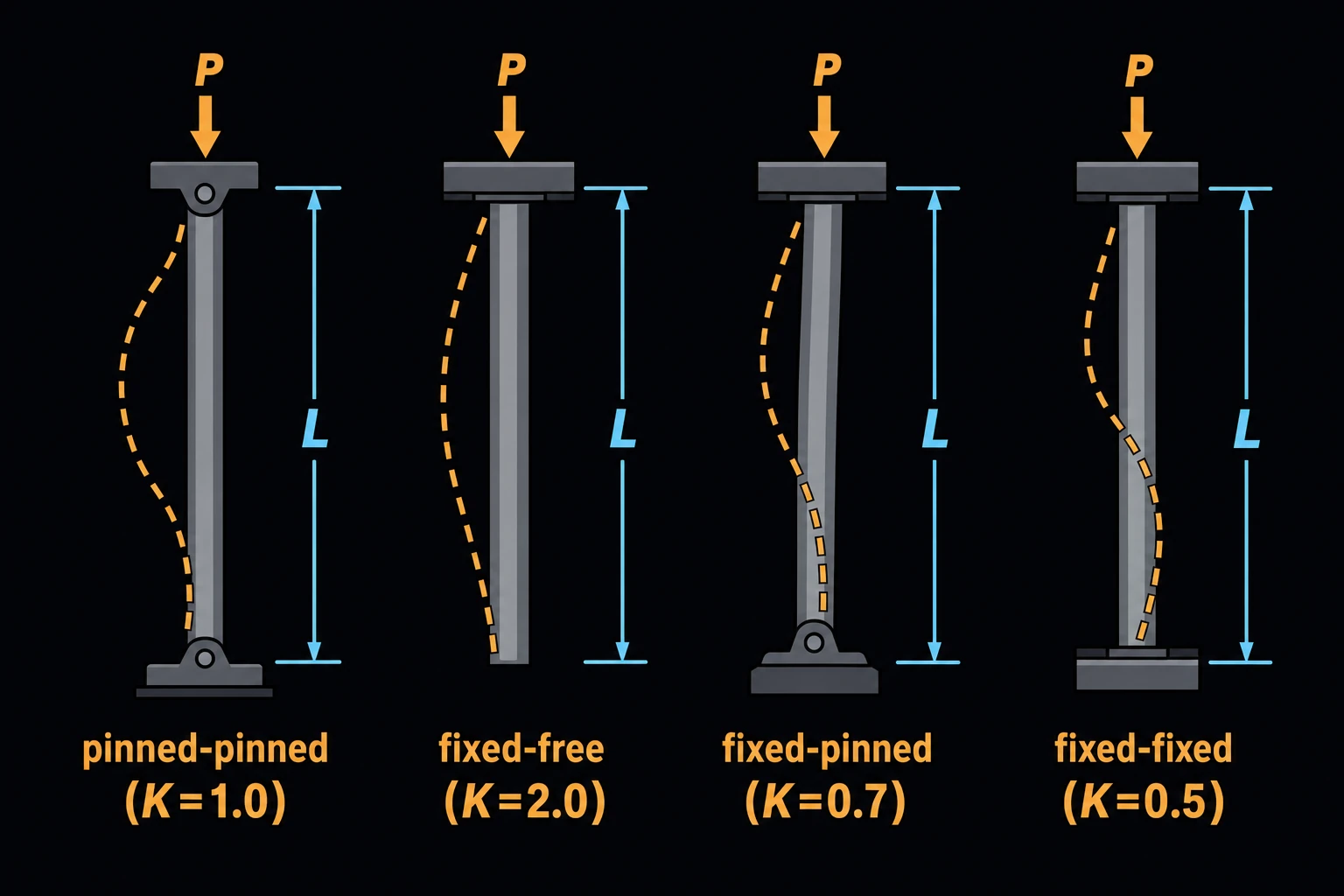
Steel Column Compression Capacity (AISC)
Finds the axial compression strength of a steel column limited by flexural buckling, by AISC 360-16 Section E3 [1]. It gives the slenderness, the buckling stresses and the LRFD and ASD strengths. Pick a W, M, S or HP shape, a rectangular HSS, a round HSS or a pipe, and the page fills its area and least radius of gyration from the AISC Shapes Database [3] and checks its walls for local buckling. Designers use it to size columns.
The column equations
Fe = π²E / (KL/r)²
Fcr = 0.658Fy/Fe·Fy when KL/r ≤ 4.71√(E/Fy)
Fcr = 0.877Fe when KL/r > 4.71√(E/Fy)
Pn = Fcr·Ag, LRFD φcPn with φc = 0.90, ASD Pn/Ωc with Ωc = 1.67
K is the effective length factor, L the unbraced length, r the radius of gyration, E the modulus of elasticity (200,000 MPa for steel), Fy the yield strength [4], Fe the elastic buckling stress, Fcr the critical stress and Ag the gross area. The first Fcr equation covers inelastic buckling of stocky columns and the second elastic buckling of slender ones; they meet at the limit.
The end-condition list fills K with AISC’s recommended design values [1]. They are a little larger than the theoretical values in the diagram, because real end restraints are never perfect. A listed shape fills its least r, about the weak axis, which governs when the column is braced equally about both axes. The page also checks the shape’s flanges, web or walls against the slender-element limits of AISC Table B4.1a: 0.56√(E/Fy) for I-shape flanges, 1.49√(E/Fy) for their webs, 1.40√(E/Fy) for HSS walls and 0.11E/Fy for round walls.
Limits and common mistakes
- If the weak axis is braced at mid-height, check the strong axis too: enter its r (shown as rx) and full length as a custom section.
- A slender-element warning means local buckling (AISC E7) lowers the strength below the values shown.
- Channels, angles and tees are not offered. They can also buckle by twisting (E4, E5), which this page does not check.
- Pick the grade the shape is made in: A992 for W-shapes, A500 for HSS, A53 for pipe.
- The page checks axial load alone. A column that also bends needs the interaction check of AISC Chapter H.
Worked example
A pinned-end building column is 4.5 m tall and braced only at its ends. Find the strength of a W12×65 in A992 steel.
- Choose Section Type W-Shape and Section W12×65 — A = 19.1 in², ry = 3.02 in.
- Keep End Conditions Pinned–pinned — K = 1.
- Enter Unbraced Length (L) 4.5 m.
- Keep Steel Grade ASTM A992 (wide-flange shapes) — Fy = 345 MPa and Modulus of Elasticity (E) 200000 MPa.
- Press Solve. The Solution shows:
Slenderness KL/r: 58.664
Elastic buckling stress Fe: 573.569 MPa
Critical stress Fcr: 268.215 MPa
Buckling mode: Inelastic buckling (KL/r ≤ 4.71Buckling mode: Inelastic buckling
radic;(E/Fy))
Nominal strength Pn: 3,305.09 kN
LRFD φcPn: 2,974.58 kN
ASD Pn/Ωc: 1,979.1 kN
Flange slenderness bf/2tf: 9.91736 (limit 13.4832)
Web slenderness h/tw: 24.9 (limit 35.875)
Check: r = 3.02 × 25.4 = 76.708 mm, so KL/r = 4500 / 76.708 = 58.66, below 4.71√(200000/345) = 113.4. Fcr = 0.658345/573.57 × 345 = 268.2 MPa, and 268.2 × 12,322.6 mm² = 3,305 kN.