Stopping Sight Distance (AASHTO)
Finds how far a driver travels from seeing an object in the road to stopping, by the AASHTO Green Book method [1]. Road designers use it to check that crest curves, horizontal curves and intersections leave enough clear sight ahead, and to set the length of vertical curves.
How the distance is calculated
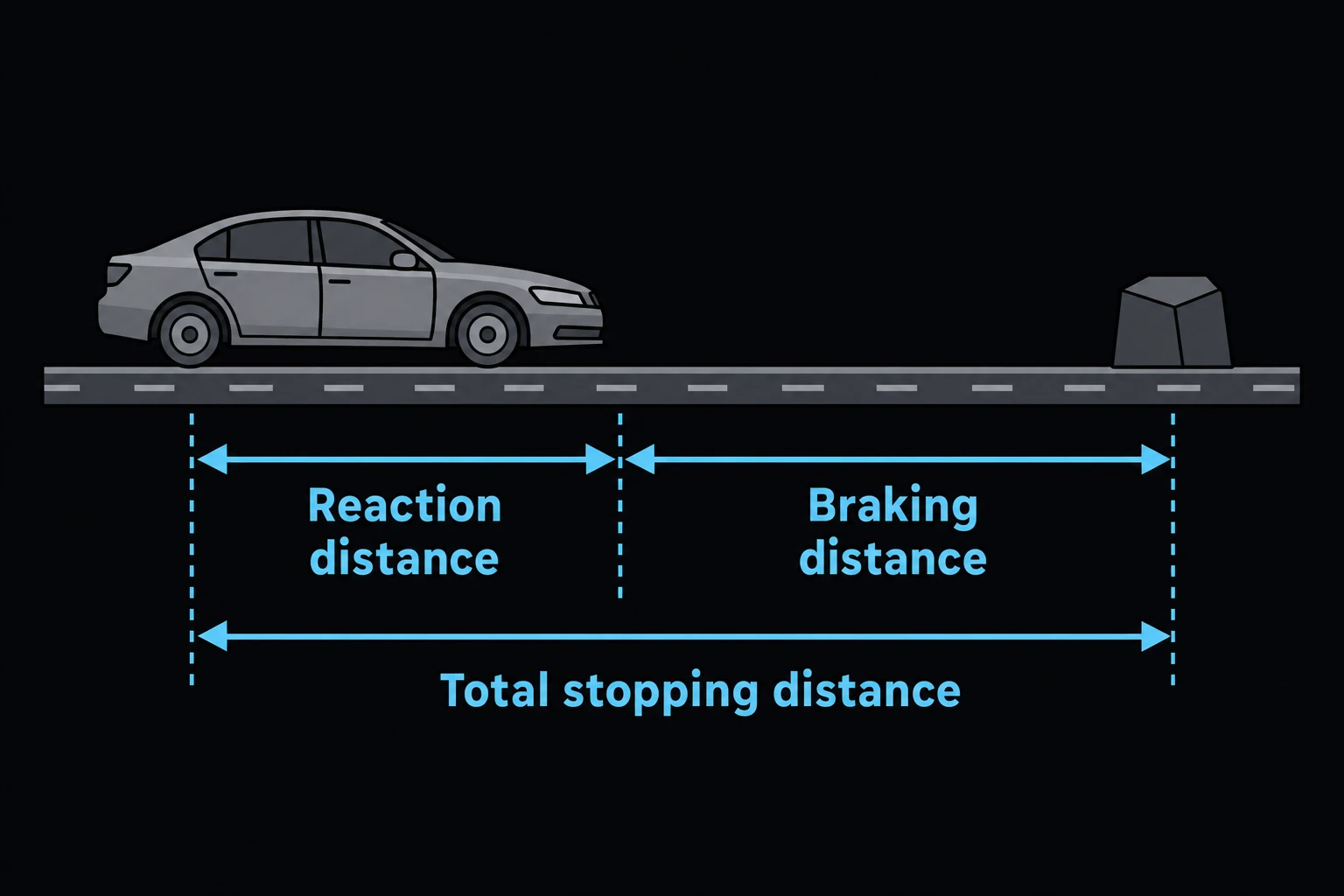
Stopping sight distance is the distance covered during the driver’s reaction plus the braking distance:
SSD = 0.278·V·t + V2 / [254·(a/9.81 + G)]
where V is the design speed in km/h, t the brake reaction time in seconds, a the deceleration in m/s² and G the grade as a decimal (+ uphill, − downhill; the page takes percent). 0.278 converts km/h to m/s, and 254 is 2 × 9.81 × 3.62. AASHTO’s design values are t = 2.5 s, which covers about 90 % of drivers, and a = 3.4 m/s², a rate most drivers reach on wet pavement and keep the car in its lane. A downgrade lengthens the braking distance and an upgrade shortens it.
Limits and common mistakes
- Enter a downgrade as negative. A positive value on a downhill road gives too short a distance.
- On a two-way road, check the downgrade direction; it governs.
- On a level road the page gives about 1 % less braking distance than AASHTO’s level-road form 0.039·V2/a, which rounds the exact constant 0.0386 up to 0.039. AASHTO rounds its design values up to the next 5 m.
- The method assumes a passenger car. Trucks need longer distances but their drivers sit higher and see farther.
- A downgrade steeper than a/9.81 (about 35 % at 3.4 m/s²) means the car cannot stop, and the page returns an error.
Worked example
A rural highway drops at 4 % toward a stop-controlled intersection. The design speed is 90 km/h. How much clear sight distance must the approach give?
- Enter Design Speed 90.
- Keep Brake Reaction Time 2.5 and Deceleration Rate 3.4.
- Enter Grade −4.
- Press Solve. The Solution shows:
Brake reaction distance: 62.55 m
Braking distance: 104.016 m
Stopping sight distance (SSD): 166.566 m
Check by hand. 0.278 × 90 × 2.5 = 62.55 m. The braking term is 8100 / [254 × (0.3466 − 0.04)] = 8100 / 77.87 = 104.0 m. On level ground the same car brakes in 92.0 m, so the slope adds 12 m. Design for at least 170 m, compared with 160 m in AASHTO’s level-road table [1].