Stress & Strain
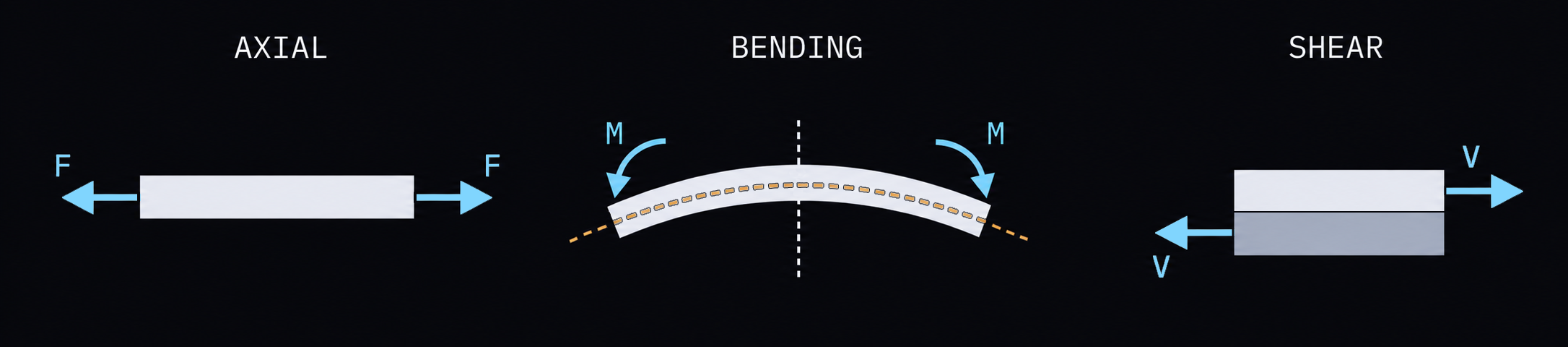
Finds the basic stress in a member from the load and its section: the axial stress, strain and stretch of a bar in tension or compression, the bending stress at the outer fiber of a beam, or the average shear stress on a pin, bolt or key. Students and designers use it for quick first checks before a detailed design.
Equations
σ = F/A ε = σ/E δ = ε·L = F·L/(A·E)
F is the axial force (positive in tension), A the cross-sectional area, E the elastic modulus, L the original length, ε the strain (change in length per unit length) and δ the elongation [1]. Pick a material to fill in E, or type your own.
σ = M·c/I τ = V/A
For bending, M is the bending moment at the section, c the distance from the neutral axis to the outer fiber and I the moment of inertia about the neutral axis [1]. For direct shear, V is the shear force and A the area that shears. The links next to A, c and I open the Section Properties calculator.
Limits and common mistakes
- All three are linear-elastic results. Above the yield strength, ε = σ/E no longer holds.
- A compression member can buckle long before it is overstressed. Check a slender strut with the Euler Column Buckling calculator.
- σ = F/A holds away from holes, notches and load points. Near them the local stress is higher.
- M·c/I gives the peak bending stress, at the outer fiber. For an unsymmetric section, use the c of the fiber you want: the two faces have different values.
- V/A is an average. In a beam the peak shear is higher: 1.5 times the average for a rectangle.
- A bolt or pin in double shear has two shear areas. Enter both.
Worked example
A 12 mm round aluminum hanger, 2 m long, carries a sign that weighs 8 kN. Find the stress in the rod and how far the sign drops when it is hung.
- Choose Loading Type Axial.
- Enter Axial Force (F) 8000 N and Cross-Sectional Area (A) 113.097 mm² (π × 12²/4).
- Enter Original Length (L) 2000 mm.
- Choose Material (E) Aluminum (wrought). The modulus fills in as 71.7 GPa. Press Solve. The Solution shows:
Axial Stress (σ): 70.7357 MPa
Axial Strain (ε): 9.86551e-4 mm/mm
Elongation (δ): 1.9731 mm
Check by hand. 8000 N / 113.1 mm² is 70.7 MPa. Dividing by 71,700 MPa gives a strain of about 0.001, so the 2 m rod stretches about 2 mm. The stress is well below the yield strength of common structural aluminum alloys, so the elastic result holds.