Superelevation & Minimum Curve Radius (AASHTO)
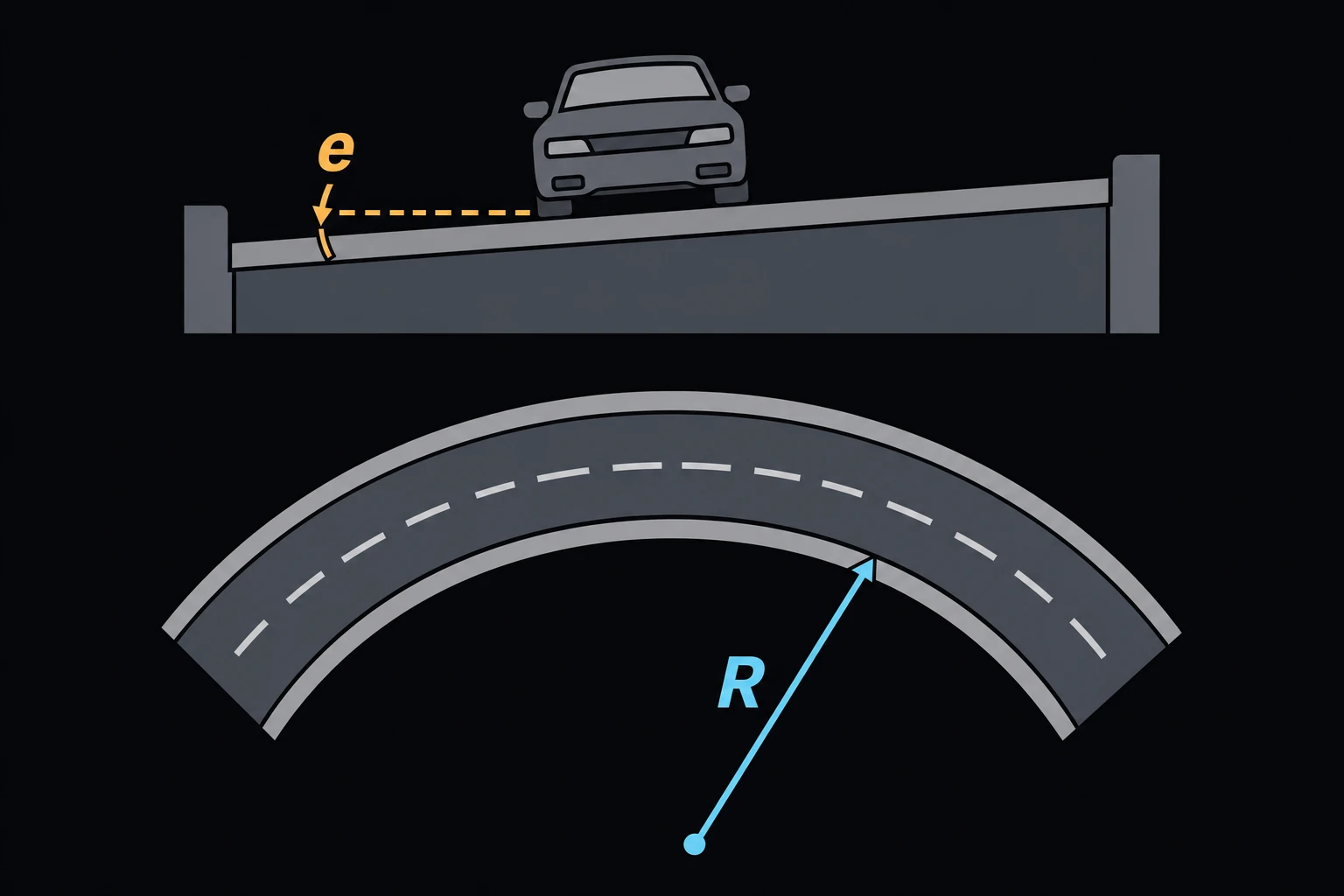
Finds the sharpest horizontal curve a road can have at a given design speed, or the bank (superelevation) a curve of known radius needs. It uses the point-mass curve formula of the AASHTO Green Book [1]. Highway designers use it to lay out alignments and to check existing curves.
How it is calculated
A car on a curve needs a sideways force to turn. The tilt of the pavement and the tire friction share that force:
Rmin = V2 / [127·(emax + f)]
e = V2 / (127·R) − f
where V is the design speed in km/h, R the radius in meters, e the superelevation (cross slope, m per m; the page takes and shows percent) and f the side friction factor. 127 is g × 3.62 = 9.81 × 12.96. V2/(127R) is the lateral demand: the total that e and f must supply together. Picking a Design Speed fills V and the maximum f from AASHTO Table 3-7. Those f values fall with speed, from 0.40 at 15 km/h to 0.09 at 120 km/h, and are set for driver comfort, well below the friction at which a car skids. Maximum Superelevation Rate offers the 4 to 12 % rates the table covers. Agencies pick emax by climate and setting: about 4–6 % in towns, 8 % on most rural roads, and lower where ice is common.
Limits and common mistakes
- Enter emax in percent and f as a decimal (0.12, not 12).
- The superelevation result assumes the full friction f is used. AASHTO spreads e and f over the curve, so a flatter curve gets more bank than this minimum; take design values from its tables of e versus R.
- A negative e means friction alone holds the car. Use the normal crown or the minimum cross slope instead.
- The formula ignores the length needed to run the bank in and out (superelevation runoff), and sight distance across the inside of the curve.
Worked example
A new rural highway is designed for 100 km/h with emax = 8 %. What is the tightest curve allowed, and how much bank would a 450 m curve need at most?
- Choose Solve For Minimum radius, Design Speed 100 km/h (f = 0.12) and Maximum Superelevation Rate 8 %.
- Press Solve. The Solution shows:
Minimum radius R_min: 393.701 m
e_max + f used: 0.2 - Choose Solve For Superelevation rate, enter Curve Radius 450 m and press Solve:
Required superelevation rate e: 5.49781 %
Within e_max? Yes
Lateral demand V²/(127R): 0.174978
Check by hand. 1002 / (127 × 0.20) = 393.7 m, which AASHTO’s Table 3-7 rounds to 394 m for these values [1]. For 450 m, 10,000 / 57,150 = 0.175, less 0.12 friction leaves 5.5 % of bank. That is within the 8 % limit. With AASHTO’s distribution, the design bank for this curve would be higher than 5.5 %, but still under 8 %.