System Reliability (Series / Parallel / k-of-n)
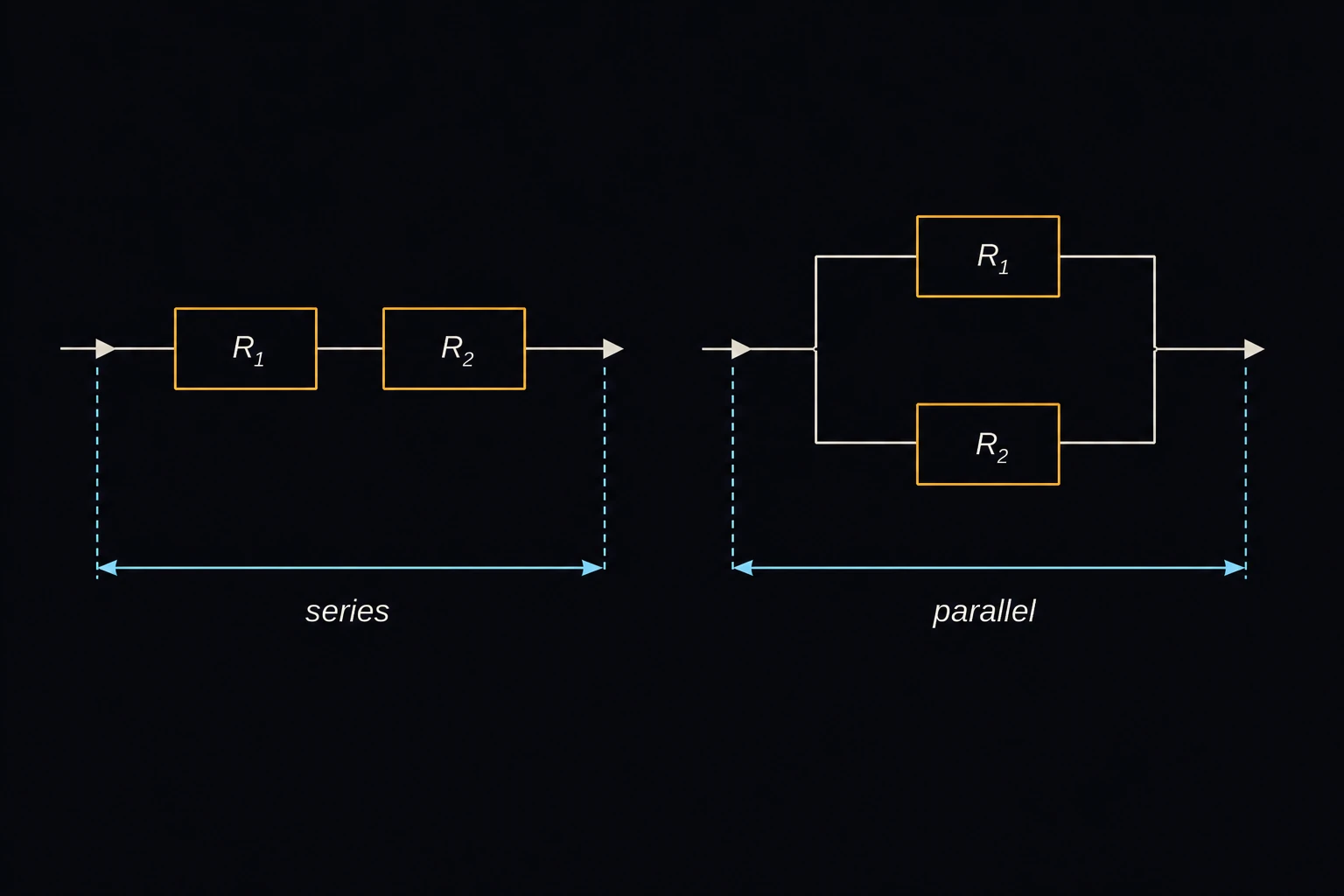
Finds the reliability of a system built from components whose own reliabilities you know: up to six in series, up to six in active parallel, or n identical units of which k must work. It also gives the system unreliability and, for series and parallel, the reliability of the weakest or strongest component. Reliability and design engineers use it to compare redundancy schemes in a reliability block diagram [1]–[3].
Equations
Series: Rs = R1·R2·…·Rn
Parallel: Rs = 1 − (1 − R1)(1 − R2)…(1 − Rn)
k-of-n: Rs = Σi=k…n C(n,i)·Ri(1 − R)n−i
Ri is the reliability of component i: the probability, from 0 to 1, that it works for the whole mission. Rs is the system reliability, and the unreliability is 1 − Rs, worked out directly so a tiny value keeps its digits. A series system fails when any component fails. An active parallel system works while any one component works. A k-of-n system works while at least k of its n identical units, each of reliability R, work. C(n,i) is the number of ways to choose i units from n [1], [2].
Limits and common mistakes
- Every R must be for the same mission time. Convert failure rates first, for example with R = e−t/MTBF from the MTBF, Failure Rate & Availability calculator.
- The equations assume failures are independent. A shared power supply, common software or the same maintenance error can fail all the redundant units at once, so real redundancy gains are smaller [3].
- Parallel here means active (hot) redundancy, with all units running. Standby units with a switch need a different model.
- For a mixed diagram, reduce each series or parallel group to one reliability and combine the groups in a second run.
Worked example
A cooling skid has four identical pumps, and it needs three of them running to carry the load. Each pump has a 0.95 chance of running through a one-year campaign without failure. What is the chance the skid makes it through the year?
- Choose Configuration k-out-of-n (identical units).
- Enter n (total units) 4 and k (units required) 3.
- Enter Reliability of each unit (R) 0.95.
- Press Solve. The Solution shows:
System reliability (3-of-4): 0.985981
System unreliability: 0.0140188
Check: all four run with probability 0.954 = 0.814506, and exactly three run with 4 × 0.953 × 0.05 = 0.171475. Their sum is 0.985981. Three pumps with no spare, in series, would give only 0.953 = 0.857.