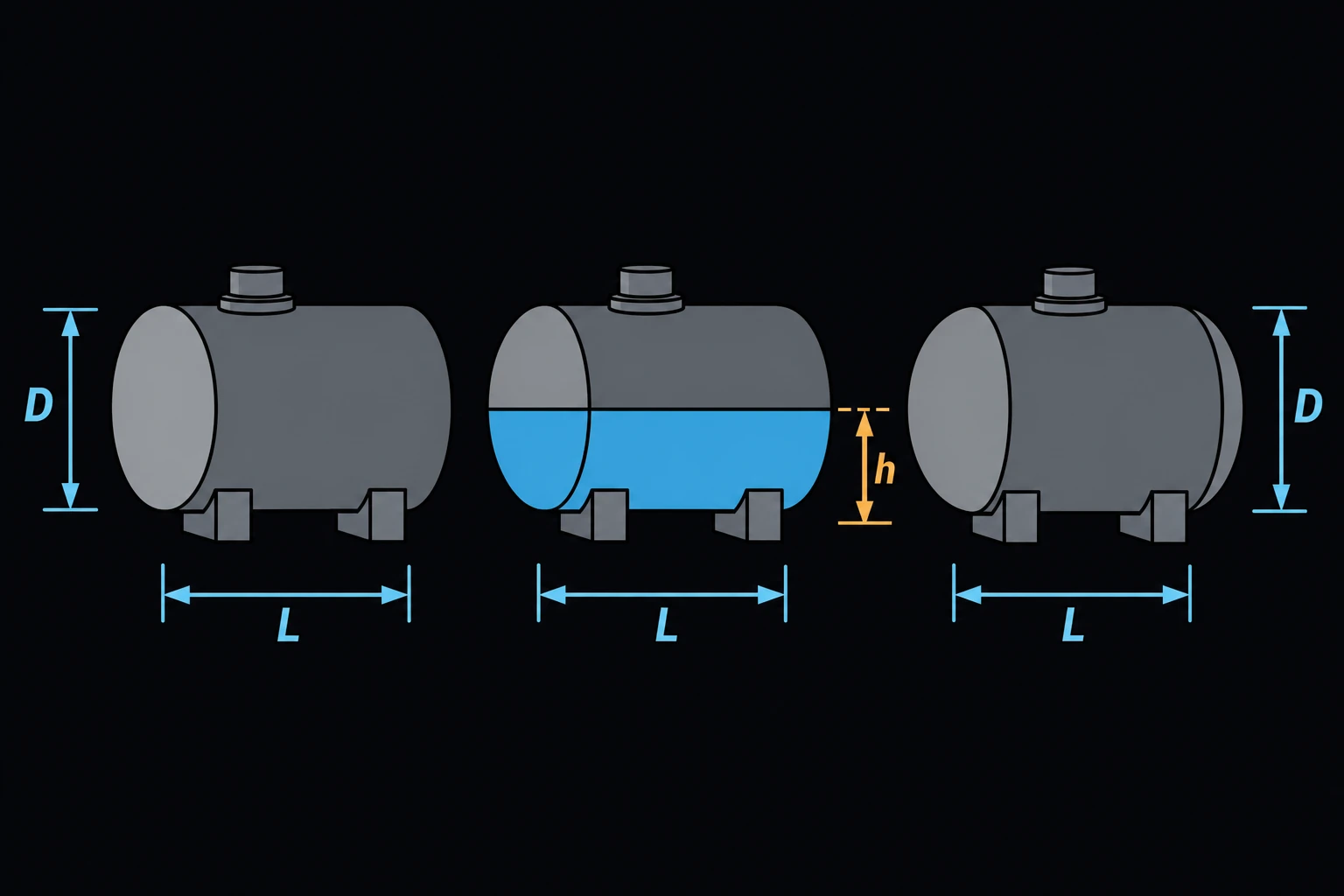
Tank Volume & Partial Fill
Finds the full volume of a vertical or horizontal cylindrical tank with flat, 2:1 elliptical or hemispherical heads, and the volume of liquid at a measured level. It also gives the percent full and the empty space left (ullage). Operators use it to turn a dip reading into an inventory; engineers use it to size tanks and set level alarms.
Equations
Vcyl = π·D²·L/4
Vheads = π·D³/12 (2:1 elliptical) Vheads = π·D³/6 (hemispherical)
D is the inside diameter and L the length of the straight shell between the head tangent lines. Vheads is the volume of both heads together [1], [2]. A 2:1 elliptical head is D/4 deep and a hemispherical head D/2.
In a horizontal tank, the liquid in the shell fills a circular segment of depth h:
A = R²·acos((R − h)/R) − (R − h)·√(2R·h − h²)
V = A·L + Vheads·(3u² − 2u³), u = h/D
R = D/2. The head term is exact for both curved heads, because a 2:1 elliptical head is a hemisphere squashed along the tank axis [1]. In a vertical tank the level rises first through the bottom head, then the shell, then the top head, and each head fills like a spherical cap.
Inputs
- For a horizontal tank, Liquid Level is the liquid depth, from 0 to D.
- For a vertical tank, it is measured from the bottom of the lower head, up to the overall height L plus both head depths.
Limits and common mistakes
- Use the inside diameter. With the outside diameter, a 3 m tank with 12 mm walls reads about 1.6 % high.
- L is tangent to tangent, not the overall length, which includes the heads.
- Torispherical (ASME flanged and dished) heads hold less than 2:1 elliptical heads of the same diameter. Using the elliptical choice for them overstates the head volume.
- The volume is geometric. It ignores nozzles, internals, a sloped floor and a tank that is not level.
Worked example
A horizontal diesel tank is 3 m in inside diameter and 10 m tangent to tangent, with 2:1 elliptical heads. A dip stick reads 1.2 m of fuel. How much is in it, and how much room is left for a delivery?
- Choose Orientation Horizontal cylinder and Head Type 2:1 elliptical.
- Enter Cylinder Diameter 3 m and Cylinder (tangent-to-tangent) Length / Height 10 m.
- Enter Liquid Level 1.2 m and press Solve. The Solution shows:
Cylindrical-section volume: 70.6858 m³
Both heads volume: 7.06858 m³
Total tank volume: 77.7544 m³
Total tank volume: 20,540.5 US gal
Maximum liquid depth (= D): 3 m
Liquid volume at this level: 28.8914 m³
Percent full: 37.1573 %
Ullage (empty volume): 48.863 m³
Check by hand: the segment angle is 2·acos(0.3/1.5) = 2.7389 rad, so A = 1.5²/2 × (2.7389 − sin 2.7389) = 2.6403 m² and the shell holds 26.403 m³. The heads, a sphere cap of depth 1.2 m halved along the axis, add π × 1.2² × (4.5 − 1.2)/3/2 = 2.488 m³. Together: 28.89 m³. That is 0.4 D deep but only 37 % full, as expected: a round tank holds less than its depth fraction below the middle.