Tap Drill Size
Finds the drill diameter to use before tapping a thread, for the percentage of full thread depth you want. Pick a metric coarse or fine thread, or a UNC or UNF inch thread, from the list [2], or type any major diameter and pitch. Machinists and designers use it when a tap drill chart doesn’t list the thread, or when a hard or tough material calls for a shallower thread than the chart’s 75 %.
Equation
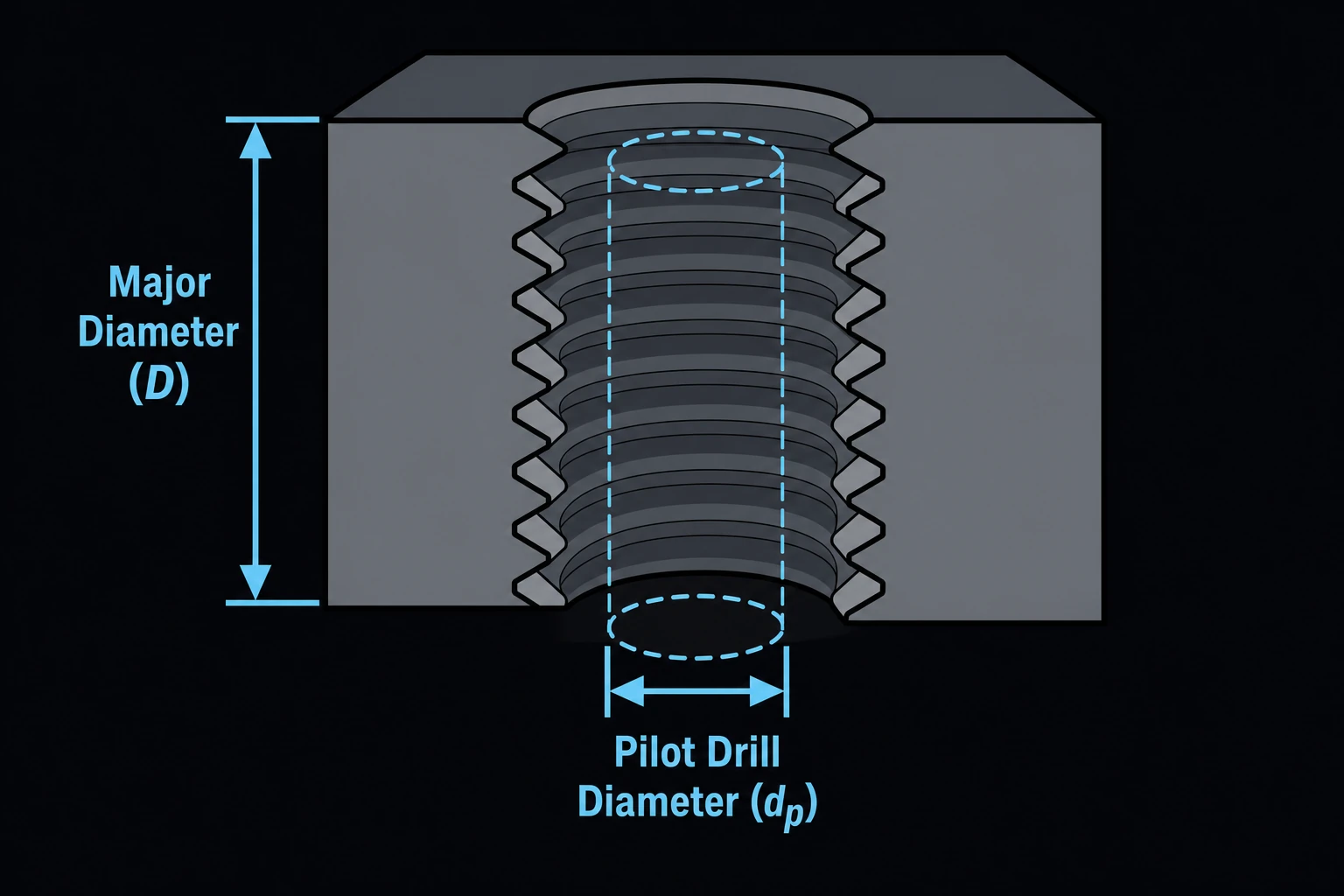
d = D − 1.299038·P·(%/100) P = 25.4/n
d is the tap drill diameter, D the thread’s major diameter and P its pitch, in mm. For an inch thread with n threads per inch the page converts the pitch with the second equation, and D with 25.4 mm per inch. % is the percent thread engagement [1]. At 100 % the drill leaves a thread depth on each side of 0.6495·P, three-quarters of the height of the sharp 60° thread triangle; that is where the factor 1.299038 (twice 0.6495) comes from.
Limits and common mistakes
- 75 % thread is the usual choice. A deeper thread adds little strength but needs much more tapping torque and breaks more taps. Use 60–65 % in stainless steel, tough alloys and deep holes.
- The equation is for 60° threads (ISO metric and Unified). It doesn’t apply to tapered pipe threads, or to thread-forming taps, which need a larger hole.
- The result is a diameter, not a drill. Pick the nearest standard drill, and check that the hole stays within the internal thread’s minor diameter limits. Drills also cut slightly oversize.
Worked example
A 1/4-20 UNC hole is to be tapped in an aluminum bracket. Which drill gives a 75 % thread?
- Choose Thread Spec Type Inch (threads per inch).
- Choose Thread Size 1/4"-20 UNC. The major diameter and threads per inch fill in.
- Leave Percent Thread Engagement at 75 and press Solve. The Solution shows:
Tap Drill Diameter: 5.11267 mm
Thread Pitch Used: 1.27 mm
That is 5.11267 / 25.4 = 0.2013 in. The nearest standard drill is a #7 (0.201 in), the usual tap drill for 1/4-20 in the handbook charts [1]. Check by hand: 6.35 − 1.299 × 1.27 × 0.75 = 6.35 − 1.237 = 5.113 mm. For metric threads the shop rule d ≈ D − P gives nearly the same answer: M8 × 1.25 at 75 % gives 6.78 mm, and the usual drill is 6.8 mm.