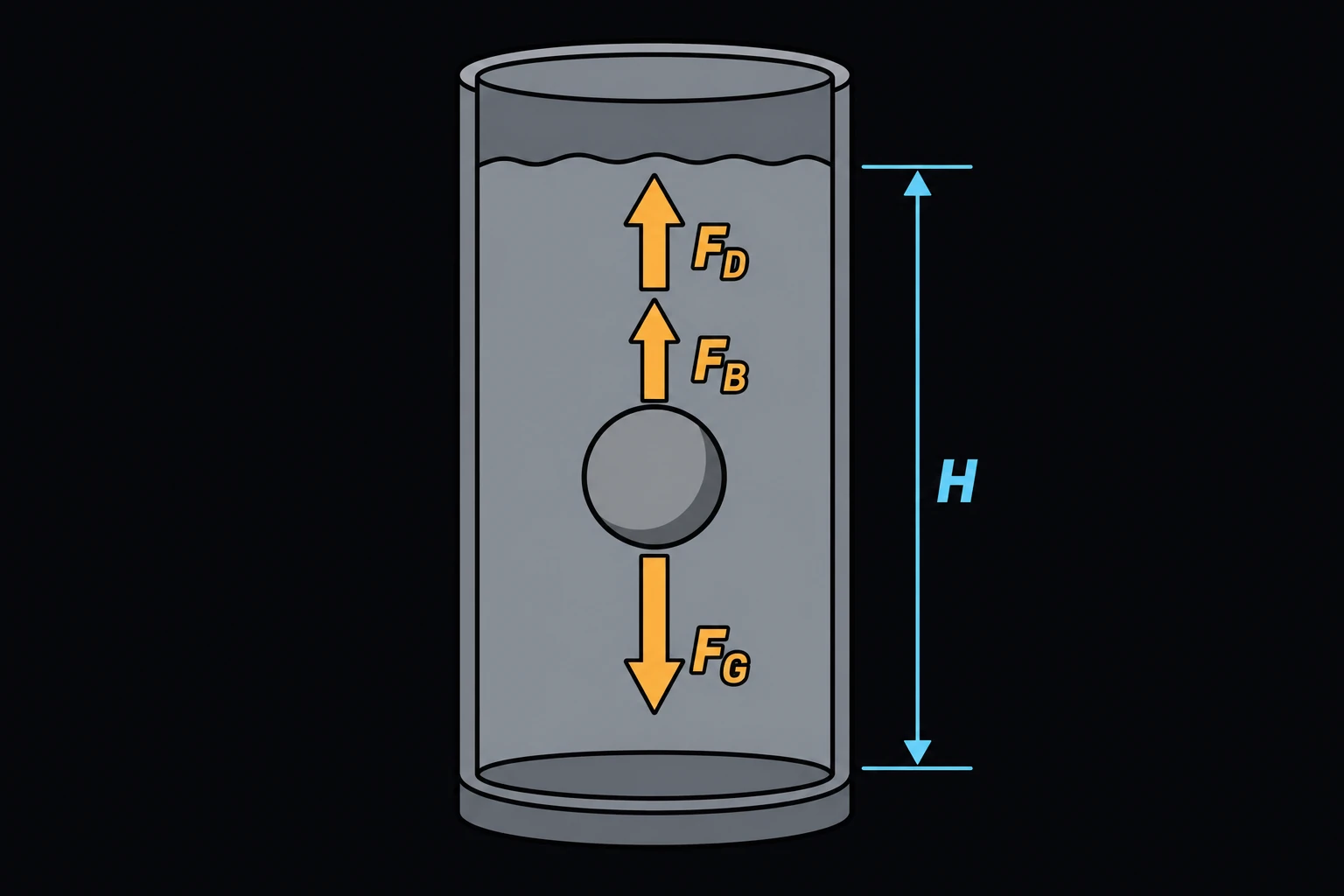
Terminal Settling Velocity
Finds how fast a solid sphere sinks through a still fluid once drag, buoyancy and gravity balance. It covers fine particles in creeping flow up to coarse ones in the Newton range, and reports the Reynolds number, drag coefficient and regime. Engineers use it to size grit chambers, clarifiers, thickeners and settling tanks, and to check whether solids will drop out of a slow-moving line.
Equations
vt = √(4·g·dp·(ρp − ρf)/(3·Cd·ρf)) Re = ρf·vt·dp/μ
Cd = (24/Re)·(1 + 0.15·Re0.687), but not below 0.44
dp is the particle diameter, ρp and ρf the particle and fluid densities, μ the fluid viscosity and g = 9.80665 m/s². Cd is the drag coefficient, from the Schiller–Naumann curve [2], [3]. It tends to Stokes’ 24/Re for small Re and levels off at Newton’s 0.44 near Re = 1000 [1]. Because Cd depends on vt, the page solves the two equations together, so one smooth curve covers every regime. For reference it also shows Stokes’ law, v = g·dp²·(ρp − ρf)/(18μ), which holds only below Re = 1.
Inputs
- Choosing a Particle Material fills in its solid density [8]–[11]. Use the density of the grains, not the bulk density of a heap, which includes the voids.
- Choosing a Fluid fills in its density and viscosity [4]–[7]. Viscosity matters most: water at 5 °C is half again as viscous as at 20 °C.
Limits and common mistakes
- The result is for one smooth sphere in an endless, still fluid. Angular grains, flakes and fibers settle more slowly.
- Many particles together settle more slowly than one alone (hindered settling). Above a few percent solids by volume, correct for it [1], [3].
- Near a wall, or in a tube not much wider than the particle, the wall slows it down.
- Don’t use the Stokes estimate outside Re < 1. It overstates the speed of larger particles, by a widening margin.
Worked example
A grit chamber at a wastewater plant must catch silica sand of 0.2 mm and larger in water at 15 °C. What settling velocity should set its surface area?
- Enter Particle Diameter 0.2 mm.
- Choose Particle Material Quartz / silica sand (SiO₂). The density fills in as 2648 kg/m³.
- Choose Fluid Water, 15°C. The density fills in as 999.1 kg/m³ and the viscosity as 1.138 cP. Press Solve. The Solution shows:
Terminal velocity vt: 0.0227437 m/s
Particle Reynolds number Re: 3.99354
Drag coefficient Cd: 8.34358
Settling regime: Intermediate (1 ≤ Re < 1000)
Stokes-law estimate (for reference): 0.0315762 m/s
Check by hand: with Cd = 8.344, vt = √(4 × 9.807 × 0.0002 × 1648.9/(3 × 8.344 × 999.1)) = 0.0227 m/s, and Re = 999.1 × 0.0227 × 0.0002/0.001138 = 3.99. This matches the figure of about 0.02 m/s commonly used for 0.2 mm grit. Stokes’ law would overstate it by 39 %, because Re is above 1.