Thermal Expansion
Finds how much a part grows or shrinks with temperature: the change in length of a bar, pipe, rail or beam, or the change in volume of a solid or a liquid. Pick a material to fill in its expansion coefficient, or type your own. Use it to size expansion gaps, loops and joints, and to check fits that must hold hot and cold.
Equations
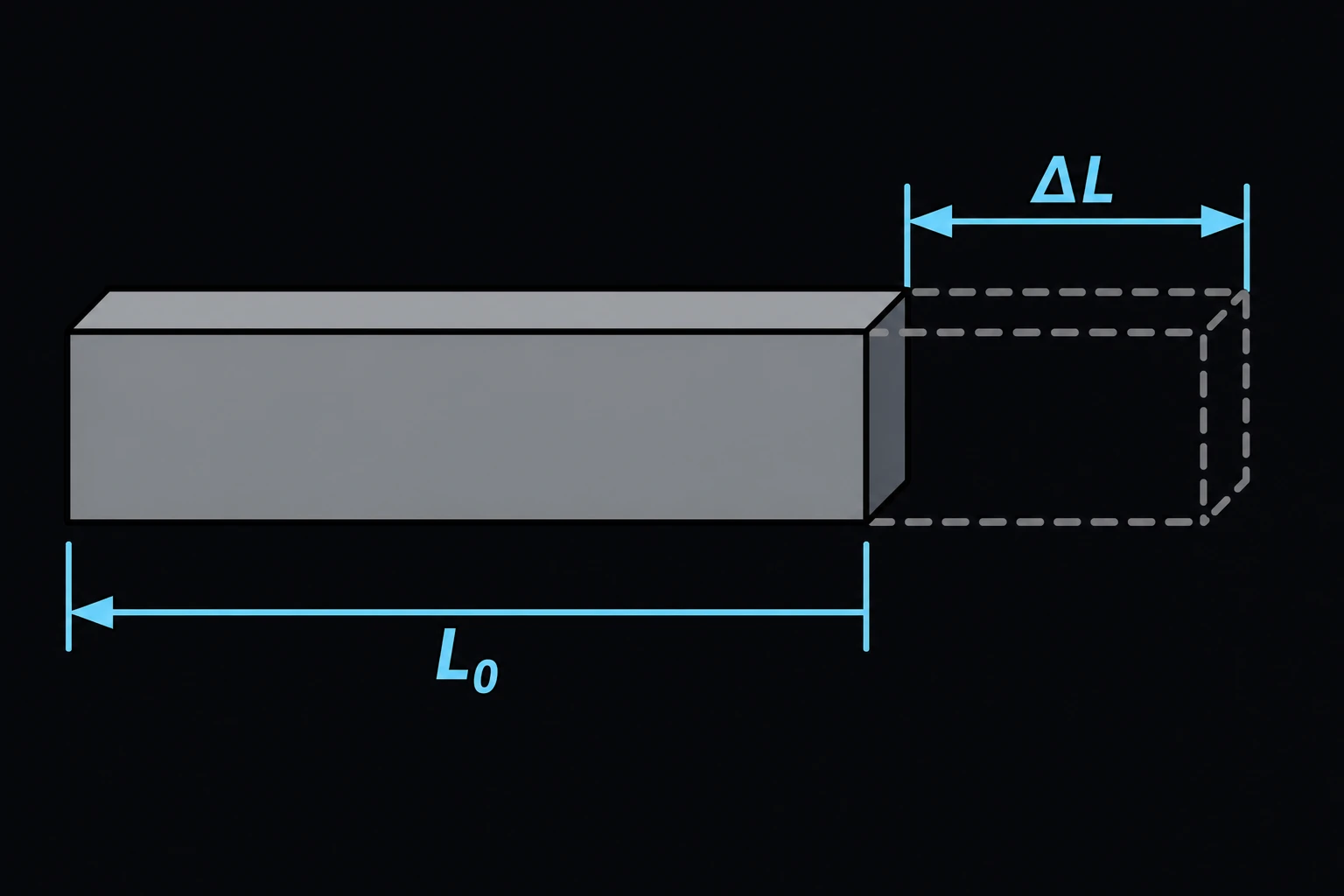
ΔL = L0·α·ΔT ΔV = V0·β·ΔT
L0 and V0 are the original length and volume, and ΔT the temperature change: positive for a rise, negative for a drop. α is the linear expansion coefficient, in µm of growth per meter per °C (the same number as 10−6/°C) [1]. β is the volumetric coefficient. For a solid that expands alike in every direction β = 3α [2], and the page also shows the exact change of a cube, V0·((1 + α·ΔT)³ − 1), which differs only for very large changes. A liquid, or a solid that expands differently each way, needs β entered directly.
Limits and common mistakes
- The coefficients are near-room-temperature values [2]–[4]. α rises with temperature, so over a range of hundreds of degrees use the mean α for that range.
- ΔT is a difference, not a reading: a change of 10 °C is a change of 18 °F. Per °F, α is 5/9 of its per-°C value.
- The result is free expansion. A part held at both ends doesn’t grow; it takes a stress of about E·α·ΔT instead [1].
Worked example
A 30 m run of steel pipe between two anchors carries hot water. It is installed at 10 °C and runs at 90 °C. How much must the expansion loop take up?
- Choose Expansion Linear.
- Enter Original Length 30000 mm.
- Choose Material Steel. The coefficient fills in as 12 µm/(m·°C).
- Enter Temperature Change 80 °C and press Solve. The Solution shows:
Change in Length (ΔL): 28.8 mm
New Length: 30,028.8 mm
Check against the rule of thumb that steel pipe grows about 0.8 in per 100 ft for every 100 °F. 30 m is 98.4 ft and 80 °C is 144 °F, so the growth is 0.8 × 0.984 × 1.44 = 1.13 in, or 28.8 mm.