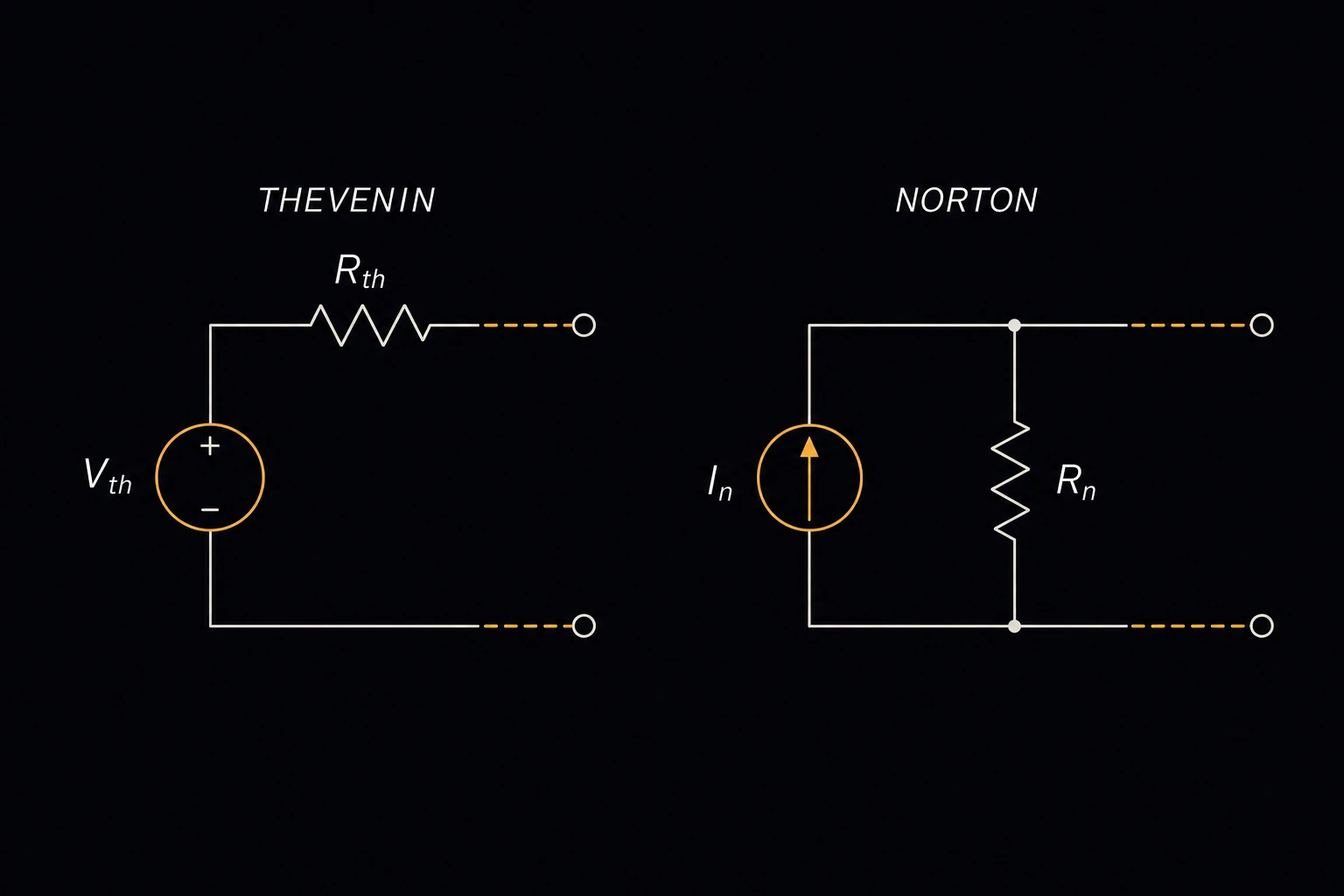
Thevenin/Norton Equivalent
Converts a Thevenin equivalent (a voltage source in series with a resistance) into the Norton equivalent (a current source in parallel with the same resistance), and back. Use it to simplify a circuit step by step: sources in series add in Thevenin form, and sources in parallel add in Norton form.
Equations
In = Vth/Rth Vth = In·Rn Rn = Rth
Vth is the Thevenin voltage, the voltage at the two terminals with nothing connected (open circuit). In is the Norton current, the current that flows when the terminals are shorted together. Rth = Rn is the resistance seen looking back into the terminals with every source switched off [1]. Both forms deliver the same voltage and current to any load, which is why one can replace the other.
Inputs and limits
- Choose the direction under Convert. Only the fields for that direction show.
- The resistance must be positive. An ideal voltage source (zero resistance) has no Norton form, and an ideal current source (infinite resistance) has no Thevenin form.
- This page converts a known equivalent. Finding Vth and Rth for a whole network is a separate step: find the open-circuit voltage, then either the short-circuit current or the resistance with the sources off.
Common mistakes
- Putting the Norton resistance in series with the current source. It goes in parallel.
- Treating the equivalent as identical inside. It only matches at the terminals: the power lost inside the Thevenin and Norton forms is not the same.
- Switching off sources wrongly when finding Rth. A voltage source becomes a short circuit; a current source becomes an open circuit.
Worked example
Two DC sources run in parallel to feed one load. Source A has an open-circuit voltage of 7.5 V and an internal resistance of 0.6 Ω. Source B has 7.2 V and 0.4 Ω. What single source do they make together?
- Choose Convert Thevenin → Norton, and enter Thevenin voltage (Vth) 7.5 V and Thevenin/Norton resistance (Rth = Rn) 0.6 Ω. Press Solve to get Norton current (In): 12.5 A.
- Repeat with 7.2 V and 0.4 Ω to get Norton current (In): 18 A.
- In parallel the Norton currents add, 12.5 + 18 = 30.5 A, and the resistances combine in parallel, 0.6 × 0.4/1.0 = 0.24 Ω.
- Choose Convert Norton → Thevenin, enter Norton current (In) 30.5 A and Norton/Thevenin resistance (Rn = Rth) 0.24 Ω, and press Solve. The Solution shows:
Thevenin voltage (Vth): 7.32 V
Thevenin resistance (Rth): 0.24 Ω
Check: the combined voltage must lie between the two source voltages, closer to the stiffer source B, and 7.32 V does. With no load, a circulating current of (7.5 − 7.2)/1.0 = 0.3 A flows from A into B, and 7.5 − 0.3 × 0.6 = 7.32 V agrees.