Three-Phase Power
Finds the line voltage, line current and the real, reactive and apparent power of a balanced three-phase load. Pick a nominal system voltage and how the load is connected, then give the current in each phase and the power factor. Electricians and designers use it to check a load against its feeder and to size transformers, generators and breakers.
Equations
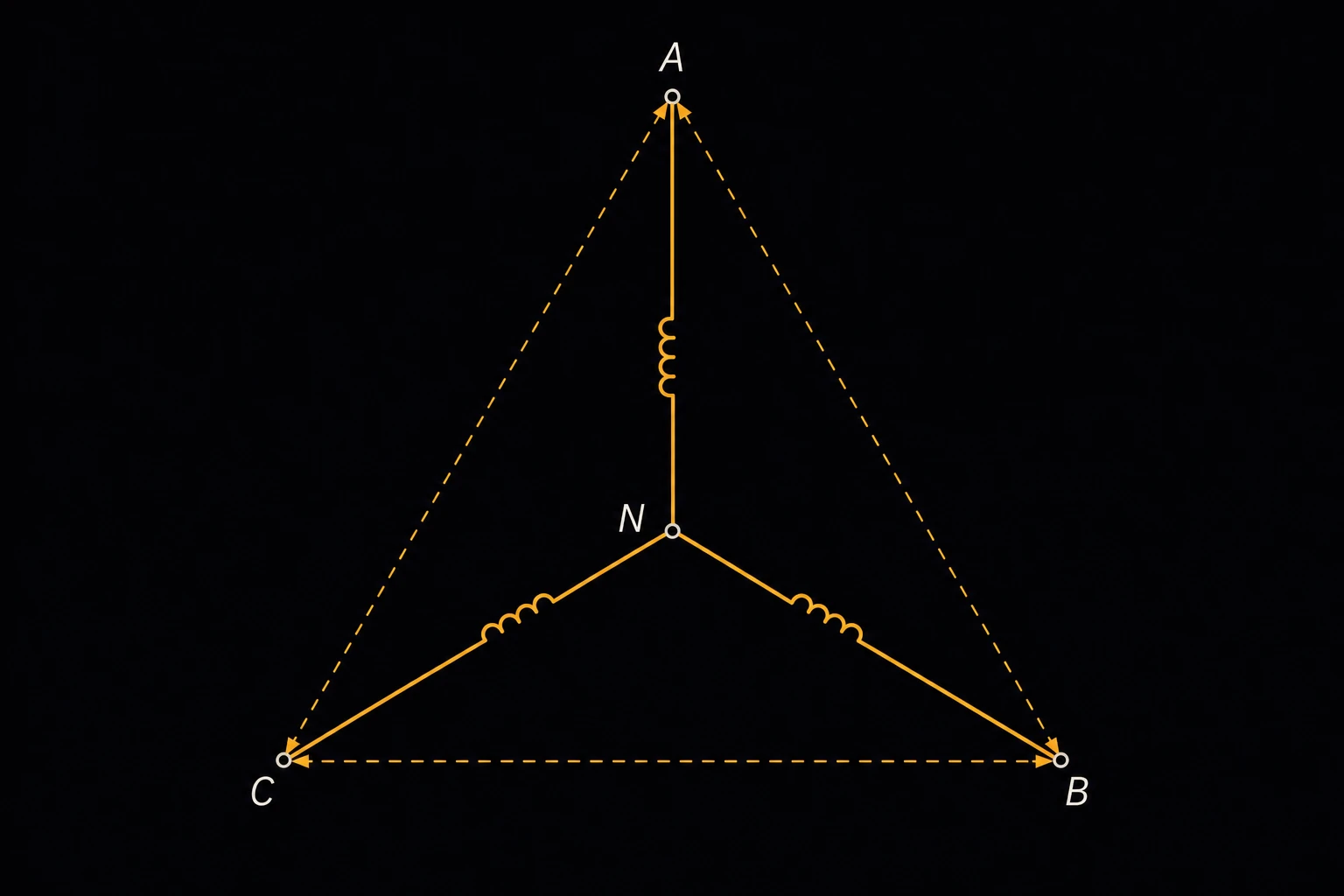
Wye: VL = √3·Vφ, IL = Iφ Delta: VL = Vφ, IL = √3·Iφ
S = √3·VL·IL P = S·cos φ Q = S·sin φ
Vφ and Iφ are the voltage across and the current through one phase of the load. VL and IL are the line-to-line voltage and the current in each supply conductor [1]. S is the apparent power in kVA, P the real power in kW and Q the reactive power in kVAR. cos φ is the power factor, the cosine of the angle between each phase’s voltage and current.
The system list holds the nominal voltages of ANSI C84.1 [2] and IEC 60038 [3]. A wye load takes the line-to-neutral voltage, such as 277 V on a 480Y/277 V system. On a 3-wire system with no neutral, such as 480 V, the page uses VL/√3. A delta load takes the line-to-line voltage. The row under the powers shows which phase voltage was used. For any other supply, choose Custom and enter the phase voltage.
Limits and common mistakes
- The load must be balanced, with the same current and power factor in all three phases. For an unbalanced load, add up the phases one at a time.
- Enter the phase current, not the line current. For a delta load the line current is √3 times larger.
- The nominal pair is rounded: 277 V × √3 is 479.8 V, not 480 V, so VL may differ slightly from the system name.
- The power factor is the load’s displacement power factor. Harmonic currents from drives and rectifiers add to S but are not included.
Worked example
A heating and ventilating unit on a 480Y/277 V system has its loads wired in wye. Each phase draws 42 A at a power factor of 0.85. What does the unit take from the supply?
- Choose Nominal system voltage 480Y/277 V and Winding Connection Wye (star).
- Enter Phase current (Iφ) 42 A and Power factor (cos φ) 0.85. Press Solve. The Solution shows:
Line voltage (VL): 479.778 V
Line current (IL): 42 A
Real power (P): 29.6667 kW
Reactive power (Q): 18.3858 kVAR
Apparent power (S): 34.902 kVA
Phase voltage used, Vφ (line to neutral of 480Y/277 V): 277 V
Check: each phase takes 277 V × 42 A = 11.634 kVA, so three take 34.902 kVA. Then P = 34.902 × 0.85 = 29.667 kW, and Q = √(34.902² − 29.667²) = 18.39 kVAR.