Time Value of Money
Solves the five time-value-of-money quantities against each other. Give any four of present worth P, future worth F, a uniform amount A per period, the interest rate i and the number of periods n, and the page finds the fifth. Engineers use it to size a loan payment, find the rate a deal really earns, or see how long savings take to reach a target.
The governing equation
P·(1 + i)n + A·[(1 + i)n − 1]/i + F = 0
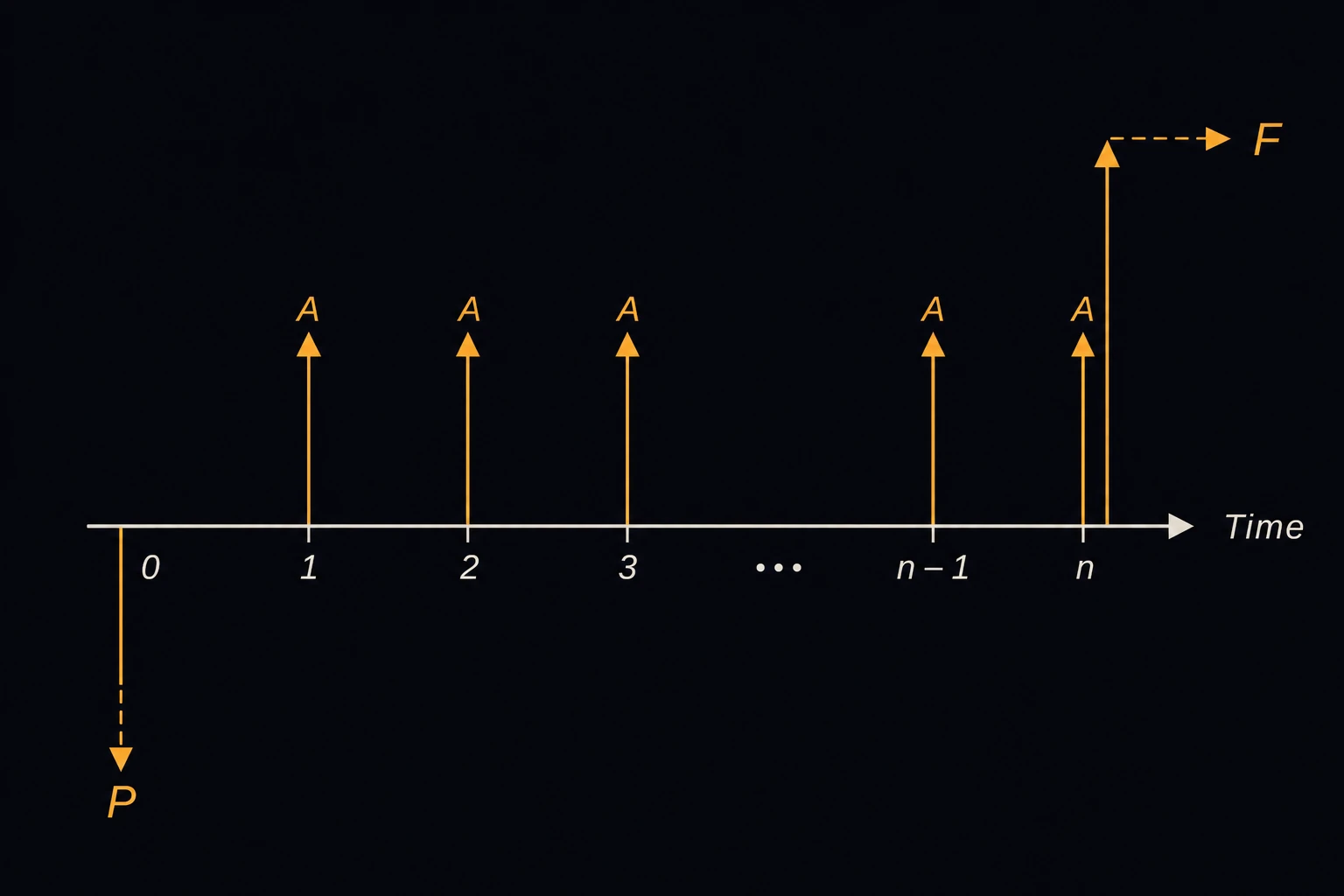
P is a single amount at time zero, F a single amount at the end of period n, and A an equal amount at the end of every period from 1 to n. i is the interest rate per period, as a decimal in the equation and in percent on the page. The equation says the cash flows, all moved to the end of period n, add to zero [1], [2]. At a zero rate, the A term becomes A·n.
P, F and A come out in closed form. The rate and the number of periods have no closed form, so the page finds them by bisection: i between −100 % and 1,000 %, and n up to 2,000 periods. It reports an error when no value in that range balances the flows.
Signs, periods and common mistakes
- Use a sign convention: money you receive is positive and money you pay is negative. A loan you take is a positive P, and its payments are negative. If every amount has the same sign, no rate balances them.
- The rate and the period must match. For monthly payments, enter the monthly rate (a 6 % nominal annual rate is 0.5 % a month) and n in months.
- The rate solved for is the rate per period, so a monthly rate is not an annual rate. The effective annual rate is (1 + i)m − 1 for m periods a year. The page’s second rate row repeats the per-period rate and does not do this conversion.
- A is paid at the end of each period. For payments at the start of each period (an annuity due), multiply A’s present worth by (1 + i).
- Leave unused amounts at 0. Results show money to six significant figures, so a payment of 4,833.20 appears as -4,833.2.
Worked example
A plant finances a 250,000 machine with a five-year loan at 6 % a year, compounded monthly, paid off in equal monthly payments. Find the payment.
- Choose Solve For Uniform amount (A).
- Enter Present Worth (P) 250000, the loan received, and Future Worth (F) 0.
- Enter Interest Rate per Period (%) 0.5 and Number of Periods (n) 60.
- Press Solve. The Solution shows: Uniform amount A: -4,833.2
The payment is 4,833.20 a month, negative because the plant pays it. Check: (1.005)60 = 1.34885, so A = 250,000 × 0.005 × 1.34885 / 0.34885 = 4,833.2. Over the loan the plant pays 60 × 4,833.20 = 289,992, so the interest is about 40,000.