Tolerance Stack-Up
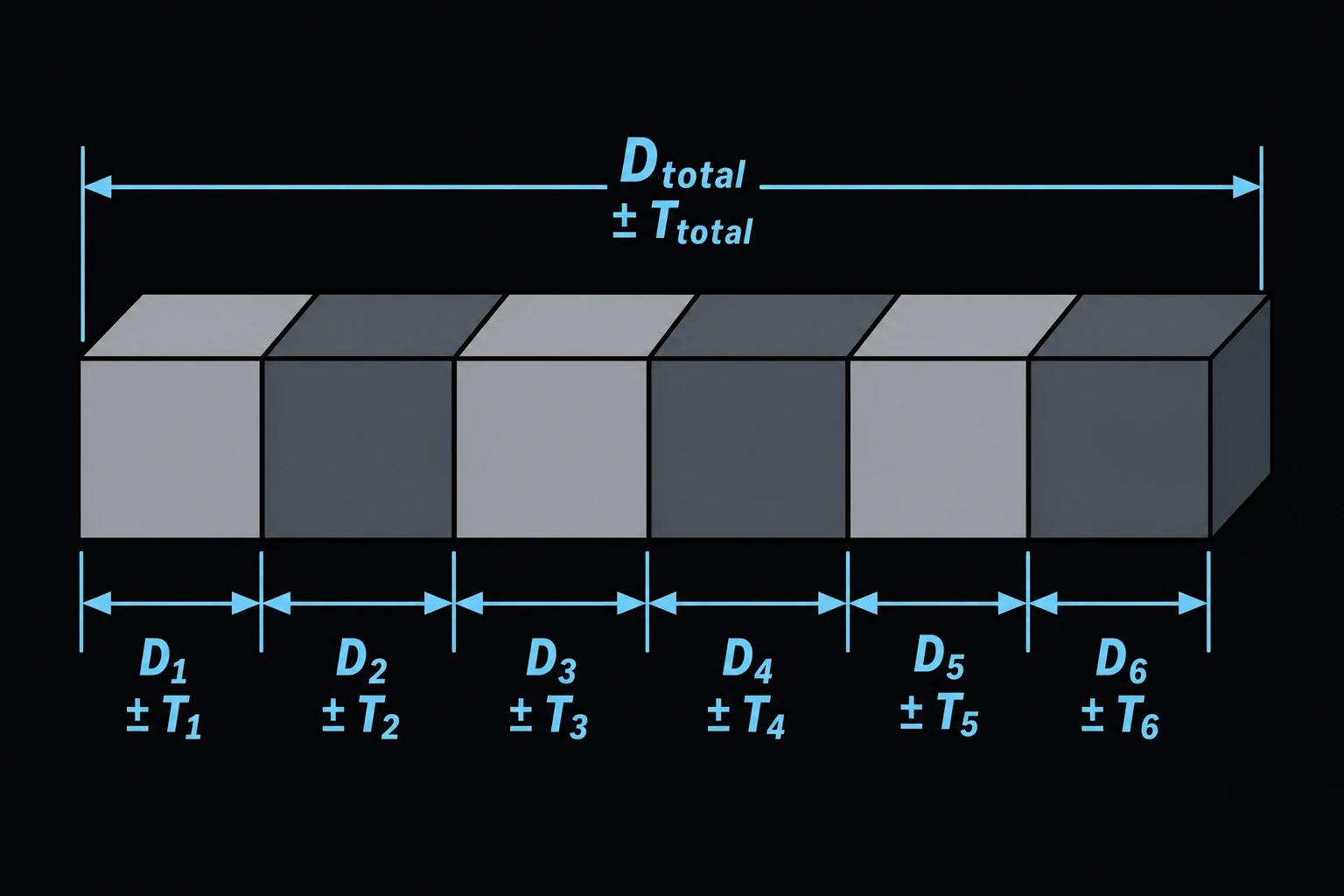
Adds up the tolerances of up to six dimensions in a chain to find how much the closing dimension (a gap, an overall length or a clearance) can vary. It gives both the worst-case and the statistical (root-sum-square) stack. Each dimension takes a typed ± tolerance, or the ISO 2768-1 general tolerance for its class and nominal size [2]. Designers use it to check that parts will assemble and to decide which tolerances to tighten.
Equations
TWC = ΣTi TRSS = √(ΣTi²)
Ti is the ± tolerance of dimension i, and the sums run over every dimension in the chain [1]. TWC is the worst case: every part at its limit in the same direction at once. The closing dimension is then its nominal ±TWC, and every assembly fits. TRSS assumes each dimension varies at random, independently, centered on its nominal and with its tolerance spanning the same number of standard deviations. Extreme parts then rarely meet, so the likely spread is ±TRSS, which is always smaller [1]. An ISO 2768-1 general tolerance depends on the class (f fine, m medium, c coarse, v very coarse) and on the size range that holds the nominal size, from 0.5 mm up to 4000 mm [2].
Limits and common mistakes
- The page stacks tolerances only. Find the nominal closing dimension yourself by walking the loop, adding dimensions in one direction and subtracting those in the other. The sign doesn’t change a tolerance’s contribution.
- Tolerances must be equal ± values. Convert a dimension such as 20 +0.1/−0 to its mean, 20.05 ±0.05, first.
- RSS is optimistic with only two or three dimensions, or when a process runs off center. Use the worst case for safety-critical fits.
- Enter 0 for an unused dimension. A rejected size means the class gives no tolerance there (2768-f over 2000 mm, 2768-v up to 3 mm).
Worked example
A bearing, a spacer and a sleeve stack along a shaft against a shoulder. The bearing width is held to ±0.05 mm, the spacer is turned to ±0.1 mm, and the 60 mm sleeve has only the drawing’s general note, ISO 2768-m. How much can the end of the stack move?
- Leave Dimension 1 Tolerance on Typed ± and enter Tolerance 1 0.05 mm.
- Leave Dimension 2 Tolerance on Typed ± and enter Tolerance 2 0.1 mm.
- Choose Dimension 3 Tolerance ISO 2768-m and enter Nominal Size 3 60 mm.
- Enter 0 for Tolerance 4, Tolerance 5 and Tolerance 6, and press Solve. The Solution shows:
Worst-Case Stack (linear sum): 0.45 mm
Statistical Stack (RSS): 0.320156 mm
Tolerance 3 (ISO 2768-m, over 30 up to 120 mm): 0.3 mm
Check: 0.05 + 0.1 + 0.3 = 0.45 mm, and √(0.05² + 0.1² + 0.3²) = √0.1025 = 0.320 mm. The sleeve’s general tolerance makes up two-thirds of the worst case, so a tolerance on that one dimension would do more than tightening the other two.