Torsion / Shaft Stress
Finds the peak shear stress and the angle of twist of a round shaft under torque, solid or hollow. For a solid shaft it can also work the other way: from the torque and an allowable shear stress, it gives the smallest diameter. The allowable can be your own number or one from the ASME transmission-shafting code [2]. Machine designers use it to size drive shafts and axles.
Equations
τ = T·r/J θ = T·L/(G·J)
J = π·do4/32 (solid) J = π·(do4 − di4)/32 (hollow)
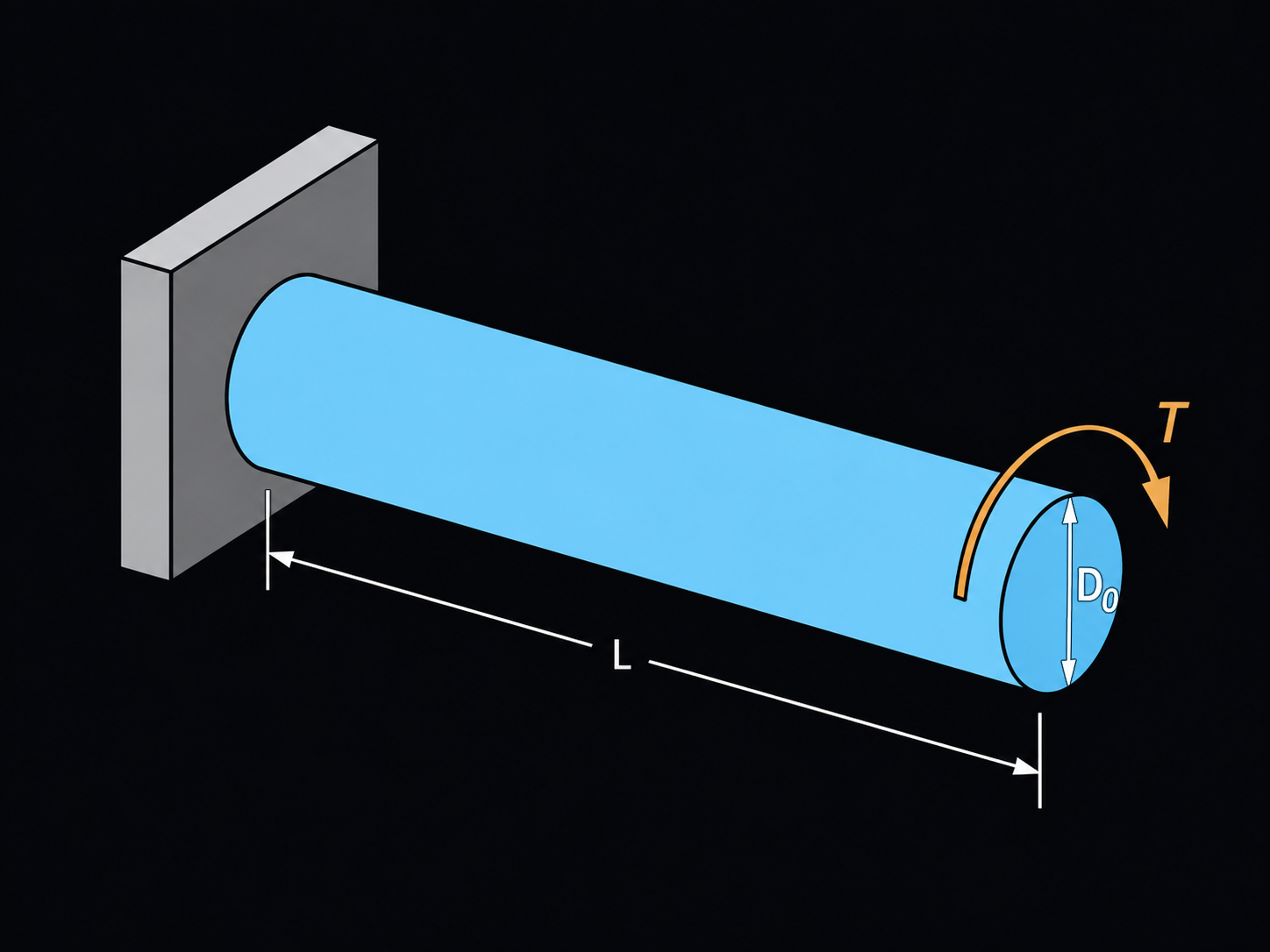
T is the torque, r = do/2 the outer radius, J the polar moment of inertia, L the length between the points where the torque is applied, and G the shear modulus [1]. Pick a material to fill in G, or type your own. τ is the shear stress at the outer surface, where it peaks. θ is the twist of one end relative to the other. For the required diameter, the solid-shaft form is solved for do:
do = (16·T/(π·τallow))1/3
The ASME code allows 8000 psi in commercial steel shafting, or 6000 psi with a keyway. For a listed steel [3] it allows the smaller of 0.30 Sy and 0.18 Sut, less 25 % with a keyway [2].
Limits and common mistakes
- The equations hold for round shafts in the elastic range only. A square or rectangular bar warps and needs other formulas.
- The result is for torque alone. A shaft that also carries belt pull or gear loads is in bending too and needs a combined check.
- The ASME allowables are static. A shaft under fluctuating or reversing torque needs a fatigue check.
- Shoulders, grooves and keyways raise the local stress. The keyway option applies the code’s 25 % reduction; it is not a stress-concentration factor.
Worked example
A commercial steel line shaft with a keyway must carry 500 N·m. The pulleys are 800 mm apart. Find the smallest diameter the ASME code allows, and the twist between the pulleys.
- Choose Shaft Type Solid and Solve for Required Diameter (given target Stress).
- Enter Applied Torque (T) 500 N·m and Shaft Length (L) 800 mm.
- Choose Material (G) Steel. The shear modulus fills in as 79 GPa.
- Choose Allowable Shear Stress Basis Commercial steel shafting (ASME code) and Keyway in the Shaft With keyway. Press Solve. The Solution shows:
Required Outer Diameter (do): 39.4842 mm
Angle of Twist (θ) at this diameter: 1.2158 deg
Polar Moment of Inertia (J): 238,612 mm⁴
Allowable Shear Stress (τallow): 41.3685 MPa
Check by hand. 6000 psi is 41.37 MPa, and (16 × 500,000 N·mm / (π × 41.37))1/3 = 39.5 mm. A 40 mm shaft works at 16 × 500,000 / (π × 40³) = 39.8 MPa, just under the allowable. The twist is 500,000 × 800 / (79,000 × 238,612) = 0.0212 rad, or 1.22°.