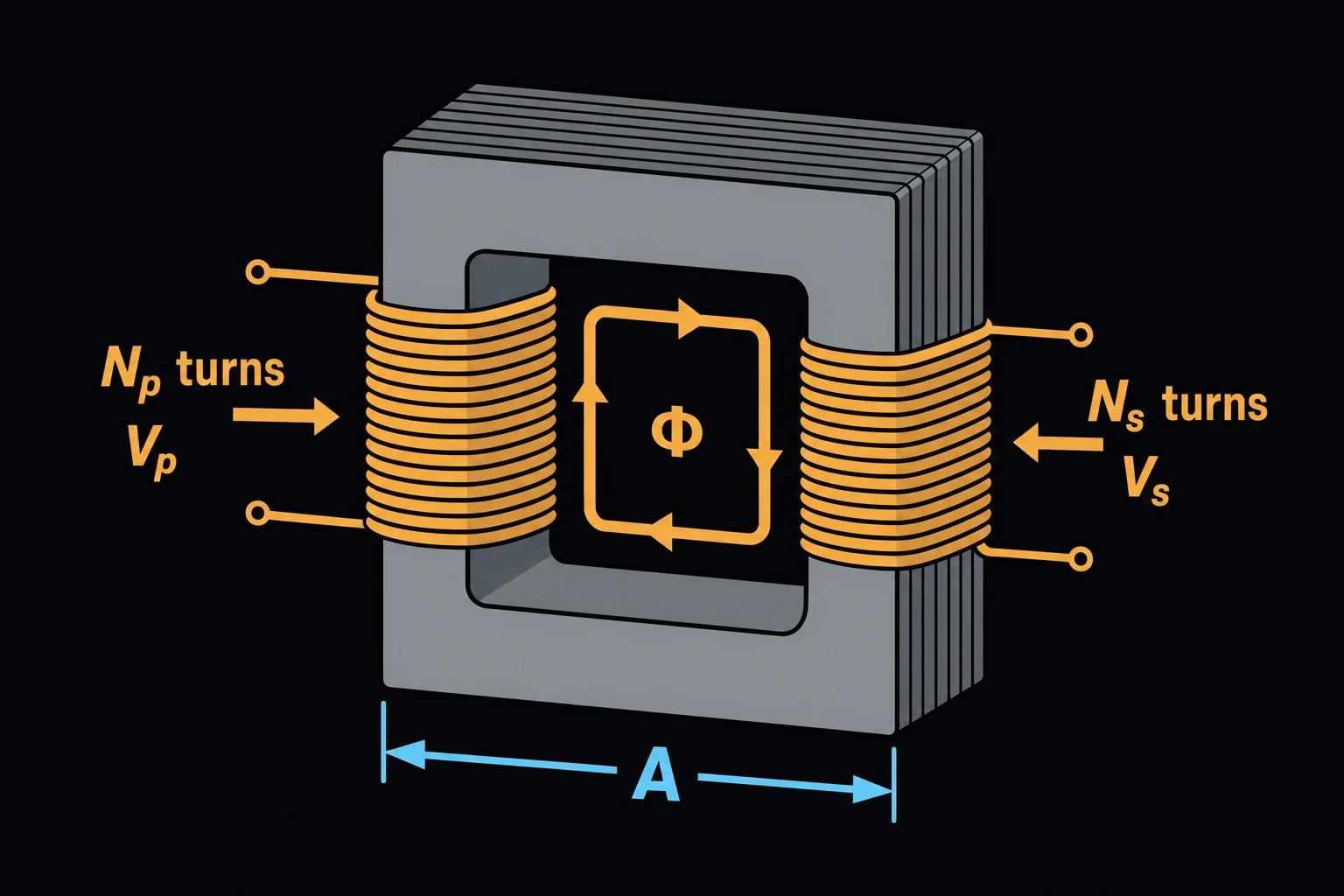
Transformer Sizing
Gives the first numbers for a small power transformer: the turns ratio, the primary and secondary currents, and the core area product Ap, which picks the smallest core that can carry the power. Give the two voltages, the VA rating, the supply frequency and three design limits for the core and windings. Designers of control, power-supply and instrument transformers use it to choose a core from a catalog before they work out the turns and the wire.
Equations
a = Vp/Vs Ip = VA/Vp Is = VA/Vs
a is the turns ratio Np:Ns, Vp and Vs are the primary and secondary voltages, and VA is the rating. The page treats the transformer as ideal: no losses and no magnetizing current.
Ap = Wa·Ac = Pt·104 / (Kf·Bmax·J·f·Ku)
Ap is the product of the core’s window area Wa and its cross-section Ac, in cm⁴ [1]. Pt is the apparent power the core handles, input plus output, taken as 2 × VA for an ideal transformer. Kf is the waveform factor from Faraday’s law: π√2 = 4.44 for a sine wave and 4.0 for a square wave [1]. Bmax is the peak flux density in tesla, J the current density in the wire in A/cm², f the frequency in hertz and Ku the fraction of the window filled with copper. The 104 converts m² to cm². The supply list fills in 50 Hz [3], 60 Hz [2] or 400 Hz aircraft power [4].
Limits and common mistakes
- Bmax depends on the core: about 1.5 to 1.7 T for silicon steel at 50 or 60 Hz, much less for ferrite or at high frequency. Too high a value saturates the core.
- J sets the copper loss and the temperature rise. 200 to 400 A/cm² suits small transformers in still air; large ones need less.
- Ku of about 0.4 allows for the insulation, the bobbin and the gaps between round wires.
- Pick a core whose catalog Ap is at least the page’s value. Then check the regulation and the temperature rise; they are not computed here.
- The secondary voltage is the full-load value. Wind a few percent more turns to make up for the winding resistance.
Worked example
A 50 VA control transformer steps 120 V, 60 Hz mains down to 24 V. It uses a silicon-steel core at 1.5 T, wire at 300 A/cm² and a window fill of 0.4. What core size is needed?
- Enter Primary voltage (Vp) 120 V, Secondary voltage (Vs) 24 V and VA rating 50.
- Choose Supply frequency 60 Hz mains (ANSI C84.1). The frequency fills in.
- Enter Bmax (T, core flux density) 1.5, J (A/cm², current density) 300 and Ku (window utilization factor, 0–1) 0.4.
- Choose Voltage waveform Sine wave — Kf = 4.44 and press Solve. The Solution shows:
Turns ratio (Np:Ns): 5
Primary current (Ip): 0.416667 A
Secondary current (Is): 2.08333 A
Area product (Ap): 20.8542 cm⁴
Check: the denominator is 4.44 × 1.5 × 300 × 60 × 0.4 = 47,952, and 100 × 104 / 47,952 = 20.85 cm⁴. Choose a core with an Ap of at least 21 cm⁴.