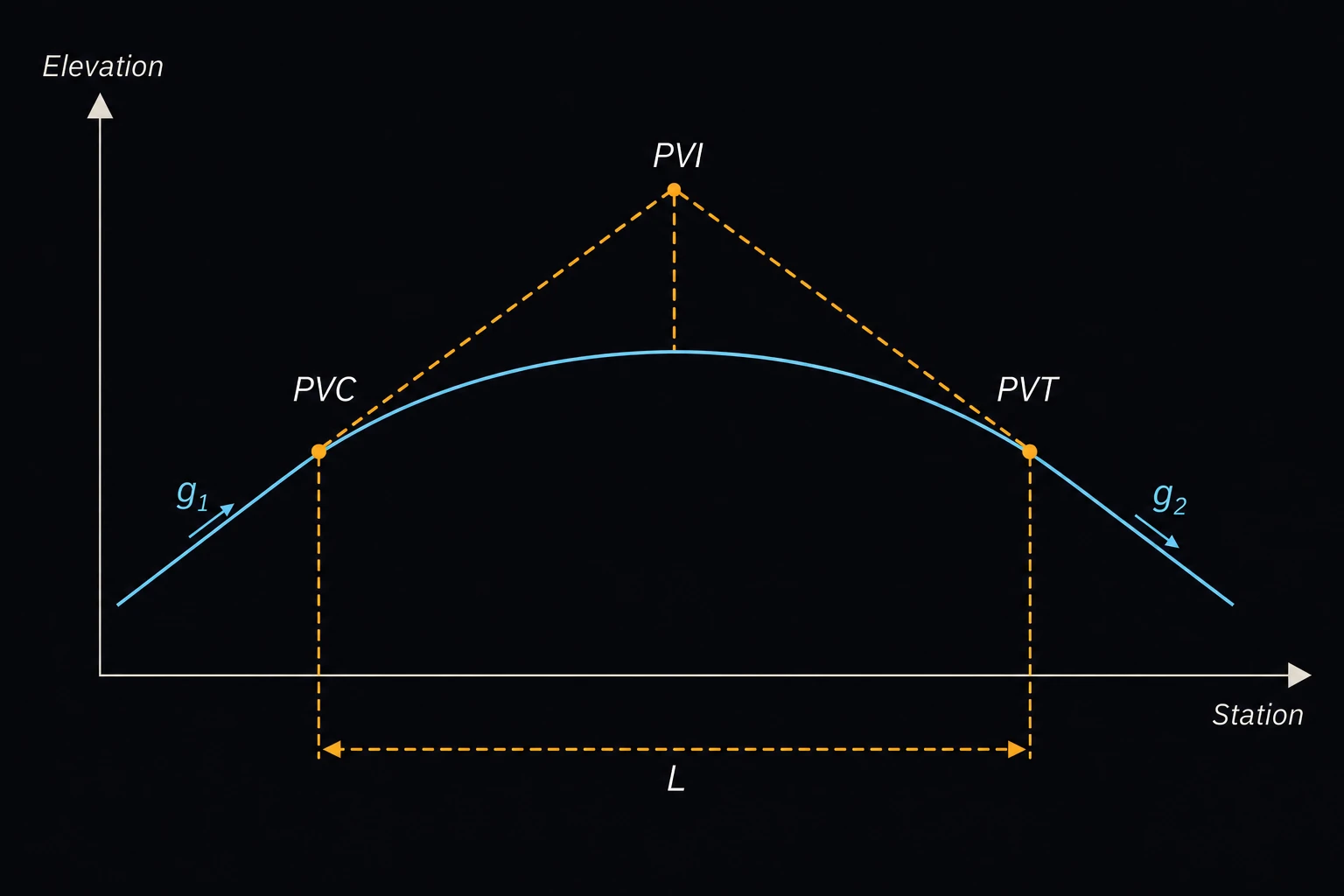
Vertical Curve
Lays out a parabolic vertical curve where two road grades meet: the rate of curvature K, elevations along the curve and the high or low point. It also checks the length against stopping sight distance and the design K of the AASHTO Green Book [1]. Highway and site designers use it to set road profiles.
How the curve is calculated
The curve starts at the BVC (also called the PVC) and is centered on the PVI, where the two grades meet. The elevation a distance x past the BVC is
y = yBVC + G1·x + (A·x2) / (2L)
yBVC = yPVI − G1·L/2
where G1 and G2 are the grades in and out (as fractions in the equation, percent on the page), A = G2 − G1, and L is the horizontal length of the curve. K = L/|A| is the length per 1 % of grade change. The high or low point is at x = −G1·L/A, if that lies on the curve. For a stopping sight distance S shorter than the curve, the minimum lengths are [1]
Lcrest = |A|·S2 / 658
Lsag = |A|·S2 / (120 + 3.5·S)
with A in percent and S in meters (crest: 1.08 m eye, 0.60 m object; sag: 0.60 m headlight, 1° beam). A Design Speed fills S from Table 3-1 and adds the design K from Table 3-34 (crest) or 3-36 (sag), with the length K·|A| it requires.
Limits and common mistakes
- Enter grades in percent with their sign: a road falling at 2 % is −2.
- x is measured from the BVC, not from the PVI, and must lie on the curve (0 to L).
- A positive A is a sag, a negative A a crest. Both sight-distance lengths are shown; read the one that matches.
- The formulas assume S < L. If the result is shorter than S, the true need is slightly less, so the page errs on the safe side.
- Comfort, drainage at a flat low point and sight lines under bridges are not checked.
Worked example
A rural road falls at 2.5 % into a dip and climbs out at 3 %, with the PVI at elevation 150 m. Check a 200 m curve for 80 km/h and find its low point.
- Enter Grade In −2.5, Grade Out 3, Curve Length 200 m and Elevation at PVI 150 m.
- Enter Distance from BVC 100 m (the PVI station) and choose Design Speed 80 km/h, which fills the sight distance with 130 m.
- Press Solve. The Solution shows:
Rate of vertical curvature K = L/|A|: 36.3636 m/%
Elevation at x = 100.0 m: 151.375 m
Low point distance from BVC: 90.9091 m
Low point elevation: 151.364 m
Min L — sag (headlight, S<L): 161.652 m
Design K, sag (AASHTO Table 3-36): 30 m/%
Minimum curve length K·|A| for the design speed: 165 m
Curve length meets design K? Yes
Check by hand. A = 3 − (−2.5) = 5.5 %. At its middle the curve sits AL/800 = 5.5 × 200 / 800 = 1.375 m above the PVI. The low point is at 2.5 × 200 / 5.5 = 90.9 m, and the headlight check needs 5.5 × 1302 / 575 = 161.7 m. The 200 m curve passes both checks.