Vertical Stress Increase (Boussinesq)
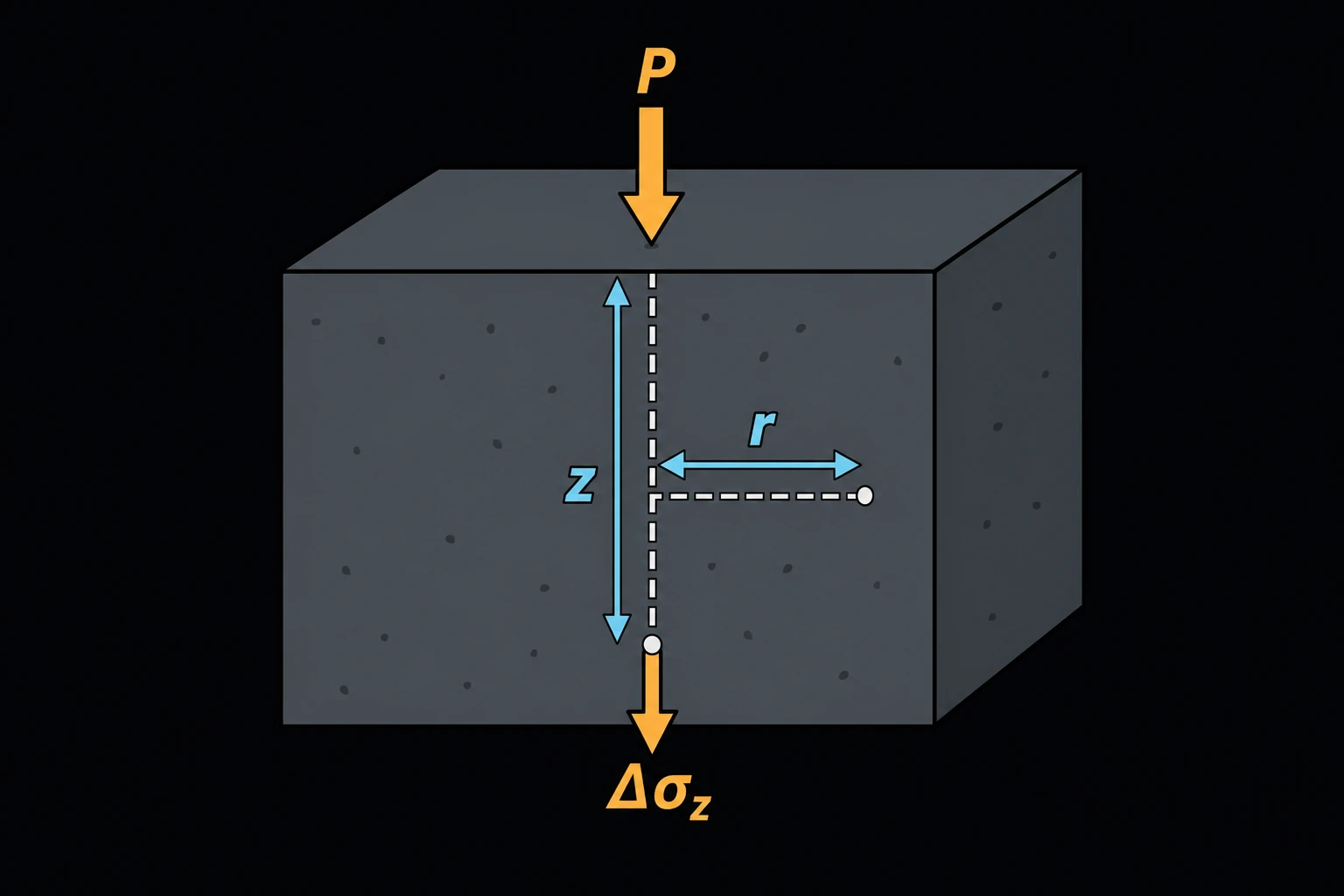
Finds how much a surface load raises the vertical stress in the soil below it. It treats the ground as a uniform elastic half-space, after Boussinesq [1]. Choose a point load, a uniformly loaded circle (stress below its center) or a uniformly loaded rectangle (stress below one corner). Geotechnical engineers use the stress increase to estimate settlement of a footing, tank or fill, and to check whether a new load reaches a soft layer.
Equations
Point load: Δσz = (Q/z²)·(3/2π)·[1 + (r/z)²]−5/2
Circle, below center: Δσz = q·{1 − [1 + (R/z)²]−3/2}
Rectangle, below corner: Δσz = q·I(m, n), m = B/z, n = L/z
Q is the point load, r its horizontal distance from the point of interest and z the depth. q is the uniform contact pressure, R the radius of the circle, and B and L the sides of the rectangle. I is Newmark’s closed-form integral of the point-load solution over the rectangle [2], [3]; it never exceeds 0.25.
Using corners
The rectangle formula gives the stress below a corner only. For any other point, split the loaded area into rectangles that each have a corner at that point, and add their results [3]. Below the center of a B × L footing, that is four rectangles of B/2 × L/2, so enter the half dimensions and multiply the result by 4. For a point outside the footing, subtract the rectangles that aren’t loaded.
Limits and common mistakes
- The soil is taken as uniform, elastic and infinitely deep. A stiff layer over a soft one spreads the load more widely than this.
- q is the net added pressure: the footing pressure minus the weight of the soil dug out to place it.
- The result is only the increase. Add the existing effective stress at that depth before using it in a settlement calculation.
- Near the surface the point-load result grows without limit. Use an area load when z is small compared with the footing.
Worked example
A 2 m × 3 m footing puts a net pressure of 150 kPa on the ground. A clay layer starts 3 m below it. How much does the footing add to the stress at the top of the clay, below the footing’s center?
- Choose Loaded Area Uniform rectangular area — below corner.
- Enter Contact Pressure 150 and Depth Below Surface 3 m.
- Enter the half dimensions: Rectangle Width 1 m and Rectangle Length 1.5 m. Press Solve. The Solution shows:
Newmark influence factor I (corner): 0.0612355
Vertical stress increase Δσz (corner): 9.18533 kPa
The four quarters add to 4 × 9.18533 = 36.74 kPa below the center. A summation of the point-load formula over a fine grid of the 1 m × 1.5 m quarter gives the same 9.185 kPa. As a rule-of-thumb check, the 2:1 method spreads the load over (2 + 3) × (3 + 3) = 30 m², giving 150 × 6 / 30 = 30 kPa. That is an average across the spread width, so it is lower than the peak below the center.