Via Current Capacity
Estimates how much current one plated through-hole via can carry for a given temperature rise. PCB designers use it to decide how many vias a power or ground connection needs when it changes layers.
The via equations
A = π·t·(d − t) I = 0.024·ΔT0.44·A0.725
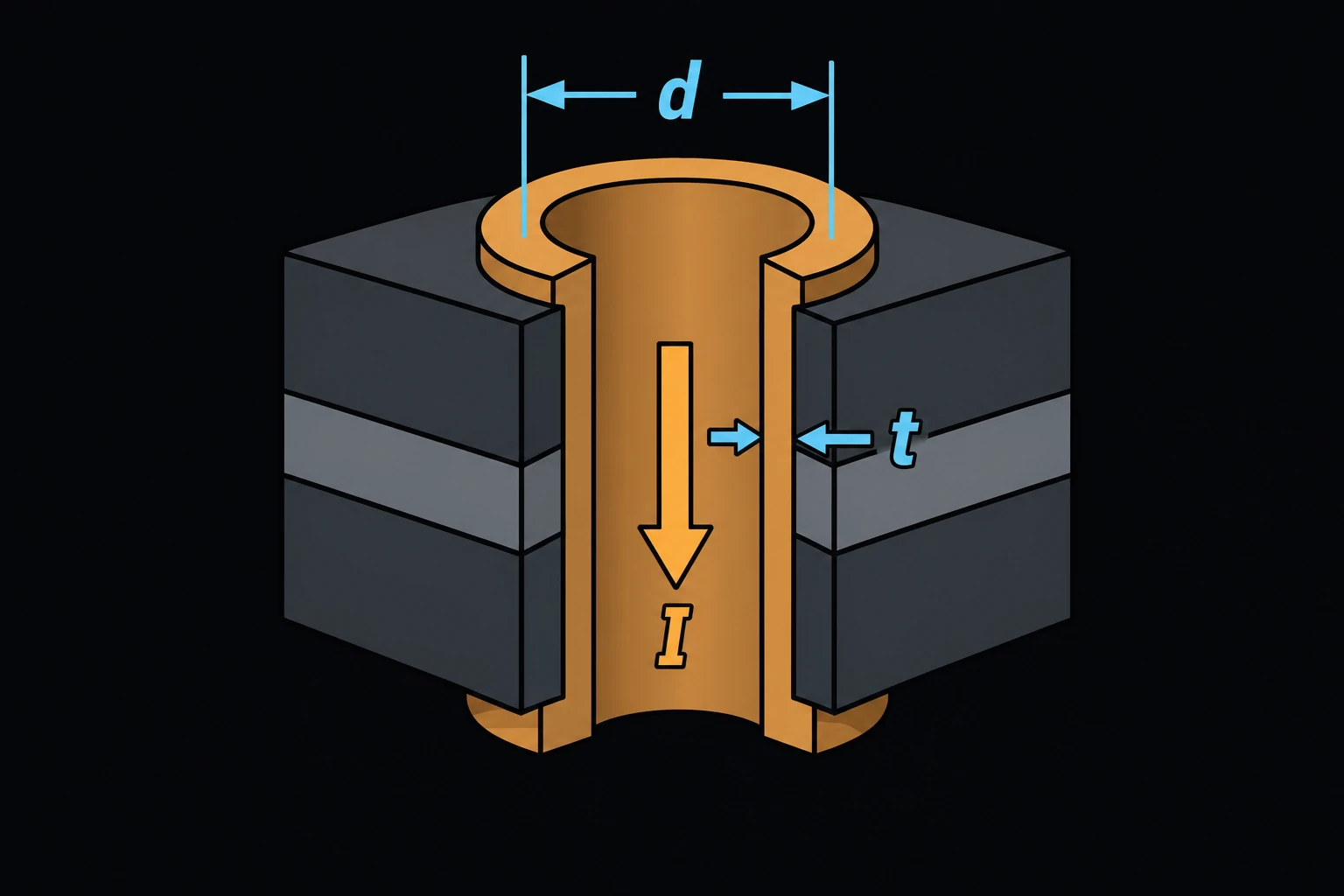
d is the drilled hole diameter and t the thickness of the copper plated onto the hole wall. A is the copper cross-section of the barrel in square mils: the ring between the drill wall and the finished bore. I is the current in amperes and ΔT the allowed temperature rise in °C. The page treats the barrel as an internal trace with the same copper area and applies the IPC-2221 internal-layer curve, k = 0.024 [1]. The via’s length doesn’t enter, because the curve relates current to area and temperature rise only.
Choosing a Plating specification fills t with the IPC-6012E minimum average plating: 20 µm for Class 1 and 2 boards and 25 µm for Class 3 [2]. Choose Custom to enter the thickness your board house guarantees.
Limits and common mistakes
- This is an estimate. A short barrel joined to planes sheds heat well, so real vias often carry more. Use the result as a conservative guide, not a rating.
- Enter the drill diameter, not the finished hole size. The finished hole is smaller by twice the plating.
- IPC-6012E allows thin spots below the average (down to 18 µm for Classes 1 and 2, 20 µm for Class 3) [2]. Don’t use a thicker value than the minimum unless the fabricator guarantees it.
- Several vias in parallel share the current, so the count is the total current divided by the result, rounded up. Spread them out so they don’t heat each other, and add one or two spare.
Worked example
A 2 A supply must pass from the top layer to an inner plane on a Class 2 board, through 0.3 mm drilled vias. The connection may rise 10 °C. Find how many vias it needs.
- Enter Drilled via diameter (d) 0.3 mm.
- Choose Plating specification IPC-6012E Class 1 or 2: 20 µm minimum average.
- Enter Allowable temperature rise (ΔT, °C) 10.
- Press Solve. The Solution shows: Estimated current capacity: 0.726227 A
2 A ÷ 0.726 A = 2.75, so place at least three vias, and four for margin. Check: d = 11.81 mil and t = 0.787 mil give A = π × 0.787 × 11.02 = 27.3 mil². Then 0.024 × 100.44 × 27.30.725 = 0.726 A.