Weibull Reliability
Evaluates a two-parameter Weibull life distribution: the reliability and failure probability at a time you choose, the hazard (instantaneous failure) rate, the mean life and a B-life such as B10. It also says whether the shape parameter means early failures, random failures or wear-out. Reliability and maintenance engineers use it with a shape and scale fitted to failure data, for example to set an overhaul interval or to check a warranty period [2], [3]. The live panel below the Solution plots R(t); drag its cursor or type a time to read the curve.
Equations
R(t) = e−(t/η)β F(t) = 1 − R(t)
h(t) = (β/η)·(t/η)β−1
MTTF = η·Γ(1 + 1/β)
Bx = η·(−ln(1 − x/100))1/β
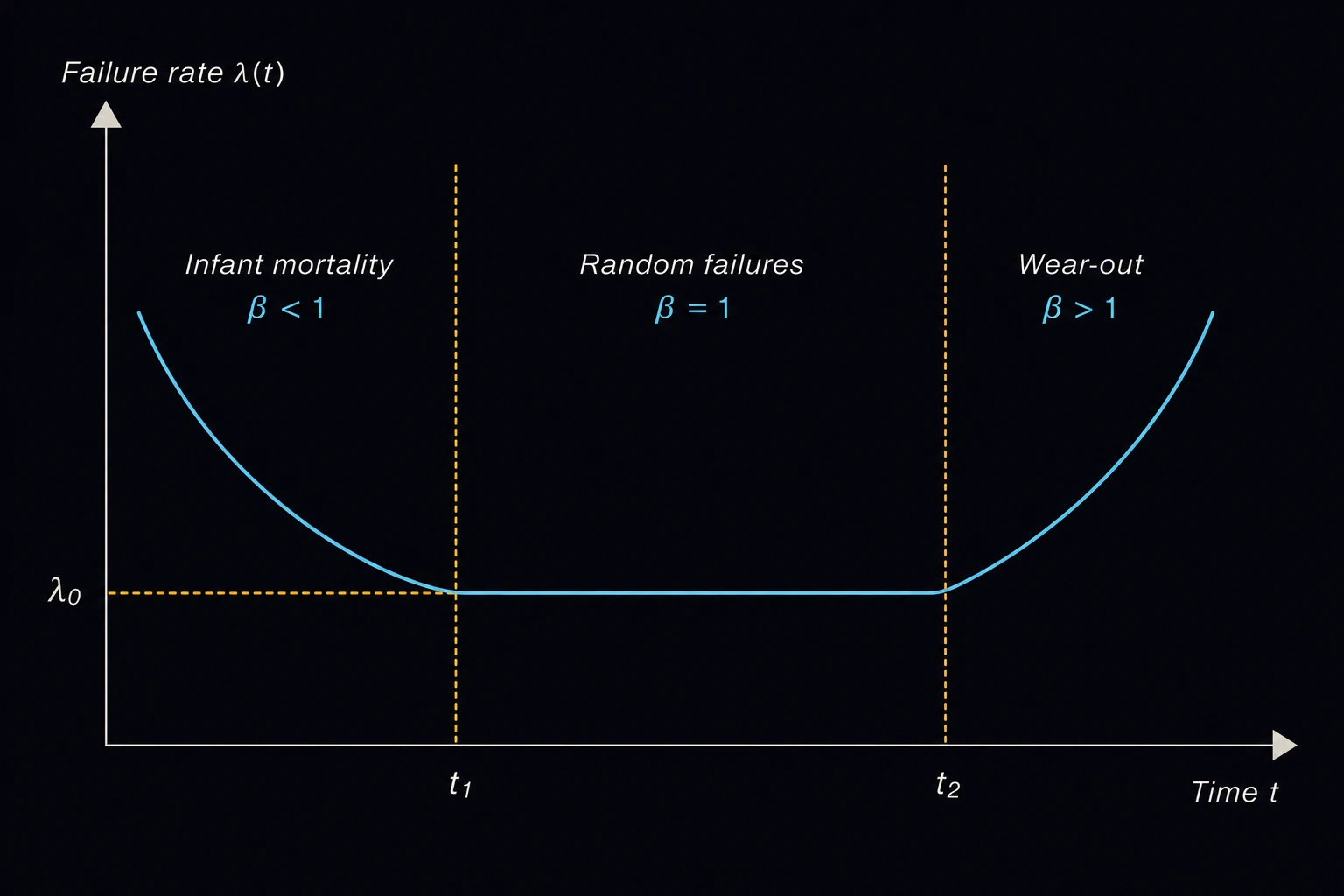
β is the shape parameter and η the scale parameter, or characteristic life: the time by which 63.2 % of the population has failed, whatever β is [1], [2]. t is the age of interest, in hours like η. Γ is the gamma function. The Bx life is the age by which x % of the units have failed, so B10 is the age at which 90 % survive. β < 1 gives a falling hazard (infant mortality), β = 1 a constant one (the exponential case, where η equals the MTBF), and β > 1 a rising one (wear-out) [3].
Limits and common mistakes
- The result is only as good as the fit. With fewer than about ten failures, β is uncertain, and the B-life with it [2].
- The page uses the two-parameter form, with failures possible from t = 0. If no unit can fail before some age, a three-parameter fit with a location shift is needed.
- Don’t confuse η with the mean life. They are equal only when β = 1.
- The live panel’s time cursor is separate from Time of Interest, so set both when you compare.
Worked example
A fan bearing’s field failures fit a Weibull distribution with β = 1.5 and η = 40,000 hours. The fans run around the clock. What share will survive the first year, and when should the bearings be changed so no more than 10 % fail in service?
- Enter Shape Parameter (β) 1.5 and Scale Parameter / Characteristic Life (η, hr) 40000.
- Enter Time of Interest (t, hr) 8760, one year.
- Enter B-Life Percentage (e.g. 10 for B10) 10 and press Solve. The Solution shows:
Reliability R(t): 0.90259
Failure probability F(t): 0.0974096
Hazard rate h(t): 1.7549e-5 per hr
Mean life (MTTF): 36,109.8 hr
B10 life: 8,923.02 hr
Failure mode: β > 1 — increasing hazard (wear-out)
Check: t/η = 0.219, and 0.2191.5 = 0.1025, so R = e−0.1025 = 0.903. The B10 life is just over the year, which fits the 9.7 % failed by then. A change every 12 months keeps failures below 10 %.