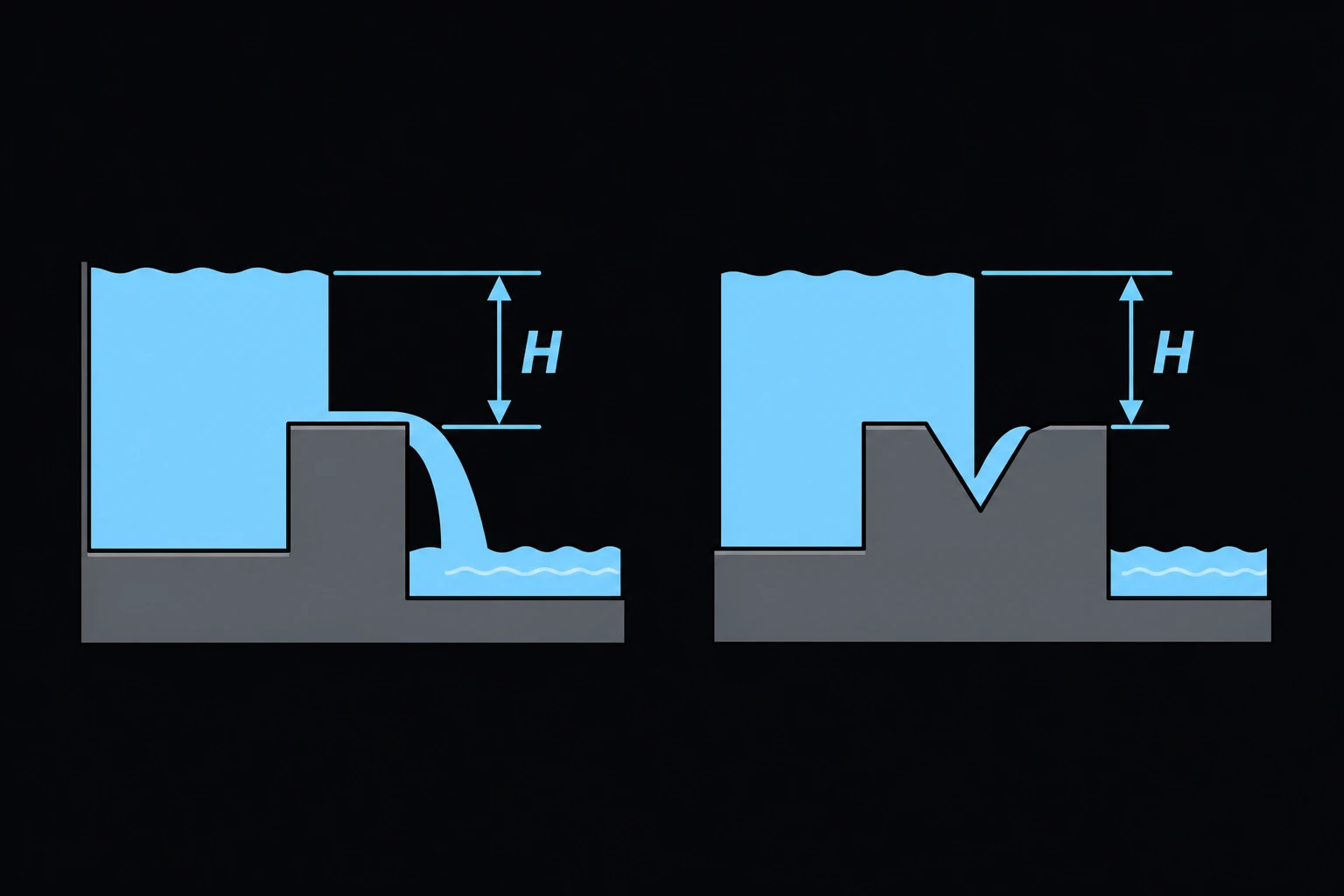
Sharp-Crested Weir Flow
Finds the flow over a sharp-crested weir from the head of water above its crest. It covers four shapes: the full-width (suppressed) rectangular weir, the rectangular weir with end contractions, the V-notch and the trapezoidal Cipoletti weir. Irrigation districts, treatment plant operators and stormwater designers use it to measure flow in open channels and to rate overflow structures.
Equations
Suppressed: Q = (2/3)·Cd·√(2g)·b·H1.5
Contracted (Francis): Q = 1.84·(b − 0.2H)·H1.5
V-notch: Q = (8/15)·Cd·tan(θ/2)·√(2g)·H2.5
Cipoletti: Q = 1.859·b·H1.5
Q is the discharge in m³/s, H the head over the crest in m, b the crest width (the bottom width for a Cipoletti weir) in m, θ the notch angle, g = 9.80665 m/s² and Cd the discharge coefficient, the ratio of actual to ideal flow [1][3]. The Francis and Cipoletti forms have their coefficients built in, in SI units [2]. Francis takes 0.1H off the crest for each of the two end contractions. For a suppressed weir you can enter Cd or use Rehbock’s formula [1], C = 3.27 + 0.40·H/P, where P is the height of the crest above the approach channel bed. Rehbock’s C is in US units (ft0.5/s), so the page divides it by (2/3)·√(2g) with g in ft/s² to get Cd. A typical Cd is about 0.62 for a rectangular weir and 0.58 for a 90° V-notch.
Limits and common mistakes
- Measure H upstream of the weir, about four times the maximum head back, where the water surface has not started to draw down [2]. Head read at the crest is too low.
- The equations assume free flow. Air must reach under the falling sheet of water (the nappe), and the downstream water must stay below the crest. A drowned weir passes less than the page says.
- The crest must be sharp and clean. A rounded, rusty or weedy crest changes Cd.
- A contracted weir needs room for the contractions: crest width at least 3H and generous clearances to the channel walls and bed [2].
- Very low heads (below about 60 mm) give poor accuracy, because surface tension makes the nappe cling to the plate.
Worked example
A 1.5 m wide concrete channel carries plant effluent over a full-width sharp-crested weir. The crest is 0.6 m above the channel bed, and the staff gauge upstream reads 0.3 m above the crest. What is the flow?
- Choose Weir Type Rectangular — suppressed.
- Enter Head Over Crest (H) 0.3 m and Crest Width / Bottom Width (b) 1.5 m.
- Choose Discharge Coefficient (suppressed weir) Rehbock and enter Weir Height Above Approach Bed (P) 0.6 m.
- Press Solve. The Solution shows:
Equation: Q = (2/3)·Cd·√(2g)·b·H^1.5
Discharge Q: 0.472183 m³/s
Discharge Q: 472.183 L/s
Rehbock C = 3.27 + 0.40·H/P: 3.47 ft^0.5/s
Discharge coefficient Cd: 0.648863
Check in US units, where Rehbock’s formula is Q = C·b·H1.5. H/P = 0.5, so C = 3.27 + 0.20 = 3.47. H is 0.984 ft and b is 4.921 ft, so Q = 3.47 × 4.921 × 0.976 = 16.67 ft³/s, which is 0.4722 m³/s. The weir passes about 470 L/s.