Weld Strength
Checks a welded joint against the force it carries, or finds the weld leg size it needs. It covers fillet welds at any load angle, lap joints, groove (butt) welds and eccentrically loaded weld groups. Pick an electrode to design to AISC 360-22 [2] in ASD or LRFD, or type an allowable stress to use Shigley’s method [1]. Designers and fabricators use it to size a weld before it goes on a drawing.
How the strength is calculated
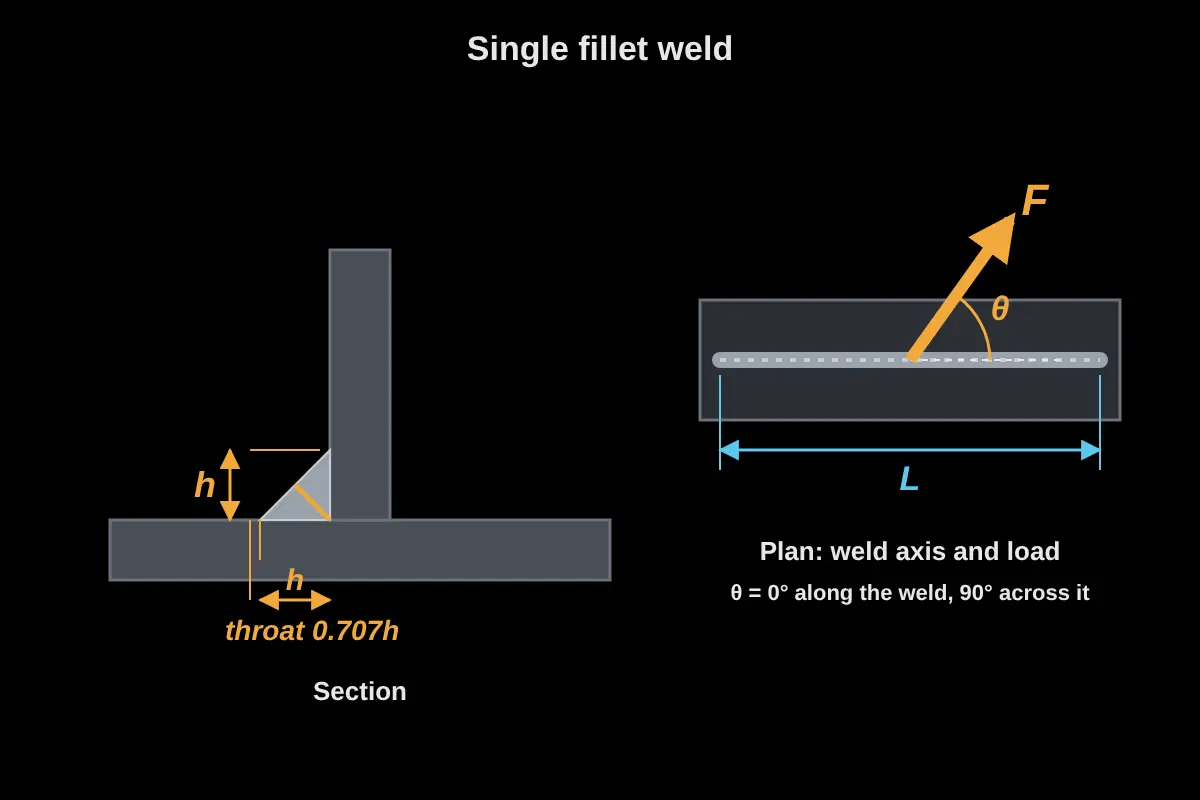
A fillet weld fails across its throat, the shortest line from the root to the face. For equal legs h the throat is 0.707h, so each weld of length L has a throat area Aw = 0.707·h·L, and the stress is τ = F / ΣAw. With an electrode, AISC gives the nominal strength
Rn = 0.60·FEXX·(1.0 + 0.50·sin1.5θ)·Aw
where FEXX is the electrode’s classification strength [3] and θ the angle between the load and the weld axis. A weld loaded straight across (θ = 90°) is 1.5 times as strong as one loaded along its length. The allowable strength is Rn/Ω with Ω = 2.00, the design strength φRn with φ = 0.75. With a plate grade, the plate next to the weld is checked too: in shear along the weld (0.60Fy and 0.60Fu) or in tension across it (Fy and Fu), on its thickness t times L. A groove weld’s throat is t for complete penetration, or the effective throat E you enter for partial. A weld group uses the elastic method [1]: direct shear F/A plus M·r/J for twisting or M·c/I for bending, with M = F·e, combined at the most stressed point.
Limits and common mistakes
- h is the leg size, not the throat.
- θ is measured from the weld axis: 0° along the weld, 90° across it.
- For LRFD, enter the factored load as the force.
- A weld shorter than 4h counts as a size of L/4, and very long end-loaded side welds are reduced; a note says when.
- A typed allowable stress gets no 1.5 increase for welds loaded across.
- Pick a plate grade. The plate, not the weld, often governs.
Worked example
A 10 mm ASTM A36 plate stands on a base plate, held by a 6 mm fillet weld 150 mm long on each side. It must carry 120 kN pulling straight up, square to the welds. Check it to AISC ASD with E70 electrodes.
- Choose Joint Type Double fillet weld and Solve for Stress & Capacity.
- Enter Load Angle 90, Weld Leg Size 6 mm, Weld Length 150 mm and Applied Force 120000 N.
- Choose Electrode E70XX, Design Basis ASD, Base Metal ASTM A36 and enter Thinner Plate Thickness 10 mm.
- Press Solve. The Solution shows:
Weld Capacity — allowable strength (Rn/Ω): 276,389 N
Base Metal Capacity (AISC J4, along the welds): 224,551 N
Joint Capacity: 224,551 N, governed by Base metal
Allowable Strength / Applied Force: 1.87126
Check by hand. FEXX = 70 ksi = 482.6 MPa, so 0.60FEXX = 289.6 MPa. The two welds give ΣAw = 2 × 0.707 × 6 × 150 = 1,272.6 mm², so Rn/Ω = 289.6 × 1.5 × 1,272.6 / 2 ≈ 276,400 N. The plate in tension gives min(250/1.67, 400/2.00) × 10 × 150 ≈ 224,600 N. The welds are stronger than the plate, so a bigger weld would not raise the joint’s capacity. A thicker or stronger plate would.