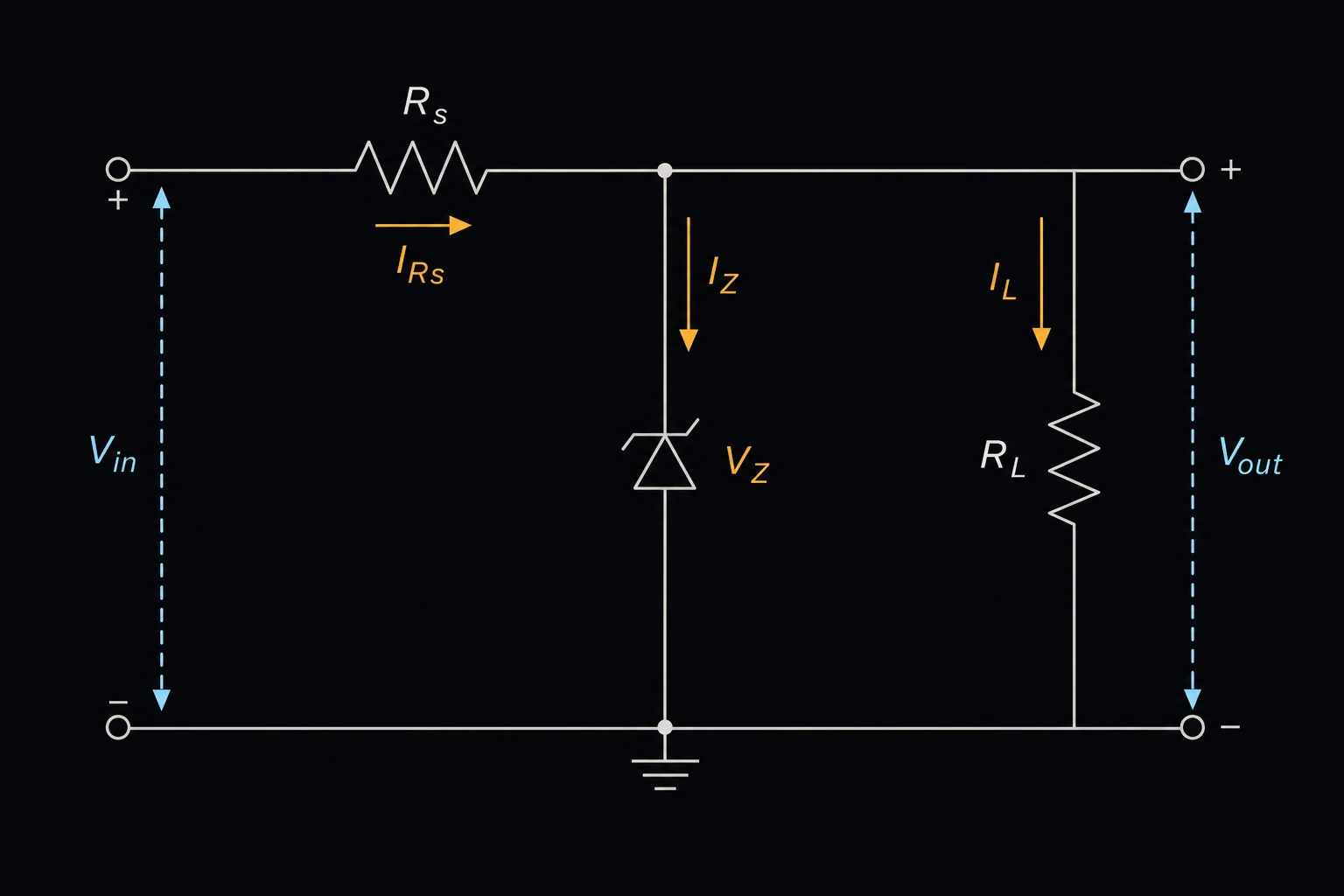
Zener Voltage Regulator
Designs the simplest voltage regulator: a resistor in series from the supply and a zener diode across the load. Enter the input voltage, the zener voltage, the current you want through the zener and the load current. The page gives the series resistor and the power in the resistor and the zener, both with the load on and with it removed. Use it for low-current references, bias supplies and clamps.
Equations
Rs = (Vin − Vz)/(Iz + Iload) PR = (Vin − Vz)·(Iz + Iload)
Pz = Vz·Iz Pz,max = Vz·(Iz + Iload)
Vin is the unregulated input and Vz the zener voltage, which is also the output. Iz is the current you want to keep flowing in the zener so it stays in regulation; the page calls it the test current because data sheets rate Vz at a test current. Iload is the load current. Rs drops the difference between input and output at the total current [1]. PR is the resistor’s power. Pz is the zener’s power with the load connected. If the load is removed, all the resistor current flows through the zener, so it must be rated for Pz,max. The voltage list holds the standard E24 voltages [3] of the 1N4728A–1N4764A series, 3.3 V to 100 V [2].
Limits and common mistakes
- Size Rs at the lowest input voltage and the highest load current, so the zener never drops out of regulation. Then check both powers at the highest input voltage.
- A standard resistor above Rs gives a little less current; below it, a little more. Recompute Iz with the value you fit.
- Rate the resistor and the zener at about twice the power the page shows, so they run cool.
- The output is not exact. Vz has a tolerance, changes with current through the zener’s dynamic resistance, and drifts with temperature. Use a linear regulator for loads above a few tens of mA or where accuracy matters.
Worked example
A circuit needs 5.1 V at up to 25 mA from a 12 V supply. The zener should keep at least 15 mA flowing. What resistor is needed, and how much power do the parts handle?
- Enter Input voltage (Vin) 12 V.
- Choose Standard zener voltage 5.1 V. Zener voltage (Vz) fills in as 5.1 V.
- Enter Zener test current (Iz) 15 mA and Load current (Iload) 25 mA, and press Solve. The Solution shows:
Series resistor (Rs): 172.5 Ω
Series resistor power: 0.276 W
Zener power (nominal, load connected): 0.0765 W
Zener power (worst case, load removed): 0.204 W
Check by hand: 12 − 5.1 = 6.9 V across the resistor at 40 mA gives 172.5 Ω and 0.276 W. With no load the zener takes 5.1 V × 40 mA = 0.204 W. A standard 180 Ω resistor passes 6.9/180 = 38.3 mA, leaving 13.3 mA in the zener at full load. With the twofold margin, fit a 1 W resistor and a 1 W 1N4733A zener.