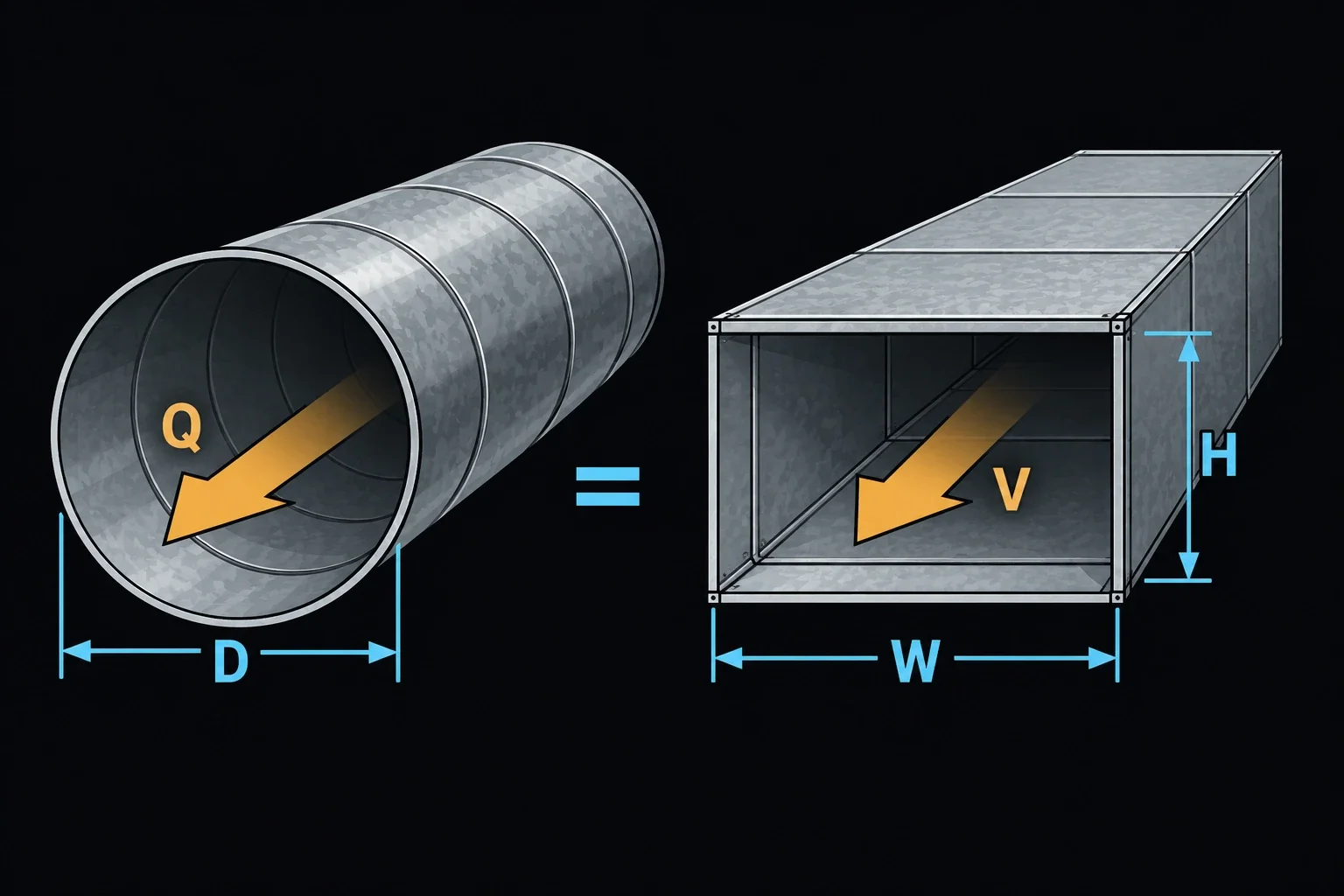
Duct Sizing & Air Velocity
Sizes a round duct for an airflow, either for a target friction rate (the equal friction method) or for a target air velocity. It then gives the next standard round size up and the rectangular duct of equal friction for a height you choose. HVAC designers use it in place of a duct slide rule (ductulator) when they lay out supply and return mains.
Equations
Δp/L = f·(1/D)·ρV²/2 1/√f = −2·log10(ε/(3.7D) + 2.51/(Re·√f))
Δp/L is the friction loss per length of straight duct, D the inside diameter, V = 4Q/(πD²) the mean velocity for an airflow Q, and ρV²/2 the velocity pressure pv. f is the Darcy friction factor from the Colebrook equation [2], with Re = ρVD/μ the Reynolds number and ε the duct’s roughness [1]. Below Re = 2300 the flow is laminar and f = 64/Re. Sized by friction, the page finds the D that gives the target Δp/L. Sized by velocity, D = √(4Q/(πV)).
The rectangular duct of width a and height b with the same friction and airflow as a round duct of diameter De follows Huebscher’s equation [1]:
De = 1.30·(ab)0.625/(a + b)0.25
The density and viscosity fill in as ASHRAE standard air, dry air at 20 °C and 101.325 kPa [1]. Change them for hot air or a high site. Picking a duct material fills in its roughness. The next size up comes from round duct made in whole inches to 20 in. and in even inches above that.
Limits and common mistakes
- The friction rate is for straight duct only. Fittings add their own losses; total them with the Duct Pressure Drop calculator.
- The calculated diameter is rarely a size you can buy. Use the next size up, and check its velocity for noise.
- The rectangular equivalent has equal friction, not equal velocity. Its area is larger than the round duct’s, so its velocity is lower.
- Keep the aspect ratio of a rectangular duct below about 4:1. Flatter ducts cost more metal and leak more.
Worked example
A branch main carries 1,200 CFM in galvanized duct with longitudinal seams, sized at 0.08 in. w.g. per 100 ft. The ceiling space allows a rectangular duct only 8 in. deep.
- Enter Airflow Rate 1200 CFM and choose Size By Friction rate (equal friction method).
- Enter Target Friction Rate 0.08 in. w.g./100 ft.
- Choose Duct Material Medium smooth — galvanized steel, longitudinal seams (0.09 mm). Leave the air at standard air.
- Enter Rectangular Duct Height 8 in and press Solve. The Solution shows:
Round Duct Diameter (D, US): 15.3042 in
Air Velocity (V, US): 939.359 ft/min
Next round size up: 16 in. (406 mm)
Velocity at the next size: 859.437 ft/min
Friction rate at the next size: 0.0643214 in. w.g./100 ft
Width (W) for the given height: 26.6928 in
Aspect ratio (W/H): 3.3366
Check: 1,200 CFM through a 15.3 in. duct (1.277 ft²) moves at 1,200 / 1.277 ≈ 940 ft/min, and a ductulator set to 1,200 CFM and 0.08 reads about 15 in. Use a 16 in. round duct, or a 28 × 8 in. rectangular one.