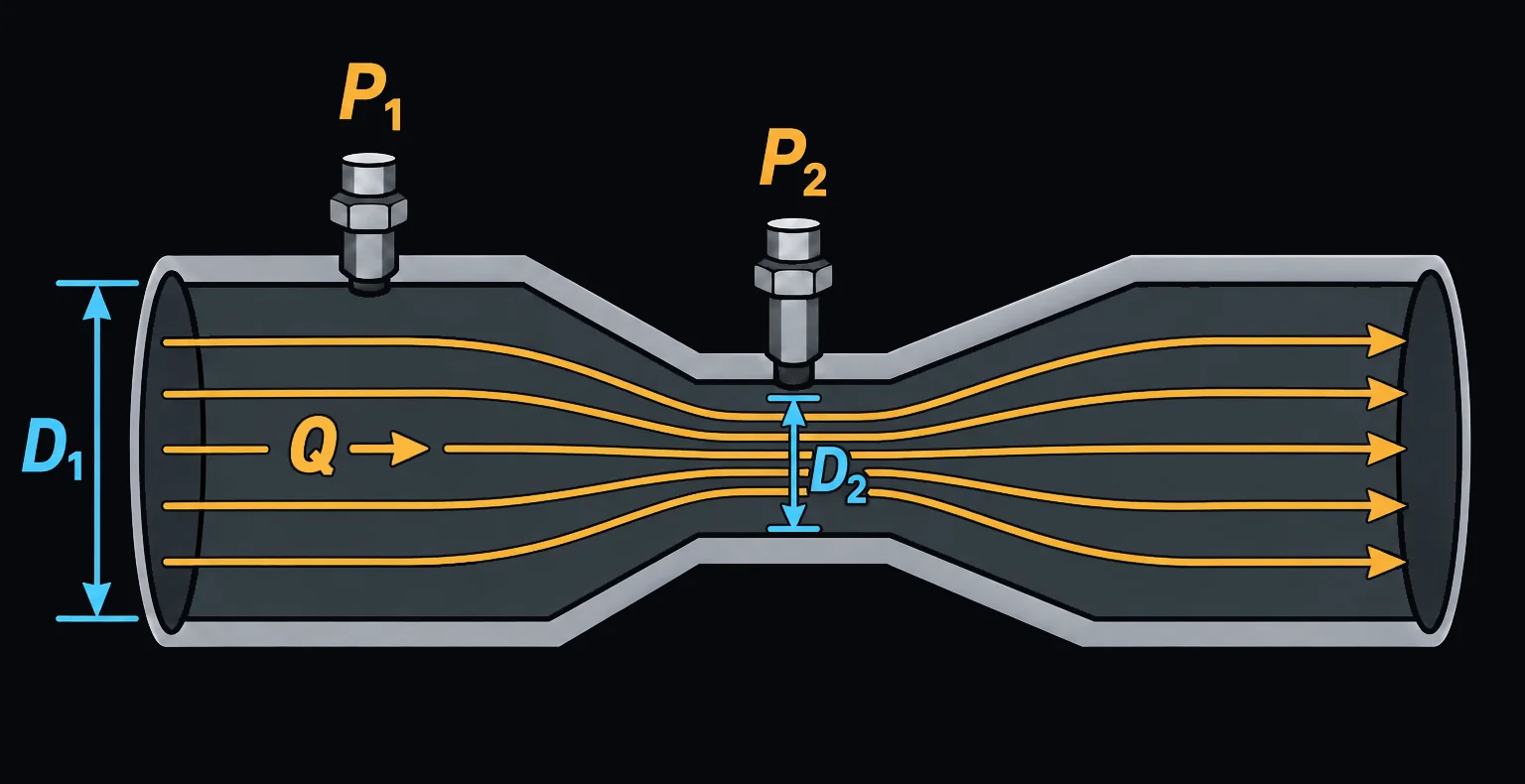
Orifice/Venturi Flow
Finds the flow rate through a differential-pressure meter, a Venturi tube or an orifice, from the pressure drop measured across it. Instrument and process engineers use it to check a meter reading, to size a throat for a target flow, or to estimate the pressure drop a meter will show.
The flow equation
Q = Cd·A2·√(2·ΔP / (ρ·(1 − β4)))
Q is the volumetric flow rate and A2 = πD22/4 the throat area. ΔP is the pressure difference between the upstream tap and the throat tap, ρ the fluid density and β = D2/D1 the ratio of throat to upstream pipe diameter. Cd is the discharge coefficient, the ratio of real to ideal flow. It covers friction and, for an orifice, the jet that narrows past the plate [1].
Pick a Device to fill in Cd. The three classical Venturi values come from ISO 5167-4 [2] and hold only within the pipe size, β and Reynolds-number range shown with each. The page adds a note when the pipe size or β falls outside that range. The sharp-edged orifice value, 0.61, is a typical figure at high Reynolds number [1]. Pick a Pipe Size and Schedule to fill in the upstream bore [3], and a Fluid to fill in its density [4], [6], [7].
Limits and common mistakes
- The equation is for an incompressible fluid. For a gas, keep ΔP to a few percent of the line pressure, or the result overstates the flow.
- The page has no viscosity input, so it can’t check the Reynolds number. Check it yourself against the range in the device label.
- D1 is the pipe’s inside diameter, not its nominal size or outside diameter.
- For an orifice plate designed to ISO 5167-2, with its own C equation and expansion factor, use the orifice plate calculator.
Worked example
A machined Venturi with a 60 mm throat sits in a 4-inch Schedule 40 line carrying water at 20 °C. The differential gauge reads 25 kPa. What is the flow?
- Choose Device Classical Venturi, machined convergent — C = 0.995. Cd fills in as 0.995.
- Choose Pipe Size NPS 4 and Schedule 40. The upstream diameter fills in as 102.26 mm.
- Enter Throat Diameter 60 mm and Measured Pressure Drop 25 kPa.
- Choose Fluid Water, 20°C (998.2 kg/m³) and press Solve. The Solution shows:
Volumetric Flow Rate (Q): 21.2073 L/s
Throat Velocity (V2): 7.50054 m/s
Diameter Ratio (β = D2/D1): 0.58674
The pipe and β are inside the machined Venturi’s range, so no note appears, and the Reynolds number, about 2.6 × 10⁵, is in range too. Check: √(2 × 25,000 / 998.2) = 7.08 m/s. Dividing by √(1 − 0.5874) = 0.939 and multiplying by 0.995 gives 7.50 m/s in the throat. Times the throat area of 0.002827 m², that is 0.0212 m³/s, or 21.2 L/s.